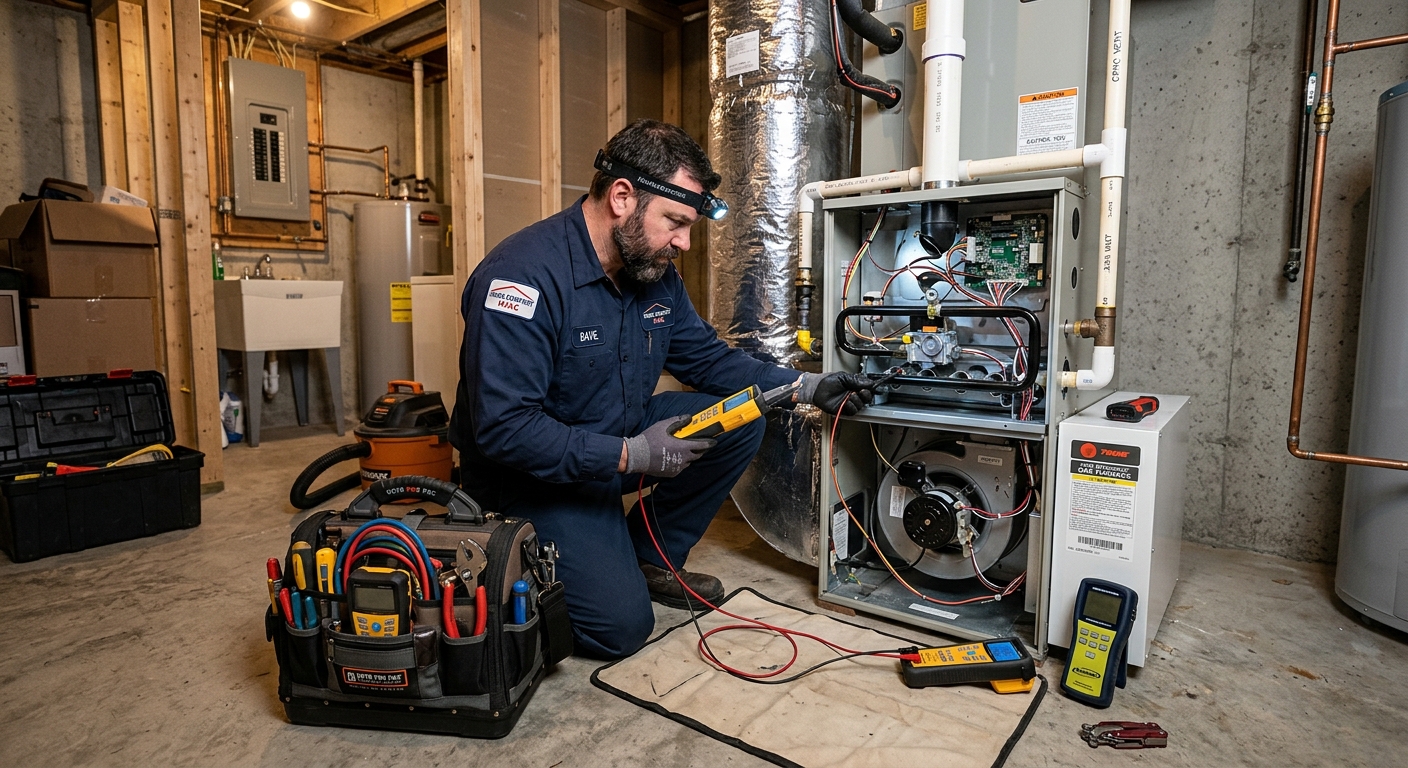
What a new HVAC system costs in Solebury
For Solebury homeowners, system replacements and upgrades are the norm, not the exception. With a homeownership rate of 90.4% and 44.3% of homes built before 1980 (U.S. Census Bureau, ACS 2024), most residents are making decisions about established properties. This is largely a replacement market, where you’re dealing with old systems or ductwork that needs attention, rather than major first‑time installations.
Nearby post‑1960 tract development in places like Bensalem and Middletown has set the pattern—existing ductwork is common, but that ductwork may not always be up to modern standards of performance or tightness. Where ducts were never run, especially in older sections, solutions like ductless mini-splits provide an alternative to the expense and disruption of new duct installation.
Solebury’s climate is heating-dominated, with 4,800 heating degree days and only 1,450 cooling degree days per year. Winters can be harsh, with a design low of 14 °F, while summers bring significant humidity. This tilts installation choices toward high-performance heating solutions, such as cold-climate heat pumps or gas furnaces, although efficient cooling is still essential for those sticky summer months. Every recommendation that follows is ordered by how reliably and efficiently a given system handles long, cold stretches and year-round humidity—not just how it takes the edge off on a hot July weekend.
| System |
Best for |
Efficiency |
Price range (installed) |
| Central AC replacement (existing ducts) |
homes with sound ductwork |
16–20 SEER2 |
$6,300–$15,000 |
| Air source heat pump (ducted) |
year-round heating and cooling |
8–10 HSPF2 |
$10,000–$21,500 |
| Cold-climate heat pump (ducted) |
heat pump as primary heat |
9–11 HSPF2 |
$16,500–$21,500 |
| Ductless mini-split (single zone) |
additions, rooms without ducts |
20–30 SEER2 |
$4,000–$8,900 |
| Full duct system installation |
homes with no existing ducts |
— |
$11,500–$23,000 |
Installed estimates for a typical Solebury home. Equipment tonnage, duct condition and electrical capacity move these more than brand.
What a real HVAC quote contains
A real HVAC quote for a Solebury homeowner is a detailed breakdown, not just a brand and a dollar figure. Ask for specific model numbers for both the indoor and outdoor units; these must be paired—mixing and matching drops efficiency and can void warranties. Every quote should include the proposed equipment’s tonnage and attach the detailed load calculation that supports it. Do not accept “matched to existing” as an answer.
Pay close attention to mention of line-set replacement versus reuse, and whether the quote spells out any needed electrical work or panel upgrades. Modern systems often draw more power or require dedicated circuits, so an electrician may be involved. Look for condensate management—where will the water go?—and thermostat details: sometimes, a basic model comes “free,” but zoning or Wi-Fi thermostats cost extra.
Permitting is not optional in Bucks County municipalities, and it should be itemized. You deserve a copy of the commissioning/startup report after installation—static pressure, refrigerant charge, and airflow numbers show that the system was properly tested, not just “turned on.” Labor warranties are not the same as equipment warranties, and a quote should differentiate the two. If a quote lists only a brand and a price, you can’t compare it to anything else, and you probably shouldn’t sign it.
| Line item |
What to look for |
Red flag if… |
| Equipment |
model numbers, indoor and outdoor matched |
brand name only |
| Sizing |
load calculation attached |
matched to the old nameplate |
| Ductwork |
condition assessed, sealing scoped |
not mentioned |
| Electrical |
circuit and panel capacity confirmed |
assumed adequate |
| Line set |
replaced or documented as reused |
silent |
| Commissioning |
measured airflow and charge, documented |
no startup report |
| Warranty |
labour years stated separately |
manufacturer only |
| Permit |
included and priced |
'not needed' |
When ductless is the right answer
Ductless mini-splits aren’t just for add-ons or exotic renovations—they are often the right choice for Solebury homes that never had central air or where a room was left off the main system. These units excel in converted attics, basements, garages-turned-offices, or finished spaces where extending existing ducts would mean tearing into plaster, disturbing finishes, or fighting with framing.
Single-zone systems cost less up front, serve one room exceptionally well, and are the simplest to install. Multi-zone setups can run several indoor heads off a single outdoor unit, but keep in mind: if you want perfect performance in every room, multiple single-zone units can outperform a bundled multi-zone system, albeit sometimes at a higher total cost. This is because shared refrigerant lines on a multi-zone often mean one room’s needs can compromise another’s comfort, especially on muggy summer days.
Head placement is both a technical and an aesthetic decision. You need open wall area, and you’ll see the unit. Condensate from cooling cycles must drain by gravity or a pump, which has to be routed somewhere safe. Post‑1960 tract homes in places like Bensalem and Middletown often had forced air from the start, but in Solebury’s older homes, the central air may be retrofitted, or entirely absent—prime territory for efficient ductless units, even if their value isn’t obvious until you weigh the cost and disruption of new ductwork.
The decision point on an aging system
When your Solebury home’s HVAC system starts acting up, the first and best question is not “What will a new one cost?” but “What failed, and why?” System age is basic: under 10 years, most issues are repairable for a fraction of the replacement cost—especially if it’s a fan, capacitor, or control board. Ten to fifteen years in, if a repair runs more than a third the cost of replacement, it’s time to think about a new system. Once past fifteen years, major repairs usually aren’t wise money.
The nature of the failure matters enormously. Compressor failure in an older heat pump or AC, or a cracked heat exchanger in a furnace, are both deal-breakers—these parts are so central and expensive to replace that fixing them just chains you to a system nearing the end anyway.
Be aware of refrigerant type. If your heat pump or AC uses R-22, any major leak or compressor loss is an automatic candidate for replacement—support for R-22 is gone. Newer systems with R-410A fare better, though this refrigerant is also part of a federal phase-down over time. Finally, in Solebury’s climate, the cost difference from efficiency upgrades alone won’t usually pay back quickly, so don’t bank on energy savings to justify a new system unless your utility bills are sky high.
| Situation |
Recommendation |
Typical cost |
Reasoning |
| Under 10 years, single component failure |
Repair |
$300–$1,200 |
Most parts are cheaper to fix than to replace the system |
| 10–15 years, repair over a third of replacement |
Consider replacing |
$6,300–$15,000 |
At this threshold, better to invest in new |
| 15+ years, any major failure |
Replace |
$6,300–$15,000 |
Money spent on repairs unlikely to pay off |
| Cracked heat exchanger, any age |
Replace immediately |
$6,300–$15,000 |
Carbon monoxide risk—no safe repair |
| Compressor failure past warranty |
Replace |
$10,000–$21,500 |
Main component failed, high cost, system likely near end of life |
| Working system, high bills |
Test ducts and envelope first |
$300–$800 |
Leaks and insulation often cause inefficiency, not the equipment |
The central decision for a Solebury homeowner
The key decision in Solebury is whether your primary system should be a furnace with central AC, a ducted heat pump, or some combination of the two. Bucks County’s climate—with a winter design temperature of 14 °F and 4,800 yearly heating degree days—demands reliable, efficient heat as much or more than it does cooling. Modern cold-climate heat pumps perform far better than their predecessors, retaining capacity to well below freezing, but once you reach the teens, output does begin to drop. That’s why, when continuous heating at low temperatures is needed, dual fuel systems or a backup becomes important.
PECO provides natural gas in major townships like Bensalem, Bristol, and Middletown, but this coverage doesn’t extend everywhere in the county—more rural or northern areas can be stuck with propane or fuel oil. This tips the balance: where gas is on the street, a high-efficiency furnace usually offers the lowest operating cost and highest output per dollar, especially on the coldest weeks. If there’s no gas line, heat pumps—especially cold-climate models—are far cheaper to operate than oil or propane.
Old wisdom said heat pumps don’t work here. That’s out of date. Today, a heat pump alone makes sense if you want to go all-electric and your home is reasonably tight. A furnace is still the best bet in drafty homes or where you need maximum output no matter how cold it gets. The rest comes down to cost, comfort, and whether incentives for electrification matter to you.
| Option |
Installed cost |
Operating cost here |
Best when |
Incentive eligible |
| Gas furnace + central AC |
$6,300–$15,000 |
existing gas service, coldest zones |
gas is available, winter outages are rare |
often |
| Ducted heat pump (cold climate) |
$10,000–$21,500 |
good envelope, all-electric goal |
no gas, modern insulation |
usually |
| Dual fuel (heat pump + gas backup) |
$16,500–$21,500 |
gas on site, deep cold spells |
max efficiency, reliable heat in all weather |
typically |
| Ductless multi-zone |
$11,500–$23,000 |
no ductwork, zone control |
older homes, additions, energy upgrades |
in some programs |
Mechanical permits for HVAC work in Solebury
Pennsylvania does not have a statewide HVAC license; instead, for residential installation and replacement, every contractor must hold a Home Improvement Contractor (HIC) registration from the Pennsylvania Office of Attorney General if the contract exceeds $500. For Solebury, code compliance and permitting are handled locally, not by the state—municipalities run their own code offices and enforce the Pennsylvania Uniform Construction Code, which is based on the International Residential Code.
Anyone handling refrigerant must have federal EPA Section 608 certification, regardless of whether Solebury or Bucks County imposes any local trade license. When a new system or major replacement is proposed, a mechanical permit is commonly required, with inspection after installation to confirm UCC compliance.
Before signing, you can verify a contractor’s HIC registration at the state’s online lookup. Workers’ compensation coverage is mandatory for all Pennsylvania employers—proof of this can be verified through the WCAIS system. For contracts above $500, a written agreement governed by the Home Improvement Consumer Protection Act is mandatory, including a three-business-day right to cancel.
What size system does a Solebury home need?
For most Solebury homes, getting the size of your new HVAC system right is more critical than picking the brand or model. Oversizing is not a cushion; it creates short cycling, leaves humidity high in the summer, causes temperature swings, and wears out parts before their time. Short, intense blasts of air are not comfort—they’re a sign your contractor took a shortcut.
Proper sizing for both heating and cooling requires a Manual J load calculation, which takes into account your home’s insulation, windows, air leakage, orientation, and floor area. Square footage alone means nothing—a 2,200-square-foot home from 1975 with leaky windows requires much more capacity than the same size home with modern insulation. Insist on seeing the calculation: “Did you run a load calculation, and can I see it?” If the answer is “we sized it to match the label on the old unit,” your new system will perpetuate any mistakes from thirty or forty years ago.
The purpose of a load calculation is to meet Solebury’s heating requirement at a winter design temp of 14 °F. Your new system should be sized to provide steady, even comfort at that benchmark, not just on average days. Too large, and you’ll cycle on and off; too small, and you’ll never catch up in a cold snap.
Frequently asked questions — HVAC installation in Solebury
Why does my system short cycle?
Short cycling is when your HVAC system starts and stops too quickly, never running long enough to actually condition your home properly. In Solebury’s climate, this is usually caused by an oversized unit installed for “peace of mind,” or because a contractor simply matched the tonnage on the old system without a true load calculation. It leads to higher bills, uneven temperatures, and extra wear on components. The best solution is a formal load calculation (Manual J) before any replacement—no more guessing. If you’re considering a replacement and want to avoid another round of short cycling, look for quotes that specify sizing and airflow. If only repairs are needed, addressing blower speed or fixing thermostat placement might help, often for as little as $300–$1,200.
How much does ductwork add to an HVAC installation?
For homes in Solebury that never had central forced air, adding ductwork is the single biggest cost driver in an HVAC project. Running new ducts through walls, basements, or attics—without ruining finishes—poses both technical and cosmetic challenges. For a typical single-family home, a brand-new duct system installation alone can reach $11,500–$23,000, not including the cost of the HVAC equipment itself. If existing ducts are in poor shape, upgrading or sealing will be far less but still adds a few thousand. In many 1960s–1970s tract homes nearby, full replacement is only needed for major renovations, not every upgrade.
Does Pennsylvania license HVAC contractors?
Pennsylvania does not issue a statewide HVAC license, but any contractor doing more than $500 of residential work—including new HVAC installation in Solebury—must carry a Home Improvement Contractor (HIC) registration. You can check this at the official state site. For refrigerant handling, federal EPA certification is always required. Local municipalities in Bucks County set their own permitting and mechanical inspection requirements, so the company you hire should have experience with the local code office and be prepared to pull a mechanical permit before starting your job. Contractor registration is not optional, and legitimate companies will gladly show their credentials to you before giving a quote. Replacement of a central AC, for example, will require both HIC registration and a local permit, with costs from $6,300–$15,000 when ductwork already exists.
Can a heat pump heat my house without backup?
In many newer or well-sealed Solebury homes, a modern cold-climate heat pump can handle nearly all heating down to the design temperature of 14 °F, relying only on emergency electric strips (which cost more to run) in rare cold snaps. For older, leakier homes, backup with a gas furnace or electric heat strips is usually still needed. Advances in heat pump technology mean they’re rapidly replacing traditional furnaces in all but the coldest or least efficient homes. However, sizing is everything—a perfectly sized system costs more up front ($10,000–$21,500 installed), but will nearly eliminate the need for backup heat. Dual fuel systems handle the few true deep freezes that happen every year.
Is natural gas available throughout Bucks County?
Natural gas is widely available in the southeastern Bucks County townships—Bensalem, Bristol, and Middletown have good coverage from PECO Energy. But if your Solebury property is further north or outside the main development corridors, gas may not run to your street at all. Many rural homes rely instead on propane or fuel oil, which are more costly to heat with than either gas or a modern cold-climate heat pump. In those areas, switching from oil to a ducted heat pump (installed for $10,000–$21,500) can be the more economical long-term choice, particularly as energy codes and incentives increasingly favor electric solutions.
How far ahead should I schedule in Solebury?
The Philadelphia metro, including Bucks County, is a saturated HVAC market, but that also means peak seasons fill up quickly—especially if you want a top-ranked installer or need ductwork modifications. In Solebury, waiting until your system fails in July or January almost guarantees a wait of several weeks. For central AC or ducted heat pump installations (budget $6,300–$21,500), schedule at least a month in advance if you want options. For full duct system work, plan for more lead time, especially if permits and inspections will be required. Off-season bookings can also save money and give you more attention from your contractor.
How much does a new HVAC system cost in Solebury?
Costs vary by what needs doing in your particular Solebury home. If your ductwork is solid and you’re only swapping out an old central AC, expect $6,300–$15,000 for a quality job with all the right paperwork. Upgrading to a ducted cold-climate heat pump brings a wider range—$10,000–$21,500—and completely new ductwork will push costs higher. Ductless mini-splits for a single room start around $4,000–$8,900. Every project moves with your home’s duct layout, electrical system, square footage, and what’s under the finishes.
What is the R-410A refrigerant phase-down?
R-410A is the standard refrigerant in nearly all central AC and heat pump systems installed in Solebury after 2010, but it is being phased down by federal law in favor of next-generation, low-GWP (global warming potential) refrigerants. This means the industry will gradually shift to new products and service practices through the late 2020s and 2030s. If you install a new system today ($6,300–$21,500 depending on type), it will almost certainly use R-410A, and service should remain available for at least a decade. But by the time your next replacement rolls around, expect new refrigerants and possibly new installation or service protocols.
Are duct sealing and insulation eligible for incentives?
Duct sealing and insulation are often included in federal and state efficiency incentive programs because they directly improve system efficiency and comfort—something especially relevant in Bucks County’s older homes. While specifics change from year to year, many upgrades through certified contractors can reduce out-of-pocket costs for work in that critical $300–$800 range. For full HVAC replacements or upgrades that include ductwork improvements, these measures may be eligible for additional rebates through utility or efficiency programs administered by PECO and others serving southeast Pennsylvania. Always ask your contractor what incentives are available before approving work.