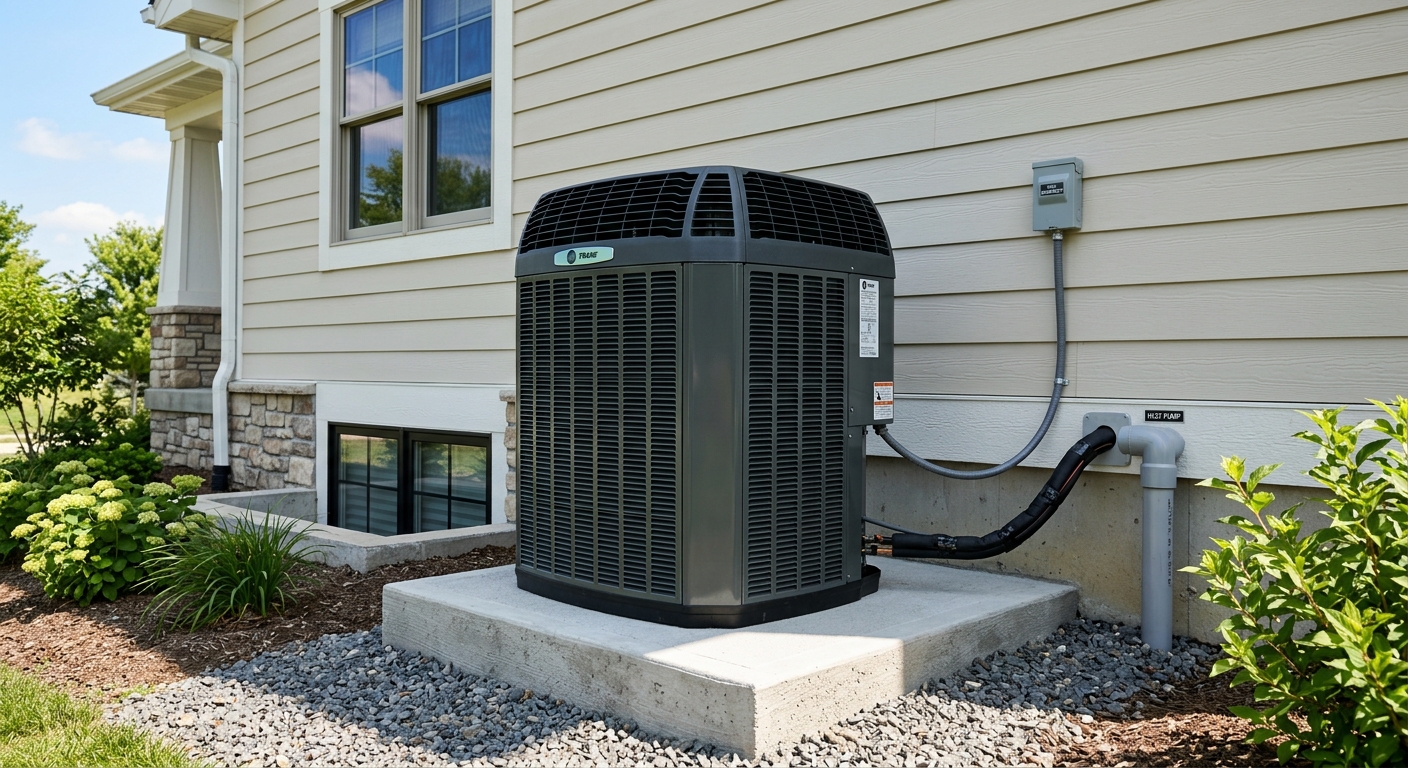
Penn Forest heating and cooling prices by system type — 2026
Penn Forest’s high homeownership rate and the prevalence of single-family homes (U.S. Census Bureau, ACS 2024) mean that most residents are directly responsible for their HVAC investments and upkeep. With just 18.5% of homes built before 1980, much of Penn Forest Township’s housing stock features large post-1950 neighborhoods. These tracts were often developed as seasonal properties, and many have since been converted to year-round residences. The result: a substantial retrofit market where older homes are being upgraded with new or improved ductwork to serve full-time heating and cooling loads. Don’t assume any system here will be plug-and-play—duct condition is a big variable in final cost.
With 6,100 heating degree days and only 850 cooling degree days each year, Penn Forest sits firmly in a heating-dominated climate. That makes heating-system efficiency, reliability, and serviceability critical—more so than AC alone. A good heat pump, sized and installed to fit this environment, can carry your home through winter’s worst. For all-electric conversions, the state’s modern cold-climate heat pumps can now handle single-digit winter lows, but only if your panel and insulation are up to the task.
| System |
Best for |
Efficiency |
Price range (installed) |
| Central AC replacement (existing ducts) |
homes with sound ductwork |
16–20 SEER2 |
$4,800–$11,500 |
| Air source heat pump (ducted) |
year-round heating and cooling |
8–10 HSPF2 |
$7,700–$16,500 |
| Cold-climate heat pump (ducted) |
heat pump as primary heat |
9–11 HSPF2 |
$12,500–$16,500 |
| Ductless mini-split (single zone) |
additions, rooms without ducts |
20–30 SEER2 |
$3,100–$6,700 |
| Full duct system installation |
homes with no existing ducts |
— |
$8,700–$17,500 |
Installed estimates for a typical Penn Forest home. Equipment tonnage, duct condition and electrical capacity move these more than brand.
Reading an installation proposal
Comparing HVAC installation quotes in Penn Forest isn’t just about the bottom line. A proper installation proposal should detail every element that affects performance, cost, and code compliance. Start by looking for model numbers for both the indoor and outdoor units—these must match to deliver the advertised efficiency. Next up, check the proposed system's tonnage and ensure a heat load calculation is attached. Sizing a system solely by the old sticker or square footage is a sign of guesswork.
Pay attention to whether the proposal covers line-set replacement or clearly describes why reusing an old line-set is justified. Electrical work is often needed; if your electrical panel is marginal or has no spare capacity, see if the quote documents this or assumes everything is “fine.” Every system needs a way to drain condensate away safely—look for specifics. Thermostat install may cost extra, and it’s worth knowing before work begins. In Penn Forest and Lehighton, mechanical permits are required for new equipment. Commissioning—a startup quality report with measured airflow and charge—should be included. Last, see how long the labor warranty is (manufacturer parts are separate). A quote with just a brand and price doesn’t tell you any of the above.
| Line item |
What to look for |
Red flag if… |
| Equipment |
model numbers, indoor and outdoor matched |
brand name only |
| Sizing |
load calculation attached |
matched to the old nameplate |
| Ductwork |
condition assessed, sealing scoped |
not mentioned |
| Electrical |
circuit and panel capacity confirmed |
assumed adequate |
| Line set |
replaced or documented as reused |
silent |
| Commissioning |
measured airflow and charge, documented |
no startup report |
| Warranty |
labour years stated separately |
manufacturer only |
| Permit |
included and priced |
'not needed' |
How to vet an HVAC contractor in Penn Forest
The quality of installation is what determines how your new HVAC system performs—brand alone won’t make or break comfort in Penn Forest. Even top-tier equipment installed poorly will underperform and could fail years early. Start by checking that any contractor bidding on your job is registered for home improvement work with the state of Pennsylvania for contracts over $500. Ask specifically if the technician handling refrigerant is covered by EPA Section 608 certification, a federal legal requirement in every zip code.
Solid contractors include a load calculation in their quotes instead of simply matching old equipment tonnage. Detailed, model-specific quotes—listing both indoor and outdoor model numbers—are another green flag. Commissioning is critical: after startup, the installer should document measured refrigerant charge and airflow, not just check if the unit runs. Finally, make sure the company’s insurance (including workers' comp if they have employees) is current—Pennsylvania offers two different verification databases to check yourself.
- Confirm active Pennsylvania Home Improvement Contractor (HIC) registration for contracts over $500.
- Check insurance and workers’ comp status using WCAIS (wcais.pa.gov).
- Ask for EPA Section 608 certification for the technician handling refrigerant.
- Look for detailed model numbers (not just brand or tonnage).
- Insist on a heat load calculation attached to sizing.
- Expect a complete scope: ductwork assessment, sealing, and any upgrades.
- Require commissioning with documented airflow and refrigerant charge results.
- Find out how many years of labor warranty are included, apart from parts.
- Clarify that all necessary permits are included and listed in writing.
- Ask about expected technician travel surcharges, common in rural Carbon County.
- See if the proposal splits out electrical work and any panel upgrades.
- Ask if lead-safe practices apply for pre-1978 homes (rare, but relevant).
Red flag: Contractors coming from larger metros or the Poconos may add travel surcharges to Penn Forest jobs—get this confirmed in writing before work starts, as rural Carbon County doesn’t guarantee the same density of local providers as nearby cities.
Operating cost, not sticker price
Sticker price matters, but your monthly heating and cooling bills depend more on how efficiently equipment converts fuel or electricity into comfort—and on how well your home’s envelope keeps that treated air indoors. Penn Forest’s 6,100 annual heating degree days mean your heating load is about seven times your cooling load, so a system’s winter efficiency should be your first concern. If you’re on PPL Electric Utilities, your rate per kWh (shown on your actual bill) is necessary for calculating annual operating cost.
Start by looking up the efficiency rating for your proposed equipment—SEER2 for cooling (air conditioners, mini-splits) and HSPF2 for heating (heat pumps). For example: a 10 HSPF2 heat pump will deliver 10 BTUs of heat for every watt-hour of electricity. Estimate your annual heating demand (BTUs) based on degree days (Penn Forest = 6,100 HDD). Divide your yearly load by the HSPF2, then by 3,412 (BTUs per kWh), to get annual kWh usage. Multiply kWh by your actual PPL Electric Utilities rate from your bill.
Example: Suppose your home needs 50 million BTUs per year for heating. A system rated 10 HSPF2 supplies 10 BTUs per watt-hour, or 34,120 BTUs per kWh (multiplying 10 by 3,412). Annual usage: 50,000,000 / 34,120 = 1,464 kWh. If your electric rate is $0.15/kWh, your electric cost for heat alone would be about $220/year.
But actual costs are highly variable: drafty homes, poorly sealed ductwork, or leaky windows can raise your real-world bill far above the estimate. Upgrading equipment without fixing major duct issues will limit any savings—making a $12,500–$16,500 heat pump perform like an old system on bad ducts.
Penn Forest's housing stock and its HVAC needs
Penn Forest’s dominant housing style—a boom of post-1950 single-family homes converted from seasonal to full-time use—means many properties have ductwork, but the quality and design may not match modern expectations. In these homes, original ducts often run with minimal insulation and layout meant just for heating, not year-round comfort. As equipment reaches first-replacement age (typically 20–25 years for late-1990s units now failing), it’s common to find oversized heating systems, undersized AC, and electrical panels at their limits.
If you’re considering a full HVAC upgrade, check the current state of your ducts: leaky connections, insufficient branches, and missing insulation are frequent in Penn Forest retrofits. For homes built before 1980 (a minority here), window quality and attic insulation are suspect; boosting envelope tightness pays off in both comfort and monthly bills. Finally, panel upgrades may be required for all-electric conversions, and flues or chimneys may need relining or replacement for safe gas operation—especially in properties once heated with fuel oil or wood.
Permits, licensing and inspections in Penn Forest
Pennsylvania does not issue a statewide HVAC contractor license. For residential work like HVAC installation and replacement, regulation and permits are handled at the municipality or borough level, not by a state licensing board. Home improvement contractors must be registered with the Pennsylvania Office of Attorney General if work totals more than $500. In Lehighton Borough (which covers a wide area of Carbon County), mechanical permits and inspections are required for HVAC replacements and new installations—always ask if this applies in your part of Penn Forest.
Refrigerant-handling technicians on your job must hold a federal EPA Section 608 certification, with no exceptions anywhere in Pennsylvania. Check this yourself for peace of mind. Contractors with employees must provide workers’ compensation coverage, which you can verify through the state’s WCAIS system. To confirm HIC registration, use the official registry at hic.attorneygeneral.gov. Don’t skip these: without proper documentation, you lack basic consumer protections and recourse if something goes wrong. For older homes (pre-1978), the federal EPA Lead RRP Rule applies for disturbing any paint—again, verify certification.
Repair or replace your Penn Forest system?
The decision to repair or replace depends mostly on your system’s age, the nature and cost of the failure, and whether upcoming upgrades could improve long-term comfort or efficiency. In Penn Forest, if your equipment is under 10 years old and suffers a one-off component failure, a repair is typically the wise move—most major parts are still available, repair costs are recoverable, and you’re likely within or just outside your warranty.
For units in the 10–15 year range, compare the repair bill to the cost of a full replacement. The industry rule of thumb is: if the repair is over a third of a new system, replacement is often smarter, especially if you’re eyeing a duct or panel upgrade anyway. Any unit over 15 years with a major failure—cracked heat exchanger or compressor out of warranty—should almost always be replaced, as reliability drops and new refrigerant rules often make parts and service harder to come by.
Two situations where replacement is non-negotiable: a cracked heat exchanger (dangerous due to carbon monoxide) and a failed compressor on an older unit. Struggling efficiency? Test your ducts and air sealing before shelling out for new equipment—many Penn Forest homes show savings here long before mechanicals are swapped.
| Situation |
Recommendation |
Typical cost |
Reasoning |
| Under 10 years, single component failure |
Repair |
$300–$1,200 |
Parts usually available, remaining service life justifies repair. |
| 10–15 years, repair over a third of replacement |
Consider replacing |
$4,800–$11,500 |
Investment may be better put toward a new, efficient unit. |
| 15+ years, any major failure |
Replace |
$4,800–$11,500 |
At end of expected service life; new units offer better efficiency and reliability. |
| Cracked heat exchanger, any age |
Replace immediately |
$4,800–$11,500 |
Health and safety hazard; never repair a cracked heat exchanger. |
| Compressor failure past warranty |
Replace |
$7,700–$16,500 |
Core system failure, repair is impractical and expensive. |
| Working system, high bills |
Test ducts and envelope first |
$300–$800 |
Duct and air sealing is usually the most cost-effective improvement. |
Frequently asked questions — HVAC installation in Penn Forest
Should I close vents in unused rooms?
Closing vents in unused rooms is a common suggestion, but it often causes more harm than good in Penn Forest’s typical homes. Most houses here use mid-to-late 20th-century ductwork, which was sized and balanced for all vents open. Closing off vents increases system pressure, forcing your blower to work harder and potentially causing duct leaks or reduced system lifespan. In the worst cases, you’ll end up with no real savings and can even make uncomfortable hot or cold spots elsewhere. If energy savings are a concern, invest in professional duct sealing (typically $300–$800 here) before trying cheap tricks. That way, you get lasting savings and avoid damaging your system.
Is a heat pump a good choice for Penn Forest winters?
A modern cold-climate heat pump is absolutely a viable option for Penn Forest, which sees a winter design temperature down to 4°F. Today’s cold-climate units are engineered for stable output below freezing, especially if your home is well insulated and your ductwork is tight. Utility costs with a ducted heat pump ($7,700–$16,500 installed) can rival or even undercut propane or fuel oil, both common in rural Carbon County. Natural gas users have better economics for high-efficiency gas furnaces, but for everyone else, a heat pump backed by electric resistance strips (for rare deep cold snaps) is now the “all-in-one” system of choice here.
How far ahead should I schedule in Penn Forest?
In Penn Forest and the rest of rural Carbon County, it’s often necessary to book HVAC installations weeks ahead, especially from May through September. HVAC firms serving the area juggle work in both the Allentown–Lehigh Valley metro and the Poconos resort zones, so local demand can quickly tie up technician calendars. Surcharges for travel are common. Bigger projects—like a heat pump with new ductwork ($8,700–$17,500)—will need even more lead time, as municipal permits and electrical work can add delays. For summer or pre-winter installs, reach out at least 3–4 weeks before your target timeline.
How do I verify an HVAC contractor's insurance?
In Pennsylvania—including Penn Forest—you can directly verify a contractor’s workers’ compensation insurance using the WCAIS system at wcais.pa.gov. For contracts over $500, the contractor should also supply you with a copy of their Home Improvement Contractor registration from the Office of Attorney General. These protections matter: without insurance, you’re on the hook for injuries on your property. If a company subcontracts, verify every subcontractor’s coverage as well. Reputable companies include this documentation with quotes, whether the job is a $4,800–$11,500 AC changeout or a full retrofit.
Are duct sealing and insulation eligible for incentives?
Duct sealing and insulation improvements can sometimes qualify for federal or utility incentives—though in Penn Forest, most rebates target envelope work (windows, attic insulation) or high-efficiency equipment. PPL Electric Utilities occasionally offers special programs for energy-saving upgrades, but eligibility varies. Out-of-pocket, expect $300–$800 for a duct sealing job, money well-spent if your utility bills seem high for your home’s size and age. It’s worth checking PPL’s current program directory, as offers change every year.
What is the R-410A refrigerant phase-down?
R-410A is the common refrigerant in residential heat pumps and air conditioners installed in Penn Forest since the 2010s. Federal law is phasing it down in favor of lower-global-warming alternatives. This means new AC and heat pump units (from 2025 onward) may use different refrigerants, requiring compatible equipment and service tools. R-410A will remain available for servicing, but costs may rise if your system needs a recharge down the line. If you’re installing a new central system ($4,800–$11,500), ask what refrigerant it uses and whether parts will be readily supported over the next decade.
Is a high-efficiency system worth the extra cost here?
Whether a high-efficiency system pays back in Penn Forest depends on your actual fuel costs and how tight your home is. Since heating costs in this climate dominate (6,100 HDD vs. just 850 CDD), a cold-climate heat pump or a high-efficiency gas furnace is often worth the investment—especially for homes switching from propane or fuel oil. That said, jumping from a midrange to a high-end model (for example, upgrading from $7,700–$16,500 to the very top end) pays off most when ducts and insulation are up to par. If your ductwork is leaky or your attic under-insulated, spend your upgrade dollars there first.
Why do HVAC quotes in Penn Forest vary so much?
Quotes for the same job can swing wildly in Penn Forest for a few reasons. Technician travel surcharges are common, with firms splitting work between the Poconos, Allentown–Lehigh Valley, and rural townships. Ductwork, electrical upgrades, and permit fees vary depending on home age and local requirements. One quote might include all electrical and commissioning (“turnkey”), while another lists only base equipment. The full duct system install range ($8,700–$17,500) highlights these differences. Always compare quotes line by line, and don’t hesitate to ask what’s included or skipped.
How cold does it get in Penn Forest and does that affect heat pumps?
Penn Forest’s winter design temperature is 4°F—meaning systems should be ready for single-digit cold spells. Modern cold-climate heat pumps are now built for these conditions, with some still providing up to 80% of their rated output even below 0°F. That said, backup electric heat is standard in eastern Pennsylvania just in case. If you’re thinking about a year-round solution, a ducted cold-climate heat pump ($12,500–$16,500) works provided your insulation and electric service are up to par. It’s worth double-checking that your installer sizes both the unit and the backup heat strip for this region’s cold snaps.