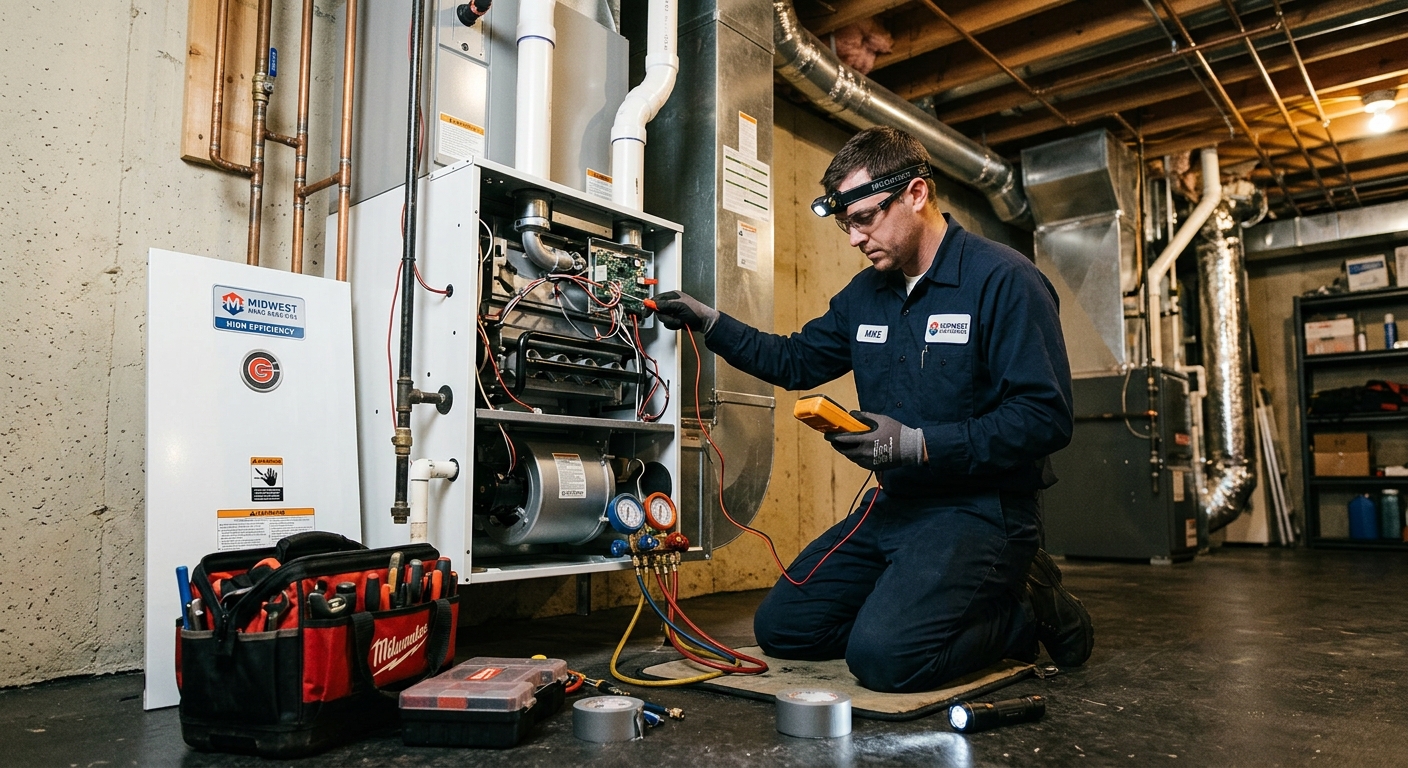
What a new HVAC system costs in St. Marys
St. Marys sits in a classic Pennsylvania retrofit market, with 76.1% homeownership and the vast majority of homes built before 1980 (U.S. Census Bureau, ACS 2024). Most residents are replacing aging systems or upgrading after many years, not outfitting new construction. In nearby Ridgway and Johnsonburg, 1900–1930 wood-frame homes are common. These houses often have unusual attic layouts, limited ductwork, or custom runs squeezed into tight spaces—a recipe for higher costs if major ductwork is needed or if historic details must be preserved.
Heating absolutely takes priority here, not cooling. Our winters drop to 2 °F at the coldest, with 6,300 heating degree days and only about 750 cooling degree days per year. If your goal is comfort and efficiency, choices that prioritize heating (such as a ducted heat pump optimized for cold climates, or a high-efficiency furnace) will usually deliver better value than focusing on a top-end AC alone. Also, with many homes lacking full duct systems, retrofits and add-ons like ductless mini-splits become real options—especially for additions or rooms the original builder never intended to cool.
| System |
Best for |
Efficiency |
Price range (installed) |
| Central AC replacement (existing ducts) |
homes with sound ductwork |
16–20 SEER2 |
$4,700–$11,000 |
| Air source heat pump (ducted) |
year-round heating and cooling |
8–10 HSPF2 |
$7,500–$16,000 |
| Cold-climate heat pump (ducted) |
heat pump as primary heat |
9–11 HSPF2 |
$12,000–$16,000 |
| Ductless mini-split (single zone) |
additions, rooms without ducts |
20–30 SEER2 |
$3,000–$6,500 |
| Full duct system installation |
homes with no existing ducts |
— |
$8,400–$17,000 |
Installed estimates for a typical St. Marys home. Equipment tonnage, duct condition and electrical capacity move these more than brand.
What you can actually claim on a heat pump here
If you’re installing a heat pump in St. Marys, incentives come at three levels: federal tax credits, utility rebates, and occasional state programs. Federal tax credits reduce your tax bill the following year after installation, and are claimed on your income tax return. Utility rebates give you cash back or a check soon after installation, directly reducing your out-of-pocket cost up front. It’s important to remember that a tax credit won’t help immediately with cash flow the way a rebate does.
The most consistent option is the federal tax credit, available for many high-efficiency heat pumps. The actual amount can change year to year, so always check current IRS forms. As for utility rebates, St. Marys is served by Penelec (FirstEnergy) and natural gas customers rely on National Fuel Gas Distribution Corporation. Both may offer rebate programs at times; these can shift each year, and eligibility depends on the equipment and sometimes the installer. For up-to-date information, check the efficiency or rebate section of Penelec and National Fuel's websites.
State-level programs run intermittently and amounts change, so any dollar figure you see online is only a loose guide and not a quote. The ENERGY STAR rebate finder is another good starting point, but always verify what’s actually active for your ZIP code and utility. If you’re budgeting, look up your specific utility’s efficiency incentive page and ask your contractor to check the latest details. Don’t count on advertised figures until you’ve seen them on your proposal and confirmed them with your utility.
Ductwork: the part nobody quotes properly
Ductwork is often the weak link in Elk County’s older homes—especially those in Ridgway and Johnsonburg, where many houses date from 1900–1930. In these buildings, original duct systems may be pieced together, sized for an old furnace, or not even present in some rooms. It is extremely common for decades-old ductwork to leak, wasting enough heated or cooled air that it can swamp the efficiency gains of even top-end new equipment.
A duct blaster test is the gold standard for measuring these leaks. It pressurizes the system and quantifies how much air escapes—revealing problems that no visual inspection can show. If leakage is high, you’ll then have to choose between sealing (using specialized tape or mastic at joints and seams) or, in cases of crumbling or grossly undersized ductwork, complete replacement. Undersized cold-air returns are a chronic issue in these homes too — they choke airflow and make any new system run less efficiently.
Homes with ducts in unconditioned attics or crawlspaces lose even more to leakage and conduction, especially during the long Pennsylvania heating season. Before rushing to replace an old furnace, it’s worth having your ducts tested and sized. This is not work to tack on after a new unit is installed—most contractors never revisit ductwork once the new system is running. Test and seal first, and you’ll save more than you spend, both up front and on your energy bills.
Mechanical permits for HVAC work in St. Marys
Pennsylvania does not issue a statewide residential HVAC contractor license. Instead, St. Marys enforces residential code and mechanical permits locally through the City of St. Marys Codes Department. If you live in a surrounding township, your work is inspected by your local office.
Anyone handling refrigerants on your project must have EPA Section 608 certification, which is federal and applies in all fifty states. While you won’t find a Pennsylvania “HVAC license” to check, you should always verify that your contractor is registered as a Pennsylvania Home Improvement Contractor (required for jobs over $500) — you can check this at hic.attorneygeneral.gov.
Mechanical permits are required for most system replacements and all new installations. Ask to see a copy of your permit application before any work begins. For liability: workers’ compensation insurance is mandatory for all employers in Pennsylvania. Use the official WCAIS system (wcais.pa.gov) to verify active coverage—never just take a contractor’s word for it. These steps give you actual recourse if something goes wrong and keep you in compliance with state consumer protection law.
The comfort problem that isn't temperature
In St. Marys and Elk County, with 6,300 heating degree days and a winter design temperature of 2 °F, air that's heated inside can get bone-dry fast. Static shock, dry throats, and cracked woodwork often are just as uncomfortable as a cold draft. In summer, humidity is a bigger complaint than heat itself—especially in older homes with less insulation and air sealing. One issue is that oversized air conditioners cool air faster than they can remove moisture, leaving rooms clammy rather than dry and comfortable.
Whole-house humidifiers help, but be aware they require regular cleaning and maintenance to avoid mold and mineral scale. Not everyone needs one: modern homes with balanced ventilation might only need a portable unit in the harshest months. For filtration, using a higher MERV filter sounds appealing, but anything above MERV 13 can put a strain on standard HVAC blowers unless the duct system was designed for it. In tightly sealed, newer homes, mechanical ventilation is critical to avoid trapped humidity and mold—but in Elk County’s draftier housing stock, open windows in spring and fall still go a long way.
Add-on air cleaners, UV lights, and even some ventilation products are easy to oversell. In this climate, focus first on the right system size, humidity control and filtration that matches your ductwork—extras rarely give a measurable return.
When an HVAC repair stops being worth it
As a homeowner in St. Marys, the smartest decision isn’t always a replacement. A simple repair can keep a system running efficiently for years if the unit is under a decade old and the failure is straightforward—think a capacitor, pressure switch, or control board. If your system is over 10 years (typical service life runs around 15–18 years), or if the price of repair creeps over about a third of a replacement, it’s time to weigh your options. Past 15 years, major repairs rarely make sense, because even working units lose efficiency and may not be compatible with newer refrigerants.
There are two red-line cases where replacement is effectively mandatory: a cracked heat exchanger (it’s a carbon monoxide risk and disables the furnace by code), and a compressor failure after the warranty is up. Otherwise, a refrigerant leak or electrical failure can often be fixed. High utility bills don’t automatically mean the system is failing—leaky ductwork or poor air sealing can be the actual culprit, and these fixes cost far less.
| Situation |
Recommendation |
Typical cost |
Reasoning |
| Under 10 years, single component failure |
Repair |
$300–$1,200 |
Still under expected service life; OEM parts available |
| 10–15 years, repair over a third of replacement |
Consider replacing |
$4,700–$11,000 |
Investment unlikely to pay back before system ages out |
| 15+ years, any major failure |
Replace |
$4,700–$11,000 |
Parts scarcity, energy penalty, warranty expired |
| Cracked heat exchanger, any age |
Replace immediately |
$4,700–$11,000 |
Carbon monoxide risk, cannot be legally repaired |
| Compressor failure past warranty |
Replace |
$7,500–$16,000 |
Cost rivals new system; avoids repeat failures |
| Working system, high bills |
Test ducts and envelope first |
$300–$800 |
Leakage or insulation may be root cause |
Comparing HVAC estimates in St. Marys
A trustworthy HVAC quote in St. Marys will give you actual details. First, both indoor and outdoor unit model numbers matter—a mismatched pair will never perform at the rated efficiency, no matter what the brochure says. Make sure the system “tonnage” is backed by a specific load calculation for your actual house, not just replaced with the same size as the last unit. Ask if the refrigerant lines (line set) are being reused or replaced; old, contaminated lines mean new equipment could fail faster. If significant electrical work is needed, be certain that a panel upgrade is included in writing. Pay attention to how the estimate handles condensate drainage, thermostat controls, and the mechanical permit—these are city requirements, not add-ons.
Also look for a commissioning report—this should confirm that the installer measured airflow and refrigerant charge after installation. The labor warranty is not the same as the manufacturer’s part warranty, so have both spelled out. If your quote just lists a brand and one price, you’re not comparing apples to apples. Every legitimate quote should cover these core pieces:
| Line item |
What to look for |
Red flag if… |
| Equipment |
model numbers, indoor and outdoor matched |
brand name only |
| Sizing |
load calculation attached |
matched to the old nameplate |
| Ductwork |
condition assessed, sealing scoped |
not mentioned |
| Electrical |
circuit and panel capacity confirmed |
assumed adequate |
| Line set |
replaced or documented as reused |
silent |
| Commissioning |
measured airflow and charge, documented |
no startup report |
| Warranty |
labour years stated separately |
manufacturer only |
| Permit |
included and priced |
'not needed' |
Frequently asked questions — HVAC installation in St. Marys
Should I replace the furnace and AC at the same time?
Replacing both the furnace and air conditioner together isn’t always necessary, especially in older St. Marys homes where one system can far outlast the other. If both units are nearing the end of their useful lives (typically 15–18 years), or if your installer is upgrading to a matched efficiency system, then replacement together can maximize comfort and save on labor costs. But if one component (such as your furnace) is only five or six years old, you’re generally better off keeping it unless there’s a major defect. Many systems here see their AC replaced for $4,700–$11,000 while the furnace continues another decade. The exception is when newer, high-efficiency models can’t be properly matched with existing equipment—always have your installer review compatibility. If you’re offered a “discount” for replacing both up front, ask them to itemize and compare prices.
Is natural gas available throughout Elk County?
No, natural gas is not available everywhere in Elk County. In St. Marys and Ridgway boroughs, natural gas is supplied by National Fuel Gas Distribution Corporation. However, rural townships and some outlying areas mostly rely on delivered propane or fuel oil for heating. If you’re considering a new gas furnace or boiler, first check your address with the utility’s website to confirm availability. In many outlying townships, it’s common to find homes using propane heating equipment or retrofitting to air source heat pumps or mini-splits. These changes can shift installed prices significantly—ductless mini-splits for a single zone can range from $3,000–$6,500. Working with a contractor familiar with local fuel options will help you pick equipment that fits your home and fuel access.
What is commissioning and why does it matter?
Commissioning is the process of verifying and documenting that your new HVAC system in St. Marys is actually performing as designed after installation. This means your contractor measures and adjusts things like system airflow, refrigerant charge, and controls—not just flipping a switch and declaring the job done. In homes with tricky attic access or custom duct runs (common in Ridgway and Johnsonburg), proper commissioning makes the difference between years of dependable comfort and a problematic install. It’s also how you get valid manufacturer warranties. An uncommissioned system may short-cycle, fail to dehumidify, or operate far below its rated efficiency—even if you paid as much as $7,500–$16,000 for a new heat pump. Always ask for the commissioning report before making your final payment.
Why do HVAC quotes in St. Marys vary so much?
HVAC quotes in St. Marys vary dramatically because of the housing stock, local travel surcharges, and, most importantly, how much of the work the contractor actually scopes in the estimate. Older homes (especially those built before 1930) can require custom ductwork or tight attic retrofits. Some contractors from outside Elk County may add travel charges, which companies based closer often skip. Quotes can range from the basic replacement of a single unit for $4,700–$11,000 to full duct system installs up to $17,000, depending on the condition and access. A vague estimate may hide additional costs for ductwork, electrical upgrades, or permitting. Always insist on a detailed, written scope of work before agreeing to any project.
Should I close vents in unused rooms?
In most St. Marys homes, closing supply vents in unused rooms is not recommended. The old advice was to “shut off” rooms to save energy, but modern forced-air systems are designed for balanced airflow; closing vents can increase duct pressure, create leaks, and even shorten equipment life. It’s especially risky in the many older Elk County homes with undersized or leaky return ducts—blocking off a room can make the system cycle improperly and reduce comfort overall. If you’re worried about heating or cooling costs, a better solution is sealing and insulating ductwork (which may cost around $300–$800), improving air sealing, or investing in zoned controls if your system supports it. Discuss options with a contractor familiar with our region’s housing and climate before changing the way your system operates.
What does a ductless mini-split cost in St. Marys?
For Elk County and St. Marys, a standard single-zone ductless mini-split runs between $3,000–$6,500 installed. Costs are influenced by your home’s access, wiring, and whether a wall- or floor-mounted unit is required. Older homes, especially those with thick plaster or log walls, may require more labor for line set routing or specialized brackets. These systems are ideal for additions, enclosed porches, or upstairs bedrooms where ducts don’t reach. Mini-splits offer excellent efficiency for both heating and cooling in our climate, but installation prices can creep higher if you ask for features like low-ambient heating or Wi-Fi thermostats. Always ask for an itemized quote including electrical work and wall penetrations.
Who inspects HVAC work in St. Marys?
In St. Marys, residential HVAC work is inspected by the City of St. Marys Codes Department as part of the mechanical permit process. If your home is in a nearby township like Ridgway or Johnsonburg, a different local office is responsible. They ensure compliance with the Pennsylvania Uniform Construction Code (based on the IRC), but permit and inspection requirements are enforced at the municipal level. No statewide HVAC license exists for residential work, but EPA Section 608 certification is still mandatory for anyone handling refrigerants. For a central AC or heat pump installation (costing from $4,700–$16,000), the inspector will check for unsafe wiring, proper refrigerant charge, code-required clearances, and that all permits are in place before sign-off. Always check your permit status before final payment.
Can I service my R-410A system after the refrigerant change?
Yes, you can still maintain and repair your R-410A HVAC system in St. Marys even as refrigerant regulations change. R-410A is not being banned outright, but newer systems are starting to use alternative refrigerants. For the foreseeable future, both supply houses and local contractors have R-410A stock for service needs. There may be a slight increase in refrigerant cost over time, but a standard repair for a system leak or recharge remains feasible—expect to pay $300–$1,200 depending on the extent. Replacement becomes preferable only if you have major compressor or coil failures and the equipment is past warranty, but the refrigerant change itself doesn’t force you to upgrade. Ask your technician about long-term support when your next maintenance or repair is due.
What HVAC tax credits are available to St. Marys homeowners?
St. Marys homeowners are eligible for federal tax credits when upgrading to certain high-efficiency HVAC systems, including heat pumps. These credits reduce the taxes you owe the following year, but they don’t come as instant rebates. State and local incentives in Pennsylvania change frequently, so it’s best to check with your electric (Penelec) or gas (National Fuel Gas Distribution Corporation) provider’s rebate programs. For example, a qualifying central heat pump installation could earn you a tax credit of up to $2,000, but your real savings depend on the model installed (typical installed range is $7,500–$16,000). Always verify the latest details through IRS forms and your utility’s efficiency program page before committing to a new system—the programs change and eligibility can be specific to your ZIP code and contractor.