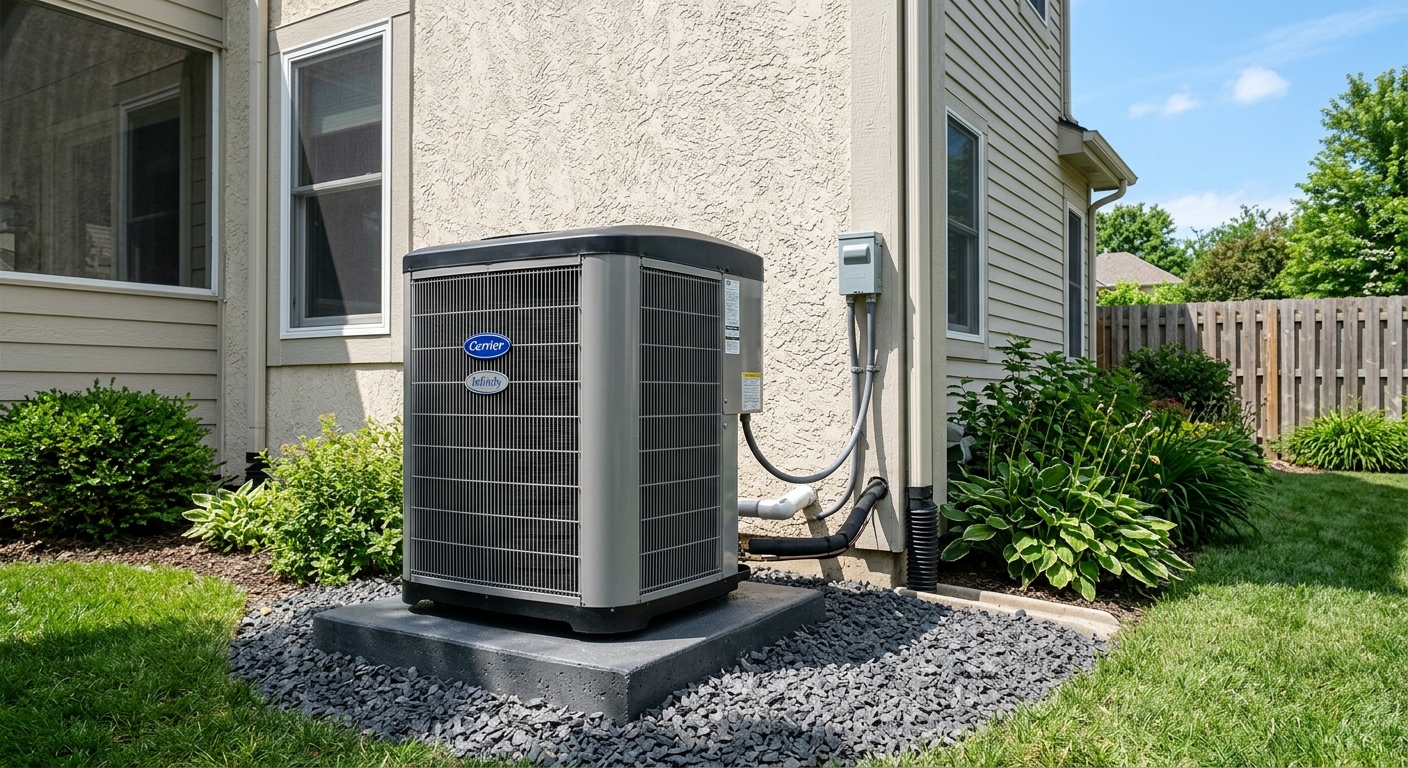
Steelton heating and cooling prices by system type — 2026
Steelton’s mix of older homes and moderate homeownership (51.7%) shapes a heating and cooling market that’s defined by retrofits and system replacement. Many owners are tackling upgrades in houses built before 1980, where aging systems and original ductwork are the rule, not the exception (U.S. Census Bureau, ACS 2024). The wave of post‑1950 tract housing around Colonial Park and Swatara Township has also driven steady demand for central air conditioning replacements — often with usable ducts, but not always in great shape.
South-central Pennsylvania’s climate tips toward heating: with 5,200 heating degree days and just 1,250 cooling degree days, winter loads drive most sizing and system decisions. Summers are humid, but the seasonal strain on air conditioning rarely justifies oversizing. In Steelton, you’re likely to find forced-air furnaces paired with central AC systems, but heat pumps are gaining share, especially in places with aging fossil fuel equipment or where ductwork can’t be relied on.
| System |
Best for |
Efficiency |
Price range (installed) |
| Central AC replacement (existing ducts) |
homes with sound ductwork |
16–20 SEER2 |
$4,700–$11,500 |
| Air source heat pump (ducted) |
year-round heating and cooling |
8–10 HSPF2 |
$7,600–$16,000 |
| Cold-climate heat pump (ducted) |
heat pump as primary heat |
9–11 HSPF2 |
$12,500–$16,000 |
| Ductless mini-split (single zone) |
additions, rooms without ducts |
20–30 SEER2 |
$3,000–$6,600 |
| Full duct system installation |
homes with no existing ducts |
— |
$8,500–$17,000 |
Installed estimates for a typical Steelton home. Equipment tonnage, duct condition and electrical capacity move these more than brand.
Mini-splits and zoning in Steelton homes
In Steelton, ductless mini-splits solve problems that older ductwork can’t. The single-biggest win is finishing an attic, basement, or adding living space where routing new ducts would mean walls and ceilings torn open. Many homes built before 1980 didn’t include central air to begin with, so retrofits — especially in neighborhoods around Swatara Township — put ductless options front and center. If you’re living in a house with tired or leaky ducts, a mini-split may save you from spending $8,500–$17,000 on all-new ductwork.
One outdoor condenser can serve one (single-zone) or several (multi-zone) indoor heads. Single-zone is efficient and straightforward — perfect for a rec room or an office. Multi-zone can cover the whole house but means a slight efficiency tradeoff and slower ramp-up when several zones call at once. Heads mount on walls, ceilings, or even flush into bulkheads, but placement does affect both comfort and how the system dehumidifies in summer. Some folks object to the visible wall units, but the minimalist look is less intrusive than you might think in a finished basement or bedroom. Every head needs a way to drain condensate, so plan this carefully, especially if you’re finishing space below grade.
Cost-wise, separate single-zone systems may outperform a single large multi-zone system, despite more outdoor equipment. If your house is among the Steelton originals or an older post‑war design, it's a ductless market even if most neighbors haven't chosen it yet.
Mechanical permits for HVAC work in Steelton
Pennsylvania does not issue a statewide HVAC contractor license for residential work. Instead, regulation happens at the municipal level. In places like Steelton and Harrisburg, a contractor needs to be registered for home improvements valued over $500 by the Pennsylvania Office of Attorney General — you can check this registration at hic.attorneygeneral.gov. For installation or replacement of central heating and cooling systems, a mechanical permit is generally required from the local code office. This is enforced locally, not by the state, unless your specific municipality has opted out.
Any technician who handles refrigerants (installing ACs, heat pumps, or mini-splits) must have a federal EPA Section 608 certification, regardless of state or local licensing. Ask to see it if the scope includes refrigerant lines or recovery. Insurance — especially workers’ compensation — is not just paperwork. Pennsylvania mandates that all employers carry it, and you can verify coverage on WCAIS (wcais.pa.gov) for peace of mind if something goes wrong.
Remember, for anything over $500, a written contract is required by the Home Improvement Consumer Protection Act, and you get a three business day right to cancel. Quick jobs, like swapping a thermostat battery or changing filters, don’t need permits. Bigger replacements or installations (a new furnace, AC, or heat pump) do — and the inspection protects both you and your resale value.
Efficiency ratings and what they mean for your bill
The key efficiency numbers for HVAC equipment are SEER2 (cooling) and HSPF2 (heating). SEER2 tells you how efficiently an air conditioner or heat pump cools your home; HSPF2 does the same for heating performance of heat pumps. Both replaced older rating systems in recent years — so if you see “SEER” or “HSPF” in an online guide, remember the new standards are stricter and not apples-to-apples.
In Steelton and elsewhere in Dauphin County, with 5,200 heating degree days against only 1,250 cooling degree days, your energy bill is driven much more by heat than AC. This means that for most homeowners, piling on for a top-tier SEER2 system (e.g., 20+) may never pay back the extra cost — especially when a right-sized 16–18 SEER2 unit gives you solid efficiency and comfort. HSPF2 is where to focus if you’re looking at a heat pump, since that efficiency hits your winter bills the hardest.
The best value is normally mid-tier: 16–18 SEER2 for AC, 9–10 HSPF2 or “cold climate” rated for heat pumps, unless you run your system constantly. Chasing the highest number makes more sense south of the Mason-Dixon line. Here, aim for reliability and a right-sized system — or you’re unlikely to make back the efficiency premium before your next replacement.
Heat pump or furnace: what makes sense in Steelton
In Steelton’s climate, the decision between a heat pump and furnace is no longer as simple as it was two decades ago, thanks to improved cold-weather performance of modern heat pumps. With a winter design temperature of 12 °F and 5,200 heating degree days a year, it is absolutely a heating-dominated market—your system works harder from November through March than on the handful of muggy summer weeks.
Modern cold-climate heat pumps remain efficient down to the low teens, and capacity doesn't collapse when you need it most. The old “heat pumps are only for the South” advice just isn’t true anymore. But, as the temperature drops below 12 °F, any air-source heat pump loses both efficiency and capacity, and that’s where backup heat comes in—either electric elements (expensive to run), or a gas furnace in a dual-fuel system. That's why dual fuel is popular in this climate zone.
Natural gas is widely available in urban and suburban Dauphin County, but further out, homes may have only propane or oil—both more expensive than using a heat pump. In those rural spots, the math often favors a high-efficiency heat pump for most of your heating load, with propane or oil as a last resort for the coldest hours. If your envelope (insulation and air sealing) is poor, a furnace can still make sense—especially if ductwork limits airflow or you’re replacing only part of a system.
| Option |
Installed cost |
Operating cost here |
Best when |
Incentive eligible |
| Gas furnace + central AC |
$4,700–$11,500 |
modest (existing gas service) |
coldest zones, gas line onsite |
sometimes |
| Ducted heat pump (cold climate) |
$7,600–$16,000 |
lower, if all-electric and tight house |
good envelope, no gas line |
often |
| Dual fuel (heat pump + gas backup) |
$12,500–$16,000 |
minimized in deep cold, gas as backup |
gas onsite, regular sub-15°F spells |
often |
| Ductless multi-zone |
$8,500–$17,000 |
varies (by usage and zoning) |
no ducts, zone control needed |
some programs |
Separating installers from equipment sellers
In the Steelton market, how your HVAC system is installed will affect comfort, reliability, and efficiency far more than the brand name on the box. In a crowded metro like Dauphin County, most larger companies will offer every make you’ve heard of. What matters is whether they properly size, install, and commission what they sell.
Always check that your installer is registered as a Home Improvement Contractor for projects above $500 (search hic.attorneygeneral.gov). Whoever handles your refrigerant lines must carry federal EPA Section 608 certification—don’t be shy about asking. A good quote should list actual model numbers and include a Manual J load calculation, not just a guess based on square footage. The test of a quality job is commissioning: measured airflow, correct refrigerant charge, and start-up documentation for your records. Without this, even top-tier equipment can let you down.
- Check Home Improvement Contractor registration
- Ask for EPA Section 608 certification for refrigerant work
- Is a Manual J or comparable load calc included?
- Demand written model numbers, not just “3-ton AC” or “high-efficiency furnace”
- Who’ll be onsite for commissioning and testing?
- Warranty registration — who owns it?
- Will ductwork be tested for leaks if reused?
- How is airflow balanced (dampers, registers)?
- Who’s liable if something is damaged?
- Is all permit/inspection included and by whom?
- Clear written contract over $500, 3-day cancellation right
Red flags: in a saturated market like greater Harrisburg–Carlisle, any bid that comes in far below average, skips the model numbers, or refuses documentation probably relies on cutting corners you won’t see until something fails.
Humidity and air quality in Steelton homes
Steelton’s climate—cold winters with lots of freeze-thaw and muggy, humid stretches in summer—means you wrestle with dry indoor air for half the year and sticky, hard-to-cool rooms for the rest. Over 5,000 heating degree days create a long season of cracked skin, static shock, and shrunken woodwork; as soon as AC flips on, humidity is the main enemy.
An oversized air conditioner will cool quickly but rarely run long enough to pull enough moisture from the air—the house feels cool but clammy. That’s why right-sizing and attention to airflow matter more than most add-ons. Whole-house humidifiers help in winter but can turn into maintenance headaches: if filters and pads aren’t changed, you risk mineral buildup, leaks, or even mold inside ducts. For filtration, increasing the MERV rating is fine—up to around MERV 13—so long as your blower is up for it; too much resistance and you’ll burn out motors or lessen performance.
Newer, tightly sealed homes may benefit from a mechanical ventilator to limit stale air and manage both humidity and indoor pollutants, but for most houses in Steelton, crack a window on mild days and invest in quality filters before springing for expensive extras. UV lights and electronic air cleaners are commonly upsold here; in most homes built before 1980, their measurable benefit is small next to basics like sealing leaky ducts and backing up a standard filter with good maintenance.
Frequently asked questions — HVAC installation in Steelton
What does a heat pump cost installed in Steelton?
In Steelton, a professionally installed air-source heat pump runs between $7,600–$16,000, depending on the size of your home, ductwork condition, and whether you choose a standard or cold-climate model. Most typical single-family homes, especially those built before 1980 that still have the original ducts, will fall in the middle or upper end of that range if upgrades are required. Cold-climate units or dual-fuel configurations push toward the higher side. Remember, labor, permits, and modifications to electrical service can add to the estimate. Always get at least two local quotes and ask if your home’s insulation or envelope needs improvement—some older Steelton homes may benefit more from sealing leaks before upgrading equipment.
How is a tax credit different from a rebate?
A tax credit in Pennsylvania, like the federal energy efficiency credit you may use for a new heat pump or high-efficiency furnace, lowers your income tax bill after you file for the year. A rebate, by contrast, is typically paid out directly by the equipment manufacturer or utility—like a check from PPL Electric Utilities after you install a qualifying system in Steelton. So if you install a ductless mini-split for $3,000–$6,600, the rebate comes back in the form of a direct payment or bill credit, while the tax credit is realized at tax time. It’s not uncommon to stack both, but you’ll need to supply proof and hang onto your receipts and model numbers.
Which utility serves Steelton?
Steelton’s primary electric utility is PPL Electric Utilities, serving the bulk of Dauphin County, including Harrisburg and surrounding townships. If your heating system runs on natural gas, that service is generally from UGI Utilities in urban and suburban areas. With upgrades—like a new central air conditioner priced at $4,700–$11,500—check for available utility rebates directly through PPL. If you’re further toward rural zones, don’t assume gas is available; propane or oil may still be in use in outlying properties.
What does a ductless mini-split cost in Steelton?
For a single-zone mini-split—perfect for a basement, attic, or new addition in Steelton—you can expect to pay $3,000–$6,600 installed. The lower end covers straightforward installs where the outdoor unit sits close to the indoor head and there’s easy access for wiring and condensate routing. More complex jobs, or multi-zone systems serving several rooms, jump up in price and can approach the cost of a low-end ducted system. Older Steelton homes are great candidates for these systems when ductwork is leaky or missing altogether, and you might also qualify for utility rebates that trim the initial bill.
Do I need to be home during installation?
While most Steelton homeowners prefer to be home on installation day—especially for access and answering any questions—it’s not absolutely required if access is prearranged and you trust your contractor. For installations costing upwards of $7,600 for a heat pump or central AC, being present at least when work begins and wraps up lets you resolve surprises and review the system at startup. Most reputable installers in Dauphin County will coordinate in advance, but plan to be reachable and available for walkthroughs or signatures as needed.
Do I need dual fuel in south-central Pennsylvania?
Dual fuel—combining a heat pump with a gas furnace—only makes sense in Steelton homes when natural gas is available onsite and you see regular deep winter temperatures. With a winter design temp of 12 °F, the extra up-front cost ($12,500–$16,000) buys lower operating expenses on sub-freezing days, with the flexibility to use cheaper heat from the pump in milder weather. In areas of Dauphin County without gas, dual fuel usually isn’t practical unless you’re on propane (which is costly as a backup). For well-sealed homes or those going all-electric, a cold-climate heat pump alone should suffice except in rare extreme cold spells.
What is SEER2 and how is it different from SEER?
SEER2 is the updated federal efficiency rating for cooling equipment, replacing the older SEER value on all new central ACs and heat pumps sold in Steelton and across Pennsylvania. SEER2 measurements use stricter testing procedures to better reflect real-world performance—generally, equipment that scored as 16 SEER under the old system might now be rated around 15 SEER2 under the new rules. If you’re shopping for a new AC (say, in the $4,700–$11,500 band), always compare SEER2 numbers, not the legacy SEER, and be wary of articles or ads quoting only the outdated figures, especially for rebate eligibility.
Why does my system short cycle?
Short cycling—when your AC, furnace, or heat pump keeps turning on and off quickly—often points to an oversized system or a thermostat problem. In Steelton’s heating-dominated climate, overpowered equipment will bring temperatures up too fast for proper humidity control, leaving rooms clammy in summer and dry in winter. It can also mean poor airflow from blocked filters or dirty coils. If you’re considering a system replacement in the $7,600–$16,000 range, insist the installer performs a Manual J load calculation, not just a rule-of-thumb guess. Correct sizing solves most short cycling—don’t let a contractor rush past this crucial step.
Does Pennsylvania license HVAC contractors?
Pennsylvania does not issue a statewide HVAC trade license for residential contractors. Instead, registration is required for home improvements over $500 with the Office of Attorney General—this covers HVAC companies working in Steelton. Separate municipal mechanical permits are also needed for system installs. For refrigerant work (like replacing a central AC at $4,700–$11,500), federal EPA Section 608 certification is required for technicians. Always verify HIC registration (hic.attorneygeneral.gov) and ask to see a copy of that federal cert if your project involves refrigerant lines or equipment.