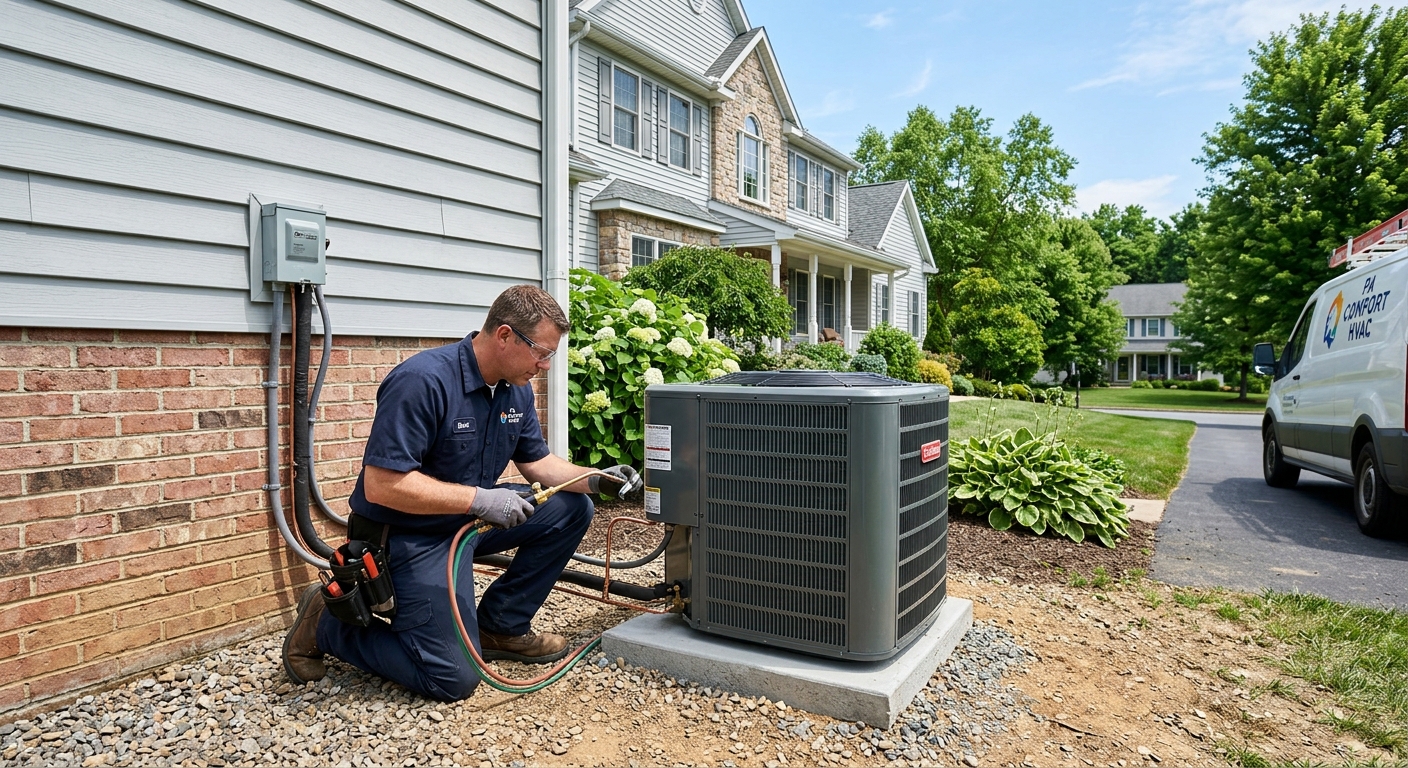
What a new HVAC system costs in Lower Oxford
Lower Oxford has a high homeownership rate and a large share of homes built before 2000 (U.S. Census Bureau, ACS 2024). This shapes the local HVAC market: you are likely looking at replacing an existing system or retrofitting one into an older home, not installing a first-ever system in new construction. Chester County’s 1970–2000 housing boom produced forced-air systems that are now reaching the end of their useful lives, which means most ductwork already exists—but its condition may vary.
Our region’s 4,800 heating degree days and 1,450 cooling degree days tilt replacement decisions in favor of systems that can reliably heat through a Southeast Pennsylvania winter. That typically means central furnace-and-AC combos or, increasingly, high-efficiency air source heat pumps that can handle both jobs. Existing homes with well-maintained ductwork can often use a central AC replacement for a lower installed price, but if your ducts are in rough shape—or never installed in the first place, as is common in pre-1980 homes—you may be looking at significant added cost for a new duct system or a ductless solution.
Here’s what you can expect for installed HVAC system prices in Lower Oxford:
| System |
Best for |
Efficiency |
Price range (installed) |
| Central AC replacement (existing ducts) |
homes with sound ductwork |
16–20 SEER2 |
$5,500–$13,500 |
| Air source heat pump (ducted) |
year-round heating and cooling |
8–10 HSPF2 |
$8,900–$19,000 |
| Cold-climate heat pump (ducted) |
heat pump as primary heat |
9–11 HSPF2 |
$14,500–$19,000 |
| Ductless mini-split (single zone) |
additions, rooms without ducts |
20–30 SEER2 |
$3,500–$7,800 |
| Full duct system installation |
homes with no existing ducts |
— |
$10,000–$20,000 |
Installed estimates for a typical Lower Oxford home. Equipment tonnage, duct condition and electrical capacity move these more than brand.
Ductwork: the part nobody quotes properly
Ductwork determines how efficiently your system delivers heating and cooling long after the shiny new equipment is installed. In older Chester County homes—many built between 1970 and 2000—the original ducts were often sized only for a furnace, not for today’s high-efficiency or combination systems. Leaks are the norm, not the exception, especially when sealed only with age-hardened tape instead of mastic or modern sealing methods. If your ductwork runs through unconditioned attics or crawlspaces, expect even greater energy loss and rooms that never quite reach the set temperature.
If you have undersized or missing return ducts (very common in expansions and retrofits), even a brand-new, high-efficiency unit won't fix airflow issues without upgrade work. That’s why a proper assessment should include a duct blaster test—which measures how much air leaks out before it ever reaches your rooms. This isn’t just a number: a high leak rate can waste up to 30% of your heating and cooling, meaning your system works harder, costs more to run, and never quite catches up in peak weather.
Sealing is always the first step if your ductwork is basically sound, and it is far less disruptive than ripping out and rebuilding everything. But when the original installation is poorly sized or crumbling, full replacement is sometimes unavoidable. The key: test your ducts before replacing the HVAC equipment, not just after—otherwise even the best unit will struggle, and every dollar spent is working against you.
Mini-splits and zoning in Lower Oxford homes
Ductless mini-splits are the go-to solution for areas where ductwork can’t—or shouldn’t—go. If you’re finishing a basement or attic, adding a sunroom, or need consistent comfort in a home office that your central air never seemed to reach, a single-zone ductless system outperforms window units and electric baseboard by a mile. In Lower Oxford, older homes with additions or complex floorplans can benefit from a mini-split system without the headaches and wall demolition a new duct network requires.
Most homeowners weigh single-zone versus multi-zone units. It’s tempting to install a multi-zone outdoor unit and hook several wall heads to it, but this approach can result in compromised efficiency and comfort compared to separate single-zone systems. The downside: mini-split heads are visible, and not everyone loves the look. Proper placement matters for both performance and aesthetics—and don’t overlook where condensate lines will run. Done haphazardly, they can cause leaks or look unsightly.
Price-wise, a single-zone mini-split runs $3,500–$7,800 installed, far less than rerunning ducts into expansions or finished rooms. For homes in Chester County that predate central air, ductless isn’t just convenient—it’s sometimes the only reasonable option.
What a real HVAC quote contains
No two HVAC quotes are truly comparable unless they spell out the same details. For Lower Oxford homeowners, that means every real quote should list model numbers for both the indoor and outdoor portions of the equipment; mismatched pairs can sabotage the expected efficiency. Always expect to see the unit tonnage, matched to a load calculation that reflects your house—not the guesswork from the old system’s sticker. If the quote skips line-set replacement, that means possible leaks and efficiency issues down the line. Electrical work (including possible panel upgrades) should not be left to chance, and the proposal should cover who handles the permit and final inspection.
The commissioning process—where the installer measures system charge and airflow, not just powers up and leaves—should result in a report you can keep. Lastly, a real quote spells out the labor warranty separate from the manufacturer’s parts coverage. If you get a price with nothing but a brand name and a promise to “take care of everything,” you’re not comparing apples to apples.
| Line item |
What to look for |
Red flag if… |
| Equipment |
model numbers, indoor and outdoor matched |
brand name only |
| Sizing |
load calculation attached |
matched to the old nameplate |
| Ductwork |
condition assessed, sealing scoped |
not mentioned |
| Electrical |
circuit and panel capacity confirmed |
assumed adequate |
| Line set |
replaced or documented as reused |
silent |
| Commissioning |
measured airflow and charge, documented |
no startup report |
| Warranty |
labour years stated separately |
manufacturer only |
| Permit |
included and priced |
'not needed' |
What a Pennsylvania HVAC contractor must hold
Pennsylvania does not issue a statewide HVAC contractor license for residential work—regulation is local. In Chester County, mechanical permits are usually enforced by each township or borough. Central system installations and replacements nearly always require a mechanical permit from your local office; your contractor should include permit handling in the proposal. For any job over $500, Pennsylvania requires Home Improvement Contractor (HIC) registration through the Office of Attorney General—check a contractor’s registration at hic.attorneygeneral.gov before you sign anything.
Any company that employs workers (not just the owner) must carry workers’ compensation insurance from the private or self-insured markets. You can verify this on the state’s WCAIS portal. For refrigerant systems like central air or heat pumps, EPA Section 608 certification is federal law; every installer who handles refrigerant must have it—no exceptions. There’s no statewide license for plumbing, electrical, mold, or restoration work either, but local permits and municipal licenses may apply depending on your township.
Do not accept a bid from anyone unwilling to put HIC registration, insurance, permit details, and EPA certification in writing. This protects you as the homeowner and keeps you squarely within state consumer protection laws.
Sizing: why bigger is worse
Most HVAC mistakes start with size. If a contractor replaces your old system with something bigger than needed "just in case," they're not giving you peace of mind—they're guaranteeing poor comfort and higher bills. An oversized system will short cycle (turn on and off too quickly), leaving your home with temperature swings, poor humidity control, and extra wear that shortens the life of every part. It won’t remove enough humidity in our humid Chester County summers and can overshoot set temperatures on cold winter nights.
Proper sizing depends on a Manual J load calculation, which considers your home’s square footage, window types, insulation, orientation, number of occupants—even shading. The typical square-footage “rules of thumb” don’t account for these, and copying the old unit’s size simply repeats past mistakes. Always ask: “Did you run a load calculation, and can I see it?” If the answer is no, or the size matches your outdated equipment exactly, you are at risk for comfort and efficiency issues.
The region’s winter design temperature of 14 °F is a key input in the calculation—your system must keep the house comfortable even at this low, but any larger and you’re inviting problems. In Chester County’s energy-conscious market, right-sizing keeps you comfortable and saves money, season after season.
Maintenance that actually extends system life
Not every task pitched as “maintenance” delivers real results. Changing your air filter regularly is the easiest way to extend blower life and ensure good airflow. Use the MERV rating recommended for your system—going too high can choke airflow and damage the blower. Coil cleaning removes built-up dust and pollen that slow the cooling process. Flushing or vacuuming the condensate drain each year prevents overflow and water damage, especially important in the humidity of southeastern Pennsylvania summers. Refrigerant should not need to be “topped off” year after year; if the charge is low, there’s a leak, and simply adding more is not maintenance but an unresolved problem.
Annual service plans can be worth it if they cover real inspection and cleaning, provide discounts on genuine repairs, and spell out exactly what’s included. They’re not worth it if the "tune-up" is a 10-minute visual inspection or a sales call for upgrades you don’t need. For Lower Oxford, schedule maintenance in early spring or fall—before the contractor’s phones are ringing off the hook with emergency no-cool or no-heat calls in July and January.
Frequently asked questions — HVAC installation in Lower Oxford
What HVAC tax credits are available to Lower Oxford homeowners?
For Lower Oxford residents, federal tax credits are available for qualifying high-efficiency heat pumps, central air conditioners, and other energy-efficiency improvements. The IRS currently offers credits up to 30% of the installed cost for some systems, but annual and per-item caps apply, and to qualify, equipment must meet minimum efficiency requirements. For a typical air source heat pump installation, that might mean a credit on a $8,900–$19,000 job. Pennsylvania doesn’t have its own statewide credit, but check for regional utility rebates through PECO as well. Always consult a qualified tax preparer and keep copies of permits, equipment specs, and final invoices to substantiate any IRS claim.
What is a Manual J load calculation?
A Manual J load calculation is the industry’s accepted method for determining the right size HVAC system for your Lower Oxford home. It takes into account factors like square footage, insulation levels, window type and exposure, air leakage, and even the local winter design temperature (14 °F in Chester County). The calculation ensures your new unit isn’t oversized—which causes short cycling and humidity problems—or undersized, leaving you cold in winter or hot in summer. If you’re quoted a central AC replacement at $5,500–$13,500 but don’t see a Manual J printout or summary attached, ask for one. It’s the best way to guarantee comfort and efficiency for your particular house—not a generic rule of thumb.
How long should an HVAC system last in Lower Oxford?
In Lower Oxford, most standard HVAC systems last 12–18 years with proper maintenance. Homes built in Chester County’s large 1970–2000 development wave are seeing their original systems reach end-of-life now, so it’s common for equipment to fail initially due to worn compressors, cracked heat exchangers, or refrigerant leaks. Harsh winters and humid summers make the equipment work hard, shortening lifespan if filters are neglected or the system is oversized and frequently cycles. For a replacement costing $8,900–$19,000 for a ducted heat pump or $5,500–$13,500 for central AC, investing in seasonal maintenance and prompt repairs can reliably push your system toward the longer end of that range.
Is a high-efficiency system worth the extra cost here?
For most Lower Oxford homes, a high-efficiency system can pay off—especially if your current equipment is more than 15 years old, and your ductwork is in good condition. With 4,800 heating degree days each year, winter heating is a real cost, and upgrades to higher HSPF2 or SEER2-rated equipment can lower utility bills. However, you’ll need to compare the extra upfront price—say, $14,500–$19,000 for a premium cold-climate heat pump system—to the expected energy savings over the years you plan to stay. In homes with old, leaky ducts or poor insulation, though, fixing the building shell might save more than simply buying the highest efficiency rated equipment.
Is natural gas available throughout Chester County?
Natural gas is plentiful in urbanized parts of Chester County like West Chester and Tredyffrin, yet in rural areas surrounding Lower Oxford, propane or heating oil remains common. Households in those outer townships may not have access to a gas main. Before selecting a gas furnace or considering a heat pump switch, verify with PECO Energy whether your address is eligible for a connection. For those with no gas available, the market tilts toward air source heat pumps or hybrid systems, where the replacement cost ranges from $8,900–$19,000.
Can a heat pump heat my house without backup?
Many new ducted heat pumps on the market can comfortably heat a Lower Oxford home through most of our winter, particularly high-efficiency “cold climate” models. Our 14 °F winter design temperature is right at the edge of what top systems can handle reliably without supplemental strip heat. In rural Chester County, many heat pumps do include electric or gas backup for those very cold snaps. For homeowners considering a switch, expect cold-climate heat pump systems to cost $14,500–$19,000 installed, and ask your contractor if the chosen unit is sized for full heating without frequent reliance on backup.
What is commissioning and why does it matter?
Commissioning is the process of verifying that your new HVAC system in Lower Oxford is set up and running according to manufacturer and code specs—not just “powering on.” It means testing for correct refrigerant charge, measuring system airflow, checking duct leakage, and calibrating controls. A full commissioning results in a written report. This matters because a poorly set up system, even if brand new, will not deliver the comfort or efficiency promised—sometimes costing more to run or failing early. For a central AC install at $5,500–$13,500, make sure commissioning is included in writing. A quote with no mention of startup checks is a reason to walk away.
Why do HVAC quotes in Lower Oxford vary so much?
Prices in Lower Oxford can swing widely due to differences in equipment brands, included features, warranties, and especially what’s buried in the fine print. Some contractors include new ductwork or electrical panel upgrades in their base price; others assume the existing setup is perfect. Oversized or premium equipment can inflate an estimate, but so can hidden costs for hard-to-access duct runs or older electrical panels. For the same basic system, you might see anything from $8,900–$19,000 for a ducted heat pump. Always ask for details: is the quote apples-to-apples on model numbers, labor warranty duration, scope of work, and permit fees? If you don’t see those, you’re not really comparing.
Does Pennsylvania license HVAC contractors?
Pennsylvania does not have a statewide license specifically for HVAC contractors working on residential jobs. Local Chester County municipalities require mechanical permits and may have their own approval processes, but the main state-level requirement is Home Improvement Contractor (HIC) registration for projects over $500. You should always ask to see a contractor’s HIC registration (verifiable online), proof of insurance, and EPA Section 608 certification for refrigerant-handling staff. For a full central AC or heat pump job—typically costing $5,500–$19,000—don’t skip verification. Hiring an unregistered contractor risks your warranty and your rights under state consumer protection laws.