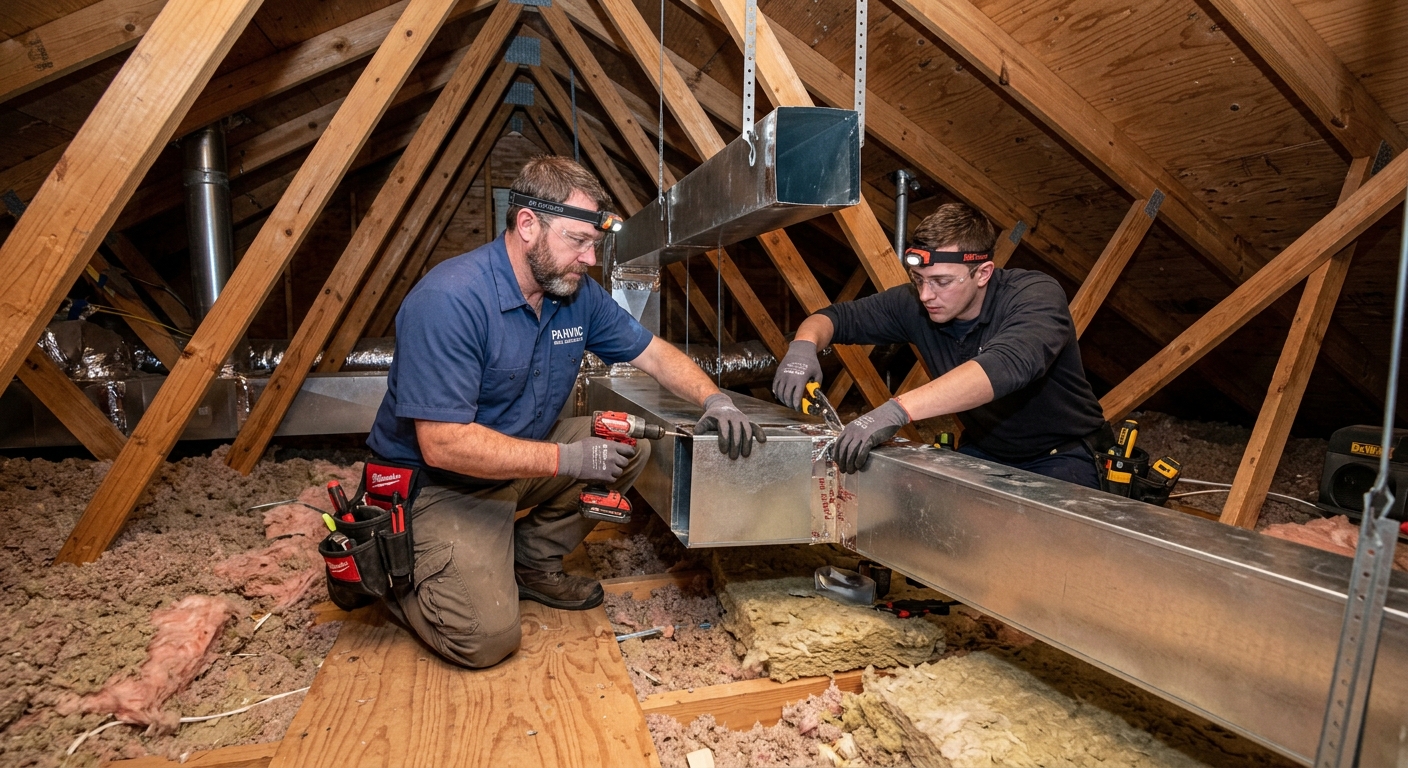
What a new HVAC system costs in Lower Heidelberg
Lower Heidelberg is a market where HVAC replacement and retrofit work makes up the majority of what we do. With a homeownership rate of 92.3% and nearly one-third of homes built before 1980 (U.S. Census Bureau, ACS 2024), it’s common to see older heating systems being replaced—often alongside air conditioning retrofits in houses that may have lived with window units or little to no ductwork. In nearby Reading and boroughs like Hamburg, there’s still a substantial stock of pre-1940 homes, which means many jobs involve installing new duct systems entirely, not just swapping equipment.
South-central Pennsylvania is best described as a heating-dominated climate. With 5,200 heating degree days and only 1,250 cooling degree days a year, the math always tilts toward winter needs over summer. The average winter design temperature bottoms out at 12 °F, so heating systems—especially heat pumps or furnaces—have to deliver steady output in real cold. Most Lower Heidelberg homes will get more value from addressing their heating equipment first, and if ductwork is already sound, central AC or a heat pump is straightforward. However, full new duct installs remain common in original homes that never had forced air.
| System |
Best for |
Efficiency |
Price range (installed) |
| Central AC replacement (existing ducts) |
homes with sound ductwork |
16–20 SEER2 |
$5,600–$13,500 |
| Air source heat pump (ducted) |
year-round heating and cooling |
8–10 HSPF2 |
$9,000–$19,000 |
| Cold-climate heat pump (ducted) |
heat pump as primary heat |
9–11 HSPF2 |
$14,500–$19,000 |
| Ductless mini-split (single zone) |
additions, rooms without ducts |
20–30 SEER2 |
$3,600–$7,900 |
| Full duct system installation |
homes with no existing ducts |
— |
$10,000–$20,500 |
Installed estimates for a typical Lower Heidelberg home. Equipment tonnage, duct condition and electrical capacity move these more than brand.
Reading the yellow label
When you look at new HVAC equipment, you’ll see several efficiency numbers on “yellow label” stickers. For air conditioners, SEER2 (Seasonal Energy Efficiency Ratio 2) is the cooling efficiency over a season. For heat pumps, you’ll see both SEER2 for cooling and HSPF2 (Heating Seasonal Performance Factor 2) for heating, both updated to new federal test standards in recent years—so older “SEER” and “HSPF” numbers you might read elsewhere don’t match what’s on the shelves today.
In Berks County’s climate, what maters most is heating efficiency—because with 5,200 heating degree days swinging against only 1,250 cooling degree days, most utility cost and most system wear happens in winter, not summer. Pumps and furnaces run longer and harder on chilly nights than during a heat wave. For this reason, if you’re comparing high-end SEER2 ratings on ACs or heat pumps, there’s rarely payback above about 18 SEER2 unless you have unusually high cooling use. On the other hand, investing in a higher HSPF2—closer to 10 on a standard system and 11+ on a cold-climate unit—can make a more noticeable dent on winter bills.
Bottom line: Don’t overspend for the highest cooling ratings. In Lower Heidelberg, a mid to upper HSPF2 is worth real money; pushing SEER2 to the max is not.
Permits, licensing and inspections in Lower Heidelberg
Pennsylvania does not have a statewide HVAC trade license for residential work. Instead, HVAC contractors are required to register as Home Improvement Contractors with the Pennsylvania Office of Attorney General, and individual townships or cities—including those in Berks County—enforce their own mechanical permit requirements. So, in Lower Heidelberg (as in much of the county), who performs your work and whether the proper permits are pulled is managed locally, not at the state level.
Anyone who handles refrigerant (for example, swapping out your air conditioner or heat pump) must have EPA Section 608 certification—that’s a federal rule, not up to the township. Mechanical permits are usually needed for central system replacement or installation, and these jobs are subject to inspection under the Pennsylvania Uniform Construction Code (UCC), which is based on the IRC. Most mechanical work over $500 must be backed by a written contract under the state’s Home Improvement Consumer Protection Act. Homeowners have three business days to cancel after signing, and contractors cannot offer to cover your insurance deductible.
Insurance is non-negotiable: all employers in Pennsylvania must have workers’ compensation coverage. You can verify this yourself using the Workers’ Compensation Automation and Integration System (WCAIS). For HIC registration checks, the state offers a public database at hic.attorneygeneral.gov. Only hire contractors who can prove registration and insurance—anything less is a red flag.
Choosing an installer in Berks County
When it comes to HVAC, quality of installation is everything. Even top-name equipment can deliver disappointing results if it’s sized wrong, poorly commissioned, or the ductwork lets half your heat leak into the attic. In Berks County’s moderate-suburban market, what separates a sound job from a short-lived one is the process, not the logo on the unit.
Start by verifying your contractor’s registration at hic.attorneygeneral.gov. Check for insurance by looking up their workers’ compensation coverage in WCAIS. Confirm that the tech actually handling refrigerant has a valid EPA Section 608 card—not just the company, but the technician on your site. Always insist on a proper load calculation for your home (not just “matching the old unit”), and get a quote with model numbers for both indoor and outdoor equipment. Final commissioning—measured airflow and refrigerant charge, documented—is the difference between quiet, efficient comfort and years of troubleshooting hot and cold spots.
- HIC registration verified at hic.attorneygeneral.gov
- Proof of workers’ comp from WCAIS (wcais.pa.gov)
- EPA Section 608 card for the refrigerant tech
- Detailed written proposal, not just a total price
- Both indoor and outdoor equipment model numbers specified
- Room-by-room load calculation included
- Scope includes duct inspection (sealing or replacement if needed)
- Electrical work and panel check addressed
- Start-up commissioning report promised
- Labour and equipment warranty spelled out separately
- Permitting included and priced
- References from other Berks County jobs available
In Berks County, pockets of rural and suburban customers mean fewer high-volume contractors. Be wary of anyone with an out-of-area address and a quick start date when others are booked out—they may be skipping steps or pulling in hired help from elsewhere who aren’t familiar with local code offices.
Gas, electric or both in south-central Pennsylvania
For most Lower Heidelberg homeowners, the key decision is which heating system makes the most sense: gas furnace, full-house heat pump, or a hybrid (dual fuel) system. South-central Pennsylvania winters bring 5,200 heating degree days and overnight lows down to 12 °F, so any system must supply dependable heat, not just take the edge off. Modern cold-climate heat pumps can handle substantial heating even in lower teens, a huge advance from decades past, but their output does decrease as outdoor temperature drops—making the design temperature and house insulation honest variables.
In urban Berks County—Reading, Muhlenberg, Exeter, and Spring—natural gas is widely available, so gas furnaces remain a cost-effective option, both for replacement and new installs. However, much of rural Berks county (and many older homes on the outskirts) rely on propane or heating oil, changing the economics. Where there’s no natural gas, a heat pump is often far more efficient and simpler long term than fueling big oil or propane tanks—especially if your goal is to move away from fossil fuels.
Dual fuel systems (heat pump with a gas backup) combine the best of both: efficient electric heat until it gets frigid, then the furnace picks up on the coldest nights. The one time a straight gas furnace plus central AC is still the clear answer is where you have steady, inexpensive gas, and the house is drafty or simply oversized for heat pump alone.
| Option |
Installed cost |
Operating cost here |
Best when |
Incentive eligible |
| Gas furnace + central AC |
$5,600–$13,500 |
lower with utility gas, higher with propane |
existing gas service, coldest zones |
furnace: rarely; AC: sometimes |
| Ducted heat pump (cold climate) |
$9,000–$19,000 |
lowest with good insulation, all-electric |
good envelope, all-electric goal |
yes, federal/state credits |
| Dual fuel (heat pump + gas backup) |
$14,500–$19,000 |
middle; electric for mild, gas for deep cold |
gas on site, deep cold spells |
yes, for heat pump portion |
| Ductless multi-zone |
$10,000–$20,500 |
lowest in mild zones, higher in envelope issues |
no ductwork, zone control |
yes |
Comparing HVAC estimates in Lower Heidelberg
To compare HVAC bids fairly, look for more than just a brand and a lump sum. The best estimate details both the indoor and outdoor unit model numbers; mixing unmatched units almost always tanks the promised efficiency. Ducted systems should be quoted with the exact tonnage based on a fresh load calculation—don’t trust a contractor that just repeats whatever size the old equipment was. Watch for line-item listings: is the refrigerant line set being replaced or reused, has the ductwork been inspected for leaks, will electrical upgrades (including panel work) be required, and is all required permitting included?
Any reputable contractor will also spell out what’s covered by the labour warranty (separate from the manufacturer’s policy), list who pays for permits, and promise to provide a commissioning report showing the system was checked for airflow and refrigerant charge at startup. If the proposal is just a logo and a price, you’re buying blind. Here is what’s worth checking:
| Line item |
What to look for |
Red flag if… |
| Equipment |
model numbers, indoor and outdoor matched |
brand name only |
| Sizing |
load calculation attached |
matched to the old nameplate |
| Ductwork |
condition assessed, sealing scoped |
not mentioned |
| Electrical |
circuit and panel capacity confirmed |
assumed adequate |
| Line set |
replaced or documented as reused |
silent |
| Commissioning |
measured airflow and charge, documented |
no startup report |
| Warranty |
labour years stated separately |
manufacturer only |
| Permit |
included and priced |
'not needed' |
Keeping a Lower Heidelberg system running
Routine HVAC maintenance doesn’t need to be a science project—or an upsell extravaganza. The most important habit is swapping your filter at the right interval. In Lower Heidelberg, most homes are best served by a filter with a MERV rating between 8 and 11—high enough to catch dust and pollen, but not so high it chokes an older blower motor. Sticking to the change schedule (monthly for thinner 1-inch types, every 3–6 months for 4-inch media) will do more for longevity than any “tune-up special.”
Once a year, ask for a full coil cleaning (both indoor and outdoor) and have them check the condensate line to prevent basement leaks. A professional should also verify refrigerant charge—never just “top it up.” If your system needs refrigerant, it leaks. Topping off without finding and fixing the leak is poor practice.
Annual service contracts can be worthwhile if they spell out exactly what’s covered and guarantee priority response. Skip any plan that mostly offers “discounts” on unnecessary upsells or expensive boilerplate. In this area, true emergencies are most common at first cold snap (October) and midsummer heat wave (July). Schedule routine service right before these peaks to avoid waiting behind a hundred “no heat” or “no cool” urgent calls.
Frequently asked questions — HVAC installation in Lower Heidelberg
What HVAC tax credits are available to Lower Heidelberg homeowners?
Lower Heidelberg homeowners may be able to claim federal tax credits for qualifying high-efficiency heat pumps, air conditioners, and furnaces. The current federal credits cover a portion of equipment and installation costs for Energy Star–rated systems; the biggest rebates tend to go to cold-climate air source heat pumps, which are well suited to Berks County’s heating-heavy climate. State programs may also apply, depending on the year and your household income. For example, installing a ducted cold-climate heat pump (rated for primary heat at our winter temperatures) could be eligible—these systems run $14,500–$19,000 installed here, so credits make a real dent. Always save your detailed invoice and keep records on model numbers to prove eligibility. Details change year to year, so verify with your accountant or the IRS guidance before signing a contract.
How much does a furnace replacement cost in Lower Heidelberg?
For a typical Lower Heidelberg home with existing ductwork and natural gas from UGI Utilities, a standard furnace replacement (often with a new central AC at the same time) usually falls in the $5,600–$13,500 range. Factors that shift the price include the efficiency rating, the complexity of venting, and whether updates to gas piping or electrical systems are required. In rural parts of Berks County with propane or oil, add the cost of fuel-tank work or switchout. Always insist on a quote that lists both indoor and outdoor unit model numbers—a bundled quote for just a furnace swap may look cheap, but can mask under-sizing, mismatched efficiency, or skipped duct sealing.
What is commissioning and why does it matter?
Commissioning is the step-by-step process of verifying your new HVAC system is actually running according to its specs once installed. In Lower Heidelberg, true commissioning means your contractor measures airflow at the registers, checks the static pressure in ductwork, and uses gauges to confirm refrigerant charge matches the manufacturer's chart for the selected model. This isn’t busywork—it’s the difference between a comfortable house and one with hot and cold spots or a system that costs more to run. Especially at our price bands—where replacing a central AC or heat pump is easily $5,600–$19,000—the installer should give you a written startup report as part of the job. Systems that get skipped through this step often underperform for years, and warranty claims are much harder if benchmark data is missing.
Should I close vents in unused rooms?
It’s a common myth that closing vents in unused rooms will save money, but in nearly all Lower Heidelberg homes—especially older construction with aging ductwork—closing supply vents raises static pressure, causing leaks and stressing the blower motor. This can increase energy use rather than lowering it. HVAC systems are designed and balanced for the whole house airflow; cutting off part of that path disrupts the balance and may shorten equipment life. If you regularly need different temperatures across parts of the house, a ductless mini-split (costing $3,600–$7,900 for a single zone) or a zoned ducted system will give better room-by-room control without harming efficiency.
Do I need a permit to replace HVAC in Lower Heidelberg?
In most Berks County townships—including Lower Heidelberg—replacing or installing a central HVAC system typically requires mechanical permits and, if electric upgrades are involved, sometimes separate electrical permits as well. Permit requirements are enforced by your local code office, not by the state directly. Portable, plug-in room units do not need permits, but anything ducted does. Not pulling the right permit can lead to refused utility hookups, insurance issues, or trouble at resale. All reputable contractors should include the permit in their written estimate; if it’s not listed on a job that costs $9,000–$19,000, that’s a red flag.
Should I repair or replace my HVAC system in Lower Heidelberg?
The repair-versus-replace decision comes down to three factors in Lower Heidelberg: system age, frequency and cost of repairs, and whether the underlying technology is worth upgrading. For units over 15 years old, needing more than one major repair, or using outdated refrigerants, replacement usually pays off—especially with energy savings in a heating-dominated climate. With replacements running $5,600–$19,000, smaller repairs may be justified if your current system is otherwise reliable and suits your comfort needs. Always have a reputable contractor do a full system assessment before deciding, as duct leaks, undersized electric, or poor airflow could mean a newer system won’t solve your comfort or efficiency problems unless those issues are also addressed.
Why do HVAC quotes in Lower Heidelberg vary so much?
HVAC pricing in Lower Heidelberg will swing widely—sometimes several thousand dollars—for the same basic job. Main reasons are: differences in duct condition (older homes often need major duct sealing or full replacement, which can range from $10,000–$20,500), whether a panel upgrade is required, and if the quote includes quality commissioning or uses builder-grade models. Some larger companies have higher overhead, while others will cut corners on installation. Make sure every quote lists all equipment model numbers, includes a load calculation, spells out what’s included for labor and parts warranties, and accounts for permits. Bids that look “low” often miss major scope items, which you’ll pay for later.
How does south-central Pennsylvania's climate affect system sizing?
With 5,200 heating degree days per year and winter design lows down to 12 °F, Berks County homes—Lower Heidelberg included—need systems sized for sustained, serious heating duty. Cooling loads here are modest by comparison, thanks to only 1,250 cooling degree days. That means for most houses, sizing is about balancing efficient heating capacity without overshooting on air conditioning. Oversizing leads to short cycling and humidity issues, while undersizing leaves you cold on the coldest January nights. The best contractors will use Manual J or equivalent software to size both the heating and cooling output and factor in duct losses if your house is older (as nearly a third of Lower Heidelberg homes are). System sizes above 3.5 tons usually mean deeper investigation—often your real need is more insulation, not more BTUs; going too big doesn’t help and just costs more: $9,000–$19,000 for an appropriately-sized heat pump beats an oversized model every time.
What does HSPF2 measure?
HSPF2 stands for Heating Seasonal Performance Factor 2, the updated federal metric that measures how efficiently a heat pump delivers heat over an entire winter season—including milder days and deep cold snaps. HSPF2 is calculated under stricter new testing protocols, which better match real-world use in places like Lower Heidelberg where our peak heating season is long and cold. A higher HSPF2 rating means more heat delivered per kilowatt-hour used and fewer high electric bills. For Berks County’s 5,200 heating degree days, systems with HSPF2 of 10 and up are now worth seeking out—even if they cost extra up front. In fact, a ducted cold-climate model with high HSPF2 typically falls in the $14,500–$19,000 installed range here, but regularly pays for itself over time compared to lower efficiency models.