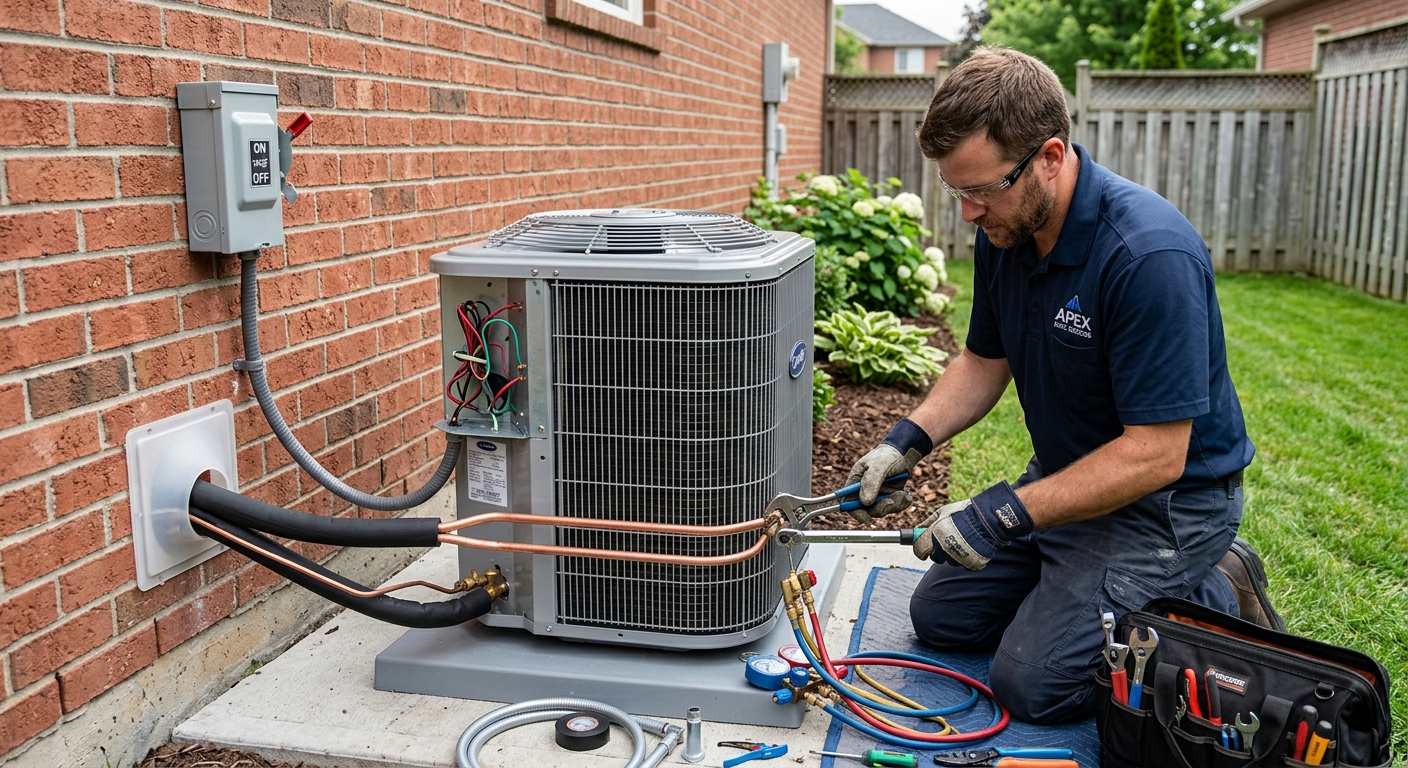
What a new HVAC system costs in Concord
In Concord, the HVAC system you choose depends a lot on how your house was built and how you actually live in it. With a homeownership rate of 70.9% and nearly a third of homes built before 1980 (U.S. Census Bureau, ACS 2024), replacement of aging systems is common, but for many, it’s a first-time install of central air, especially in older neighborhoods lined with 1920–1950 rowhouses and twins. In those homes, there’s often no existing ductwork, which limits your options unless you’re ready for a major retrofit or are open to ductless mini-split systems. For houses that are newer or already have forced-air heat, central AC or a heat pump fits right in, especially if the ductwork is in good shape.
Delaware County’s climate leans sharply toward heating needs, with 4,800 heating degree days and just 1,450 cooling degree days—so most residents are more concerned with winter performance. If you’re looking to upgrade, air source heat pumps now do reliable work in southeastern Pennsylvania’s moderate winters, and modern gas furnaces remain a straightforward option where natural gas is already piped in. For cooling, high-efficiency mini-splits really shine in older homes none too easy to retrofit.
| System |
Best for |
Efficiency |
Price range (installed) |
| Central AC replacement (existing ducts) |
homes with sound ductwork |
16–20 SEER2 |
$5,600–$13,500 |
| Air source heat pump (ducted) |
year-round heating and cooling |
8–10 HSPF2 |
$9,000–$19,000 |
| Cold-climate heat pump (ducted) |
heat pump as primary heat |
9–11 HSPF2 |
$14,500–$19,000 |
| Ductless mini-split (single zone) |
additions, rooms without ducts |
20–30 SEER2 |
$3,600–$7,900 |
| Full duct system installation |
homes with no existing ducts |
— |
$10,000–$20,500 |
Installed estimates for a typical Concord home. Equipment tonnage, duct condition and electrical capacity move these more than brand.
Repair or replace your Concord system?
Deciding between repairing or replacing your HVAC system in Concord comes down to math and common sense. Most forced air systems (furnaces, central AC, heat pumps) are built to last around 12–18 years with proper maintenance. If your unit is under 10 years old and you’re facing a common part failure—like a capacitor, control board, or fan motor—repair makes sense. It’s rarely worth springing for a full replacement unless the repair cost approaches a third of a new unit, or your system is 15 years or older and unreliable. The big outliers are a cracked heat exchanger (which can leak carbon monoxide) and a compressor failure after the warranty is up—both are game over.
Another factor unique to this region: If your system still uses R-22 refrigerant (common in systems pre-2010), repairs become increasingly impractical due to the high cost and dwindling supply of the refrigerant. Efficiencies have improved, but with more heating degree days than cooling, those efficiency gains pay back slower unless your existing system is truly at the end of its life. Always ask the technician for a clear explanation before deciding, because in many Delaware County homes, repairing makes more sense than replacing, particularly on younger equipment.
| Situation |
Recommendation |
Typical cost |
Reasoning |
| Under 10 years, single component failure |
Repair |
$300–$1,200 |
Most repairs are minor and cost-effective on newer systems |
| 10–15 years, repair over a third of replacement |
Consider replacing |
$5,600–$13,500 |
Major repair at this age risks more major parts failing soon |
| 15+ years, any major failure |
Replace |
$5,600–$13,500 |
Unit is likely near end of life; new system is safer investment |
| Cracked heat exchanger, any age |
Replace immediately |
$5,600–$13,500 |
Safety hazard; repairs are not code-approved |
| Compressor failure past warranty |
Replace |
$9,000–$19,000 |
Compressor is the heart of cooling; costly to repair if not warrantied |
| Working system, high bills |
Test ducts and envelope first |
$300–$800 |
Leakage or insulation is often the culprit over equipment itself |
How to vet an HVAC contractor in Concord
Installation quality is everything. In Concord and across Delaware County, you can buy the highest-efficiency system on the market, but if it’s installed poorly, you’ll get lousy comfort and likely higher bills. The business is dense here—lots of contractors, so you don’t need to settle for the first available bid. Don’t get sidetracked by brand debates. What matters most: proper sizing, code-compliant ductwork, and measured performance at startup.
Start by confirming the contractor holds a valid Home Improvement Contractor (HIC) registration for Pennsylvania. You can verify this directly via hic.attorneygeneral.gov. For refrigerant work, any technician actually handling lines needs to have EPA Section 608 certification; ask to see it. Get a detailed written estimate that specifies equipment model numbers, not just “3-ton AC.” Make sure they’ll run a Manual J load calculation and share results. Commissioning—meaning they measure installed airflow, temperature splits, and refrigerant pressures on startup—should always be included and documented.
- Verify HIC registration at hic.attorneygeneral.gov
- Ask for EPA 608 certification for installers handling refrigerant
- Request proof of insurance and workers’ comp (use WCAIS for workers’ comp checks)
- Quote should specify equipment model numbers, not just tonnage
- Contract should include ductwork scope (cleaning, sealing, sizing if relevant)
- Manual J load calculation included and shared
- Commissioning: measured airflow and refrigerant charge documented
- Written contract, per HICPA, required for jobs over $500
- Three-day right of cancellation is your legal right
- No deductible “waivers” — that’s prohibited
- References from similar local jobs (rowhouse, twin, or single-family as relevant)
- Clarify permit process: who applies, and who closes it out?
Red flags: In this part of Pennsylvania, HVAC is a very competitive trade—if a contractor can’t provide references or pushes you to skip a permit, move on. You have choices.
Mini-splits and zoning in Concord homes
Ductless mini-split systems are a practical solution for many Concord homeowners, especially in older rowhomes and twins seen throughout Upper Darby and Haverford. These houses often never had central ductwork to begin with, making cooling retrofits with traditional systems complicated and costly. Mini-splits excel in spaces that were never adequately served: additions over garages, converted attics, finished basements, or any room the original system couldn’t reach.
A single-zone mini-split handles one space efficiently and is usually the best value if your needs are limited to a bedroom or new sunroom. Multi-zone systems can serve an entire home with one outdoor unit and multiple indoor heads, but be aware: performance and efficiency can take a hit if the load isn’t matched well, and a failure in the outdoor unit means all zones go down. Sometimes, two or three single-zone systems beat one oversubscribed multi-zone, both in energy use and reliability. Placement matters—a head on each floor, or in spaces you actually use, not just wherever installation is easiest. And each indoor head needs a line for condensate drainage routed out of the finished space, which can shape where units go.
If you walk Concord’s older neighborhoods, high-velocity ductless or mini-split retrofits are the only realistic cooling upgrade for a sizable share of homes—owners just haven’t all learned it yet. When aesthetics are a concern, slim-duct or recessed models may fit better than the standard wall-mounted heads, so discuss the look openly with your contractor.
Permits, licensing and inspections in Concord
In Pennsylvania, residential HVAC work does not require a specialized trade license at the state level—there’s no separate state HVAC license for residential contractors. Instead, contractors need a Home Improvement Contractor (HIC) registration issued by the Pennsylvania Office of Attorney General for any contract over $500, which you can verify at hic.attorneygeneral.gov. For actual installation, the requirement for mechanical permits and inspections comes down to local municipal enforcement. In Upper Darby Township, for example, a mechanical permit is usually required for new or replacement central air and heat pump systems; check with your own municipality’s code office before the project begins.
Anyone who handles refrigerant must hold an EPA Section 608 certification—this is a federal rule, and every HVAC tech touching refrigerant lines is required to be certified, no exceptions.
Before work begins, ask to see proof of liability insurance and workers’ compensation coverage—the latter is mandatory in Pennsylvania even for small employers, and you can confirm a contractor’s status via the WCAIS (wcais.pa.gov) system. For work over $500, Pennsylvania’s Home Improvement Consumer Protection Act also means you get a detailed written contract, with both scope and price spelled out, and a three business-day right to cancel.
Manual J and the tonnage question
The most expensive mistake in a Concord HVAC install isn’t the brand—it’s getting the size wrong. Oversizing is rampant: many contractors still size by rough square foot per ton or, worse, just swapping in a new unit to match the old one’s nameplate. In Delaware County, this is often a copy of a mistake from decades ago, especially in older rowhouse neighborhoods or additions.
An oversized system will cool or heat the house too quickly, shutting off before it removes summer humidity or fully warms the shell in winter. This short-cycling means wear and tear, noise, temperature swings, and higher bills. On the other hand, going too small means inadequate comfort in a cold snap. Concord’s winter design temperature is 14 °F—the Manual J calculation is built to hit that mark, not just keep up on mild days.
Manual J isn’t some secret sauce; it’s a standardized way of measuring how much heat your house loses on the coldest night or gains on the hottest summer afternoon, based on your house’s insulation, windows, orientation, and occupancy. It can’t be eyeballed from square footage alone. When a contractor quotes you, ask directly: “Did you run a Manual J load calculation? Can I see it?” If the answer is no, or they dodge, move on. The right size for your home comes from analysis, not guesswork—especially with the mix of pre-war and post-war housing in Concord.
Filtration, humidification and ventilation
Concord’s climate brings cold, dry winters followed by humid, sometimes muggy, summers—your HVAC system needs to manage both comfort and health. In the dead of winter, forced air heating can leave indoor air uncomfortably dry, but most add-on humidifiers need regular cleaning and seasonal checks to avoid mold and mineral buildup. In tight new construction, mechanical ventilation is vital, but in older homes it’s rarely a stand-alone upgrade unless you’ve completed a deep weatherization retrofit.
For air quality, properly sized filtration works—aim for a MERV 8 to 11 filter if your blower can handle it, but don’t believe every high-MERV or HEPA marketing pitch: too much resistance can starve your system for air if it isn’t sized for it. For summer humidity, remember that oversized AC systems won’t run long enough to wring out moisture, leading to clammy rooms. Dehumidifiers or ERV/HRV units can help, but are often oversold in houses with average envelope tightness for southeastern Pennsylvania. Unless your home is unusually airtight or you have specific respiratory needs, filtration and a correctly sized system are the best return on money spent. Skip the UV lights and “air purification” add-ons unless you have a clear diagnosis or allergy trigger.
Frequently asked questions — HVAC installation in Concord
How do I verify an HVAC contractor's insurance?
Checking a contractor’s insurance is a smart move before hiring for an HVAC install in Concord. Start by asking for their certificate of insurance, which should list general liability and, if the contractor employs anyone, workers’ compensation. Pennsylvania law requires workers’ compensation for all employers, and you can directly confirm status using the WCAIS system at wcais.pa.gov. Don’t be afraid to call the insurance provider on the certificate for confirmation—the reputable outfits expect it. This helps shield you as the homeowner from liability for injuries on your property during a project potentially costing $5,600–$19,000. If a contractor can’t provide this documentation promptly, that’s a red flag in Delaware County’s crowded market.
How much does a new HVAC system cost in Concord?
The cost of a new HVAC system in Concord depends most on what’s already in your home and what type of system you choose. For a straightforward central AC replacement where the ductwork is already in good shape, expect to pay between $5,600–$13,500. If you’re adding a ductless mini-split to cool a room or addition without ducts, single-zone installs usually fall in the $3,600–$7,900 range. Full ductwork installations, sometimes necessary in older homes, begin around $10,000–$20,500. Price swings often come down to the size of your home, condition of existing ducts, and what’s needed to upgrade your electrical system. Brand and bells and whistles move numbers less than most people expect.
Do older Concord homes need ductwork replaced?
Many Concord homes—especially the 31.9% built before 1980 (U.S. Census Bureau, ACS 2024)—feature original ductwork sized for older heating equipment. Replacement isn’t always required, but in homes without existing central ductwork (like many rowhouses and twins in Upper Darby and Haverford), adding forced air typically means a new duct system, which runs between $10,000–$20,500. If you have ducts already and they’re not rusted out, damaged, or leaking badly, proper cleaning and sealing can often restore performance. In short, existing ducts should be inspected before committing to full replacement—minor repairs are usually much cheaper than ripping everything out.
How is a tax credit different from a rebate?
In Pennsylvania, you’ll occasionally see tax credits and rebates offered for high-efficiency HVAC upgrades. A tax credit means a direct reduction of your state or federal income tax owed—claim it when you file your taxes. A rebate, on the other hand, usually comes as cash back after you’ve bought and installed qualifying equipment (sometimes from PECO Energy Company or the federal government). For example, if you install a new air source heat pump costing $9,000–$19,000, you might qualify for either or both. The important difference: rebates give cash up front, tax credits offset what you owe later. Programs can change yearly—always confirm eligibility before relying on these savings.
What does HSPF2 measure?
HSPF2 (Heating Seasonal Performance Factor 2) is a newer, more rigorous standard for rating the heating efficiency of air source heat pumps. In southeastern Pennsylvania, Concord’s climate has more heating than cooling degree days, so a high HSPF2 rating (8–11) indicates a heat pump will provide more heat for each unit of electricity used over the season. For example, a cold-climate heat pump with a 10 HSPF2 rating will typically run more efficiently and offer lower winter bills compared to older models. HSPF2 is now the basis for rating rebates and code compliance for systems in the $14,500–$19,000 range.
What does a heat pump cost installed in Concord?
A fully installed ducted air source heat pump in Concord typically falls between $9,000–$19,000. If you need a cold-climate model for primary heat use, expect numbers toward the higher end—$14,500–$19,000. Installing a mini-split (ductless) for one room usually costs $3,600–$7,900. Final price depends on system size, number of zones, and readiness of existing ductwork and electrical service. It’s worth getting multiple quotes and a load calculation first, as over- or under-sizing hurts both comfort and energy savings. Don’t be upsold—spend on proper installation, not unnecessary "upgrades."
Is it worth switching from oil or propane to a heat pump?
For many Concord residents living in older homes outside the natural gas grid, moving from oil or propane to a modern cold-climate heat pump can make sense in the long run. The upfront cost—$14,500–$19,000 for a quality ducted system—can sometimes be offset by lower fuel and maintenance costs. Heat pumps shine in moderate winters like Delaware County's, especially since oil and propane prices can be volatile. You’ll want to review your home’s electrical capacity before starting: older panels may need upgrades. Each situation is unique—compare your current annual heating costs to projected heat pump use with local utility rates before making the jump.
Do I need to be home during installation?
While you don’t have to be present every minute, being home during key parts of your HVAC installation in Concord is a good idea. At the start, be available for a walk-through to review scope, head placement (for mini-splits), and answer any last-minute questions about access. It’s common in this market for contractors to need attic or basement access—typical in older houses—and someone should be there to let them in and out. Late in the job, you’ll want to see the commissioning and get an orientation to your new equipment. A replacement project costing $5,600–$19,000 benefits from your oversight, but you can coordinate with your contractor if you need to be out for part of the day.
How long should an HVAC system last in Concord?
In Concord’s climate, quality HVAC installations typically last 12–18 years for central ACs and heat pumps, and 15–20 years for gas furnaces. Houses built before 1980 often have older systems due for replacement sooner due to past installation standards and system stress. Actual lifespan depends on maintenance: regular filter changes, annual tune-ups, and prompt repairs extend life, especially with seasonal swings from cold winters (heating degree days: 4,800) to hot, humid summers. When repairs start climbing above a third the cost of new equipment—say, $5,600–$13,500 for a central AC—it’s time to budget for replacement.