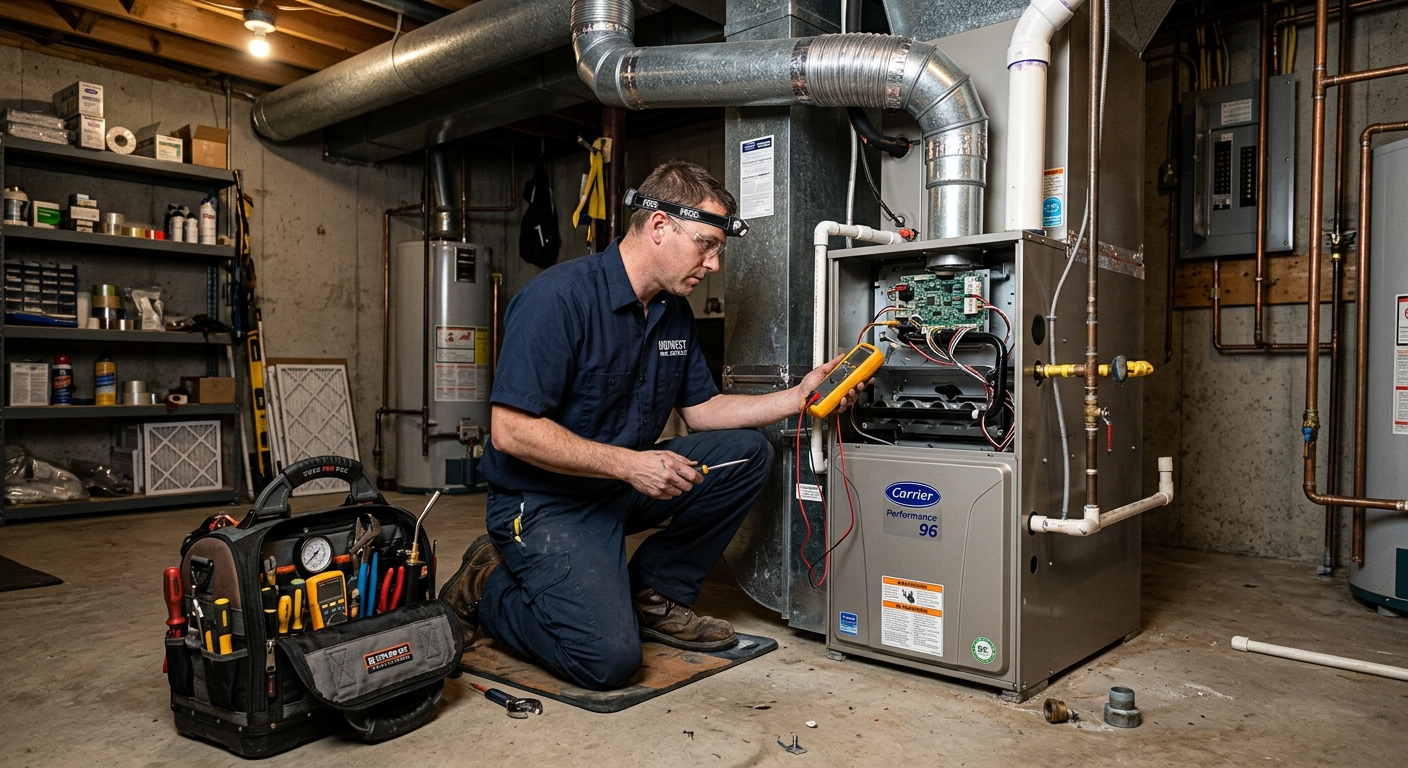
Upper Yoder heating and cooling prices by system type — 2026
Upper Yoder, with a homeownership rate of 74.5% and 77.2% of homes built before 1980 (U.S. Census Bureau, ACS 2024), exemplifies a retrofit-heavy HVAC market. Many houses, especially in Johnstown and similar areas, are small-frame pre-1950 builds where older ductwork may be shallow, leaky, or absent. The reality is that you’ll encounter everything from aging metal trunks to no ducts at all, with the era of construction directly influencing what can be reused or must be replaced.
The long heating season here—at 6,300 heating degree days and just 750 for cooling—makes north-central Pennsylvania a heating-driven market. This tilts decisions toward systems that prioritize reliable, efficient cold-weather performance over cooling ability. Central AC is still common for those few really hot weeks each summer, but for most homes, heating capacity and fuel source shape the entire project—especially where gas utility lines don’t reach and owners depend on propane or oil.
Here’s what you can expect to pay for typical HVAC installations in Upper Yoder:
| System |
Best for |
Efficiency |
Price range (installed) |
| Central AC replacement (existing ducts) |
homes with sound ductwork |
16–20 SEER2 |
$4,800–$11,500 |
| Air source heat pump (ducted) |
year-round heating and cooling |
8–10 HSPF2 |
$7,700–$16,500 |
| Cold-climate heat pump (ducted) |
heat pump as primary heat |
9–11 HSPF2 |
$12,500–$16,500 |
| Ductless mini-split (single zone) |
additions, rooms without ducts |
20–30 SEER2 |
$3,100–$6,700 |
| Full duct system installation |
homes with no existing ducts |
— |
$8,600–$17,500 |
Installed estimates for a typical Upper Yoder home. Equipment tonnage, duct condition, and electrical capacity move these more than brand.
Gas, electric or both in north-central Pennsylvania
In Upper Yoder and Cambria County, the heating decision is rarely just about price; it’s about reliable comfort during long, cold stretches. With a winter design temperature of 2°F and 6,300 heating degree days, any system will be judged first by how it heats in deep winter. Heat pumps—especially cold-climate models—do perform well below freezing, and the old objection that “heat pumps don’t work in cold areas” is exaggerated now. In reality, their output does decline as temperatures hit the single digits, making it essential to right-size the system and consider backup.
Your choice is set by fuel access. In central Johnstown, Richland, and Westmont Borough, broad natural gas means a traditional gas furnace is cost-effective and reliable—especially where homes have old chimneys or tiny returns that challenge new ducts. However, rural Cambria County relies heavily on propane or oil. For these households, pairing a heat pump with their current system often means lower bills and less hassle with fuel delivery, or else going fully electric.
A gas furnace remains the most sensible solution in homes with existing, working gas lines, especially if the envelope is leaky or heat pumps can’t cover peak loads. Everywhere else, and especially if you want to move away from fossil fuel, modern ducted heat pumps or dual fuel systems make sense.
| Option |
Installed cost |
Operating cost here |
Best when |
Incentive eligible |
| Gas furnace + central AC |
$4,800–$11,500 |
lowest with gas on site |
existing gas service, coldest zones |
partial |
| Ducted heat pump (cold climate) |
$7,700–$16,500 |
lower with tight envelope |
good envelope, all-electric goal |
yes |
| Dual fuel (heat pump + gas backup) |
$12,500–$16,500 |
intermediate |
gas on site, deep cold spells |
yes |
| Ductless multi-zone |
$8,600–$17,500 |
room-by-room savings |
no ductwork, zone control |
yes |
R-410A phase-down: repair or replace?
If your Upper Yoder AC or heat pump uses R-410A refrigerant, the new federal rules on climate-warming HFCs will affect your choices, but not in a dramatic, urgent way. The phase-down, now winding its way through the supply chain, means that new equipment is shipping with lower-impact refrigerants like R-454B or R-32. That matters mainly for replacement units; you do not have to swap out a working R-410A system.
R-410A can still be purchased and legally used for servicing existing equipment. What is changing is the price and future availability—a slow squeeze as fewer manufacturers make or import it. If your older system runs well and doesn’t lose charge, you maintain as always. But if you spring a leak, a repair that once was economic could push you toward replacement if the refrigerant cost balloons.
In short, you do not need to replace a healthy R-410A system or panic about these changes. But if you’re facing repeated leaks or a big repair bill late in the system’s life, it is rational to weigh whether to invest more or put that money toward a new system using refrigerant that will be widely available for decades. This is especially true for the 77.2% of older homes around Upper Yoder—many are already at replacement age.
Rebates and tax credits for Upper Yoder homeowners
In Upper Yoder, incentives take three forms: federal tax credits, local utility rebates, and state energy programs. Tax credits are a dollar-for-dollar reduction of tax owed on your next return—no immediate cash, but a cut in what you’ll pay to the IRS for energy-saving upgrades. In contrast, rebates (from electric or gas utilities) are discounts off your installer’s invoice or sent as a mailed check, making them more visible day one.
For electric customers, Penelec is your primary utility. Gas service comes through Peoples Natural Gas for much of Johnstown and surrounding boroughs. Both typically offer energy-efficiency incentives—often updated yearly—covering high-efficiency heat pumps, upgraded AC, and sometimes ductless units. Outlying areas relying on propane or oil will need to check for state programs or manufacturer-specific offers.
Amounts and requirements change every year—no article can promise eligibility or a firm dollar figure. Always confirm on your utility’s energy efficiency program webpage and by searching the ENERGY STAR rebate finder before signing a contract. This will show available rebates based on your ZIP code and utility, including both utility and federal options. If you file for a tax credit, plan for it to impact your tax bill, not your upfront cost, and save all documentation from your installer for tax season.
Maintenance that actually extends system life
For Upper Yoder homeowners, routine maintenance comes down to a few essentials—filter changes, coil cleaning, clear condensate drains, and verifying refrigerant charge. Replace filters every 1–3 months, using a MERV rating your blower can handle (too high restricts airflow, too low lets dust through). Keep both indoor and outdoor coils clean—clogged coils force the system to work harder, shortening its life.
Check the condensate line at the start of cooling season, especially in older basements where standing water can mean mold (always a concern in Cambria County’s damp winters). Importantly, if your system’s charge is off, don’t just “top up” each season. Losing refrigerant signals a leak—real maintenance means finding and fixing it or budgeting for replacement.
Annual service plans, often pushed hard by national brands, can be worth it if they guarantee priority scheduling and include the basics (filter, coil, and safety checks) at a fair price. Be wary if they cost more than a standalone tune-up or include “free refrigerant” for leaky equipment. Schedule maintenance in early spring or early fall—before the first hot or cold snap—so you get help before the technicians are swamped with emergencies.
Permits, licensing and inspections in Upper Yoder
Pennsylvania does not license HVAC contractors at the state level for residential work. Instead, Upper Yoder and the surrounding boroughs regulate residential HVAC installs locally through mechanical permits. Your contractor should be registered as a Home Improvement Contractor (HIC) with the Pennsylvania Office of Attorney General—this covers any contract over $500. You can search hic.attorneygeneral.gov for verification.
Regardless of permits or registration, anyone handling refrigerants must have federal EPA Section 608 certification—ask to see this for any cooling or heat pump work. Townships like Upper Yoder and Johnstown typically require a mechanical permit for new HVAC installations involving new equipment or ductwork. Minor repairs and service do not require permits in this area.
If your contractor has employees, state law says they must carry workers’ compensation insurance, verifiable through WCAIS at wcais.pa.gov. Protect yourself by requesting up-to-date insurance certificates (both liability and workers’ comp) before any project. Finally, installations must pass municipal inspection—don’t skip permits to save a fee; failure to close them can create problems when selling your home.
Ductwork: the part nobody quotes properly
Ductwork is easy to overlook—until you live with cold bedrooms or noisy, uneven airflow. In older Upper Yoder homes, many ducts were pieced in with whatever fit through floor joists or crawlspaces, sometimes before central air existed at all. Duct leakage in these houses can quietly waste 20–30% of your heating or cooling, no matter how efficient your new system is.
A duct blaster test, which pressurizes your duct system and measures leaks, is the proven way to know if you’re losing air into unconditioned spaces. Sometimes, resealing and insulating accessible ductwork is enough; in other cases—especially if you’ve only got furnace-era undersized returns or the main runs travel through unheated crawlspaces or attics—replacement is the only way to ensure comfort and efficiency.
Many Johnstown-area homes, especially those built before 1950, may never have had proper ducts for central cooling. If your existing ducts are noisy, dirty, or can’t keep up, don’t wait until after replacing your system to test them. Ductwork issues exaggerate every comfort and energy complaint. Always pressure-test and inspect before committing to new HVAC equipment—the cost of ignoring bad ductwork can eat up any savings from a top-tier furnace or heat pump.
Frequently asked questions — HVAC installation in Upper Yoder
Do older Upper Yoder homes need ductwork replaced?
Most older homes in Upper Yoder—especially those built before 1950—weren’t originally designed for modern forced-air systems, and many have makeshift or leaky ductwork. If rooms heat or cool unevenly, vents are noisy, or you notice dust and drafts, your ducts likely need sealing or even complete replacement. A duct blaster test performed before any new furnace or central AC install is the best way to find out how much air is going to unused crawlspaces or attics. Full duct system replacement in Upper Yoder runs from $8,600–$17,500, but sealing and insulation can sometimes deliver most of the benefit for much less if the existing ducts aren’t completely shot.
What does HSPF2 measure?
HSPF2 stands for “Heating Seasonal Performance Factor 2” and is the current federal standard measuring the heating efficiency of heat pumps—much like miles per gallon in a car, but for heating output per unit of power used over an entire season. In a heating-dominated area like north-central Pennsylvania, HSPF2 is more relevant than SEER2 (which tracks cooling). For Upper Yoder, look for cold-climate models with at least a 9–11 HSPF2, which can help keep operating costs competitive with gas in most winters. Higher HSPF2 values generally mean lower electric bills for the same amount of heat.
How often should I change my filter?
In Upper Yoder, with many older homes and lots of seasonal dust or pollen, changing your filter every 1–3 months is usually right. Go by how quickly your used filter looks dirty and what your HVAC manual recommends. If you have pets or family members with allergies, plan on changing more often. Using a filter with a MERV rating that your system supports is important—too high (like MERV 13 and above) can choke airflow in older blowers. Filter replacement is cheap insurance: keeping your system running efficiently and reducing future service calls, especially when replacement runs upwards of $7,700–$16,500 for a ducted heat pump in this area.
What does a ductless mini-split cost in Upper Yoder?
Installing a single-zone ductless mini-split in Upper Yoder typically costs $3,100–$6,700, depending on the placement, electrical upgrades, and the distance from the condenser to the indoor head. These systems work well for additions, finished basements, or any room that never heats or cools like the rest of the house. If your Upper Yoder home has no existing ductwork or you want to avoid major renovations, mini-splits are a solid option, and the typical system runs at the lower end of this price range for the simplest one-room setups.
How do I verify an HVAC contractor's insurance?
In Pennsylvania, HVAC contractors performing residential work must register as Home Improvement Contractors for jobs over $500, but you should never rely on registration alone. Always request the contractor’s current liability and workers’ compensation certificates (not just a number on the back of a business card), and verify workers’ comp coverage specifically through the WCAIS system (at wcais.pa.gov) for complete peace of mind. This protects you if a worker is injured on your property—and with major work like a full duct system replacement running $8,600–$17,500, it’s never worth cutting corners on insurance.
Do I need dual fuel in north-central Pennsylvania?
Dual fuel setups—pairing a heat pump with a gas or oil furnace—make sense in Upper Yoder for homes with existing gas or fossil fuel backup and a desire for versatile comfort. With local winter design temperatures of just 2°F, a heat pump alone may struggle in deep cold, leading to high electric bills or supplemental heat strips. Dual fuel lets you save money during mild weather but still get robust actual heat in single-digit conditions. Expect to pay $12,500–$16,500 for a typical install, which is higher up front, but can balance out in operating costs over several cold seasons.
What HVAC tax credits are available to Upper Yoder homeowners?
Homeowners in Upper Yoder can take advantage of federal tax credits for qualifying energy-efficient equipment. These credits directly reduce the federal tax you owe next year and typically cover a portion of the cost of a new high-efficiency heat pump, furnace, or AC. Be aware: this is not an instant rebate. Also, local utilities like Penelec or Peoples Natural Gas may offer additional rebates, which reduce your upfront invoice. Always check your utility’s energy efficiency website and the ENERGY STAR rebate finder for current eligibility, as program amounts and details change every year. For example, rebates on a cold-climate heat pump here may help bring costs in the $12,500–$16,500 range down by several hundred dollars.
When is the best time of year to replace HVAC in Upper Yoder?
The best times to schedule an HVAC replacement in Upper Yoder are early spring and early fall—March to early May or September to early November. Installers are less busy between the heating and cooling seasons, so you get more flexibility in scheduling and sometimes lower prices, especially before peak demand in single-digit cold or the short summer spike. You’ll also have more time to review quotes and get ductwork evaluated before committing to a system (which can range from $4,800–$16,500 depending on the type). Avoid waiting until your equipment fails in dead winter or the first sticky heat wave, when contractors are booked out for weeks.
How much does a new HVAC system cost in Upper Yoder?
A new HVAC system in Upper Yoder spans a wide price range, mostly set by system type, house size, and your ductwork’s condition. Replacing central AC with existing ducts typically costs $4,800–$11,500, while adding a ducted heat pump for year-round heating and cooling lands in the $7,700–$16,500 range. Ductless mini-splits cost less per zone but rise quickly for larger homes or multi-zone setups. Full new duct system installation—often required in Johnstown’s older pre-1950 homes—can add another $8,600–$17,500 to the total. Get multiple quotes and always check duct condition before signing any contract.