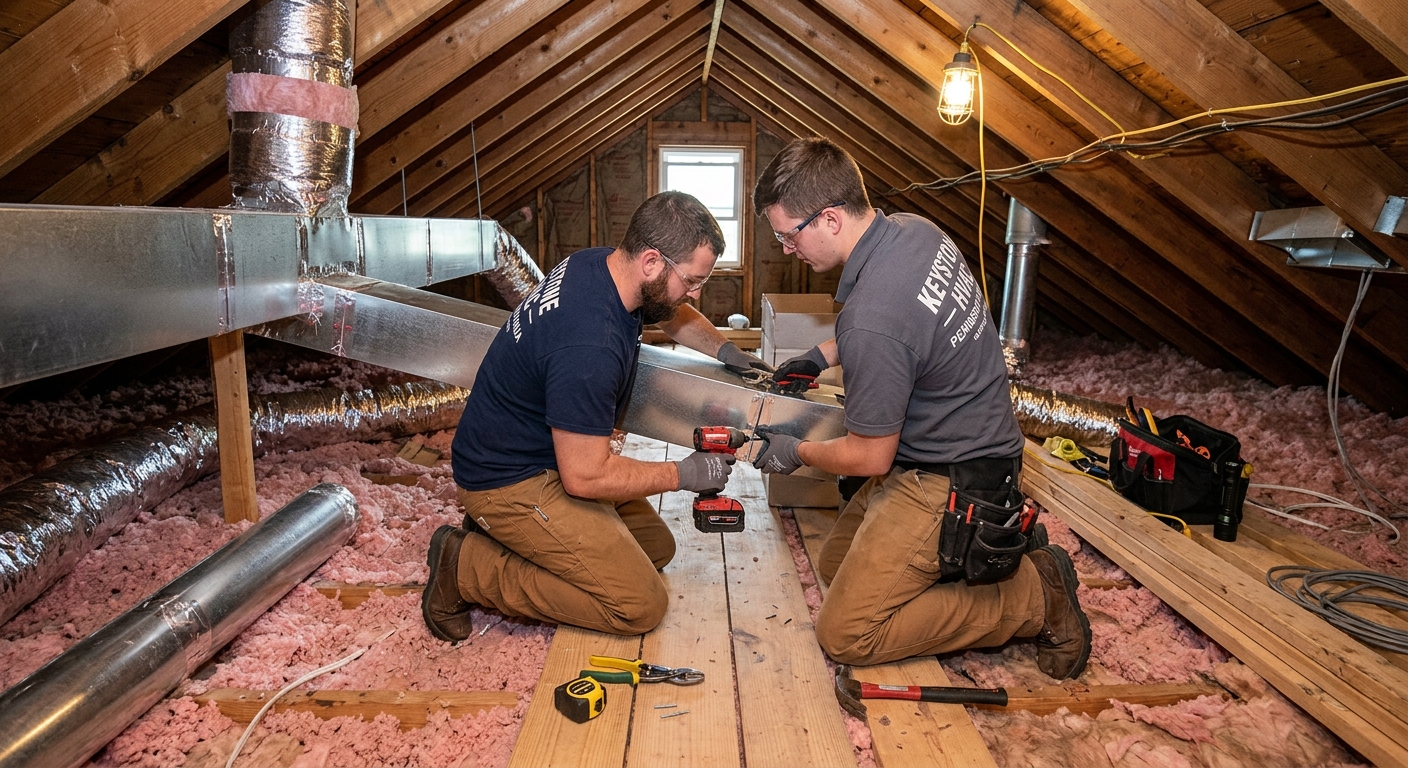
What a new HVAC system costs in West Hempfield
In West Hempfield, most homes are single-family and owner-occupied, with an 86.1% homeownership rate and 75.8% single-family homes (U.S. Census Bureau, ACS 2024). This means the market is mainly replacement, not new construction, but with 34.1% of homes built before 1980, you’ll see as many system retrofits as straight swaps—especially when ductwork is original or missing. Those mid-century and older homes often can't take a standard duct system, which is why Lancaster city’s housing stock leans heavily toward ductless and high-velocity retrofits. If your home has forced air, a central AC or a heat pump may be a straightforward job, but plenty here are on baseboard or radiator heat with no pre-existing ducts at all.
South-central Pennsylvania has 5,200 heating degree days and just 1,250 cooling degree days each year. That skews decisions: this is a heating-dominated market, which makes all-in-one heating solutions (like heat pumps, or pairing a gas furnace with AC) worth considering. Think of cooling as the amenity, heating as the essential. System prices vary with size, but ductwork condition is often the biggest variable besides equipment.
| System |
Best for |
Efficiency |
Price range (installed) |
| Central AC replacement (existing ducts) |
homes with sound ductwork |
16–20 SEER2 |
$5,300–$12,500 |
| Air source heat pump (ducted) |
year-round heating and cooling |
8–10 HSPF2 |
$8,400–$18,000 |
| Cold-climate heat pump (ducted) |
heat pump as primary heat |
9–11 HSPF2 |
$13,500–$18,000 |
| Ductless mini-split (single zone) |
additions, rooms without ducts |
20–30 SEER2 |
$3,400–$7,400 |
| Full duct system installation |
homes with no existing ducts |
— |
$9,500–$19,000 |
Installed estimates for a typical West Hempfield home. Equipment tonnage, duct condition and electrical capacity move these more than brand.
Permits, licensing and inspections in West Hempfield
Pennsylvania does not issue a statewide HVAC license. Instead, residential HVAC installation and replacement are regulated at the local level. In West Hempfield and the rest of Lancaster County, mechanical permits and inspections are typically handled by each township’s code office—and they follow the Pennsylvania Uniform Construction Code, which is based on the IRC. This means if you’re installing or replacing central HVAC equipment, you’ll probably need a permit and inspection, especially if ductwork or electrical systems are being altered. However, routine tasks like changing a filter or basic thermostat programming do not require a permit.
Contractors must be registered as a Home Improvement Contractor with the Pennsylvania Office of Attorney General if the job is over $500. You can verify this at hic.attorneygeneral.gov. For refrigerant work (which includes almost any AC or heat pump installation), federal EPA Section 608 certification is non-negotiable. Ask for proof—any reputable contractor should provide it.
Insurance matters. Pennsylvania mandates workers’ compensation coverage for all employers. You can verify compliance through the Workers’ Compensation Automation and Integration System (WCAIS) at wcais.pa.gov. If a contractor won’t show you both a valid HIC registration and proof of insurance, look elsewhere—these are basic consumer protections set out in state law.
Operating cost, not sticker price
Sticker price matters, but it’s the operating cost you’ll feel every month. In West Hempfield, heating degree days far outweigh cooling—5,200 vs. 1,250—so your heat pump or furnace will work much harder in January than your AC will in July. The local electric utility, PPL Electric Utilities, lists your actual rate per kilowatt-hour on its bill. That, plus your home’s insulation, windows, and tightness, determines your real costs.
Here’s the math: Efficiency ratings convert energy into delivered BTUs of heat or cooling. For a heat pump, HSPF2 tells you how much heat you get per kilowatt-hour. Multiply the heat loss (calculated with heating degree days and your home’s size/construction) by the thermostat setting to get annual demand in kWh. So, if your annual load is 20,000 kWh and your electric rate is $0.13 per kWh, your base heating cost is $2,600. For cooling, apply the SEER2 rating and your cooling load the same way—but in our climate, summer cooling costs are a fraction of winter heating.
Your own bill and prior energy use tell the truest story. Factor in whether your ducts are sealed and insulated—an efficient heat pump running on leaky, uninsulated ducts often performs no better than a mid-tier system. Duct leaks and attic losses are invisible but costly. Bottom line: A high-efficiency system on bad ducts can cost you more in the long run than a well-sized, mid-efficiency system on good ducts. Always compare expected performance and run your own numbers based on what you actually pay for power and fuel now.
What a real HVAC quote contains
A strong HVAC quote is detailed enough for you to compare it directly to others. It should list full model numbers for both indoor and outdoor units—not just a brand or series name—because paired equipment delivers its rated performance only as a set. Check for tonnage and whether the quote comes with a room-by-room load calculation, not just a match to your old system. Ductwork should be evaluated in place; a one-size-fits-all approach is a red flag. Tell your contractor you want to know if the line set is reused or replaced, as old lines can carry over contaminants. The quote needs to mention electrical work, including panel upgrades if required for a heat pump. Look for details on how condensate will be handled (pumps, drains), thermostat replacement, permit costs, and commissioning (which is startup testing—does someone measure airflow and refrigerant charge?).
Two warranties matter: the labor warranty (backed by the installer) and the manufacturer’s equipment warranty. Make sure labor isn’t buried as an “included” feature for less than a year. Permits should be included, not brushed aside. If you get a quote that only names a brand and a number, you can’t compare it to anything—you’re flying blind.
| Line item |
What to look for |
Red flag if… |
| Equipment |
model numbers, indoor and outdoor matched |
brand name only |
| Sizing |
load calculation attached |
matched to the old nameplate |
| Ductwork |
condition assessed, sealing scoped |
not mentioned |
| Electrical |
circuit and panel capacity confirmed |
assumed adequate |
| Line set |
replaced or documented as reused |
silent |
| Commissioning |
measured airflow and charge, documented |
no startup report |
| Warranty |
labour years stated separately |
manufacturer only |
| Permit |
included and priced |
'not needed' |
Service plans: worth it or not?
Not every “maintenance plan” saves you money. The essentials—changing filters, cleaning coils, ensuring the condensate drain is clear—can be owner tasks if you’re handy, or handled at a reasonable cost by a tech without an annual contract. Don’t let anyone sell you on filter changes more often than your real indoor air needs or blower design require; MERV 8 to 11 is plenty for most homes and won’t choke airflow like higher grades.
The true value in a plan comes from the inspection: verifying refrigerant charge (not just topping it off), testing system safety, and catching problems before they cause a shutdown. If a plan is mostly for discounts or routine cleaning with little actual testing, skip it. If it offers priority service during peak heating season, that can matter in a cold snap. Scheduled maintenance is best done in spring or early fall—before the first 90°F week or after the last freeze—so you’re not waiting in line behind emergency calls. Bottom line: pay for real checks, not just for a stamp on a card.
What size system does a West Hempfield home need?
Oversizing is one of the costliest mistakes in HVAC replacement. Many West Hempfield homes, especially those built before 1980, were built for comfort at the lowest first cost—which often meant heating only, maybe baseboard or gravity furnaces—not central air. Contractors relying on the square footage rule or “what you had before” frequently end up with systems that short-cycle: running too hard, shutting off, then repeating. This causes big temperature swings, higher utility bills, rapid wear, and lousy dehumidification.
Instead, you want a Manual J load calculation. This looks at the actual heat loss and gain of your house, room by room, using measurements, insulation levels, orientation, and window types. Simply copying the old unit’s size carries past errors right forward. Ask your contractor directly: “Did you run a load calculation, and can I see it?” If they can’t show it, you’re not getting a system sized for your real needs.
In this climate, with a winter design temperature of 12°F, your system must be sized for safe, effective heating even if we hit that cold snap. Going too big “just in case” doesn’t build in a margin of safety—it bakes in higher costs and lower comfort. Demand the calculation. It’s the $0 step that pays off every year your new system runs.
What construction era means for your system
In West Hempfield, about one in three homes predates 1980, which shapes replacement decisions. Older houses often lack central ducts, or have ductwork sized only for heating—not cooling airflows. That can make systems noisy and leave the farthest rooms uncomfortable in summer. High-velocity or ductless mini-splits offer better comfort without tearing up finished plaster or framing. Original insulation may be thin, attic air sealing weak, and window upgrades overdue, all of which boost heating and cooling loads.
Many suburban homes built since the late ‘80s or ‘90s are now into their first or even second HVAC replacement cycle. Builder-grade furnaces and air conditioners from that time are often hitting end of life—and they were sometimes oversized, especially if the builder used one-size-fits-all equipment for multiple floorplans. If you’re considering a switch to heat pump or other electric systems, check your electrical panel’s capacity first. For homes still on oil or propane, check the flue or chimney if you’re keeping combustion heat. The age and original design of the house dictate what’s possible—and what’s not worth pouring money into.
Frequently asked questions — HVAC installation in West Hempfield
Are duct sealing and insulation eligible for incentives?
Duct sealing and insulation can reduce heating and cooling costs for West Hempfield homeowners, especially in older homes where leaks and uninsulated runs are common. While some statewide and utility-based energy efficiency incentives have included duct sealing, eligibility changes year to year and depends on the utility and legislative funding. For example, PPL Electric Utilities has historically offered rebates for duct sealing as part of whole-house upgrades, but program terms change, and there is no permanent credit at the state level just for duct improvements. Even when no rebate is available, professionally sealing and insulating ducts—especially in unconditioned attics or basements—can boost comfort and keep the savings of a new $5,300–$12,500 central AC or a $8,400–$18,000 heat pump from leaking away. Always check current offerings before starting any work.
Do I need a permit to replace HVAC in West Hempfield?
In West Hempfield, mechanical permits are generally required for HVAC installation or replacement, especially for central systems or when ductwork and electrical upgrades are involved. This is in line with the Pennsylvania Uniform Construction Code, which is enforced by local townships in Lancaster County. The requirement is most strict for central AC, heat pump, or furnace replacements, where code inspection ensures safe installation and proper sizing. Exceptions are made for smaller maintenance tasks like thermostat changes or filter swaps, which don't require a permit. Any major work, such as replacing a system at a typical cost of $8,400–$18,000 for a ducted heat pump, should be permitted to keep you covered for insurance and warranty purposes. Make sure any quote you get includes the permit fee up front; if a contractor says “no permit needed,” that’s a reason to press pause.
What MERV filter rating should I use?
For most West Hempfield homes, a filter with a MERV rating of 8 to 11 strikes the right balance between effective filtration and system airflow. Higher-MERV filters, such as MERV 13, can capture finer particles but also restrict airflow if your system’s blower wasn’t designed for them, which is common in homes built before 1980. Reduced airflow strains the system, hurts efficiency, and can even cause coil freeze-ups. Unless someone in your home has specific respiratory sensitivities or allergies, stick with a MERV 8–11 filter. Install it on the recommended schedule—usually every season—rather than spending on higher grades or more frequent replacement. This simple step supports your system whether you’ve invested $5,300–$12,500 in a new AC or $3 at the hardware store for a filter. If you’re unsure, ask your contractor what MERV your blower will handle without sacrificing efficiency or comfort.
Why does my system short cycle?
In West Hempfield, short cycling—when your HVAC turns on and off rapidly—usually points to improper system sizing, especially in homes with older ductwork or units replaced without a load calculation. Oversized equipment reaches the set temperature too quickly, shuts down before humidity is removed, and then restarts minutes later, repeating the cycle. This wears out components and leads to uneven temperatures throughout the house, often felt most in homes built before 1980. Sometimes a control or safety issue is to blame (like a tripped limit or thermostat fault), but in most cases, it’s a system that was replaced “like for like” without checking the real heat load. If you’re getting quotes for a new system at $8,400–$18,000, demand a clear load calculation to prevent this problem in your next installation. Don’t accept “that’s what was there before” as an answer.
Why do HVAC quotes in West Hempfield vary so much?
Price variation in HVAC quotes, whether for a $3,400 ductless mini-split or a $19,000 full duct system, is all about scope and honesty. Some quotes only list a brand and a price—leaving out critical items like load calculation, duct sealing, electrical upgrades, or permits—which makes apples-to-apples comparison impossible. Local contractors may also differ in warranty terms and whether they include commissioning (system startup verification) and post-installation support. Older homes in West Hempfield, especially pre-1980 stock, sometimes need significant duct or electrical work—some bids will bury these costs, while others list them up front. Make sure every quote includes equipment model numbers, a load calculation, and written warranties. A thorough bidder might seem higher at first, but skipping steps only costs more in callbacks or higher operating bills.
Is natural gas available throughout Lancaster County?
Natural gas is readily available in West Hempfield and most of the larger townships in Lancaster County, thanks to main utility infrastructure. Homes in Lancaster city, Manheim Township, and East Hempfield can often connect to natural gas through UGI Utilities, making it a common choice for furnaces or hybrid systems. However, residents in more rural western or eastern townships—further from the core—sometimes have to rely on propane or fuel oil because the gas mains don’t reach every road. If you’re comparing installation costs (a furnace swap at $5,300–$12,500 versus a new heat pump), your available fuel source may tip the decision. Always check your street’s eligibility before assuming you can get gas service.
How much does a new HVAC system cost in West Hempfield?
A new HVAC system in West Hempfield runs more than just equipment—it covers design, installation, and often updates to electrical or ductwork. For a straight central AC replacement with existing ducts, expect $5,300–$12,500 installed. If you’re moving to a ducted heat pump for year-round comfort, the price is typically in the $8,400–$18,000 range. If your home has no existing ductwork, a full installation can reach $9,500–$19,000. Ductless mini-splits for single zones or additions come in at $3,400–$7,400. Costs adjust for size, complexity, and any upgrades to support insulation, electric service, or zoning. Quotes outside these bands in West Hempfield are either skipping critical steps or selling you more system than you need.
When is the best time of year to replace HVAC in West Hempfield?
In West Hempfield, scheduling HVAC installation between the spring thaw and the first hot spell—or in the lull after summer but before the real cold—gives you the most flexibility and often a better price. Local contractors are busiest during the first true heat wave and the initial cold snap, when emergency replacements stack up and labor gets tight. Aim for mid-spring or early fall appointments, ideally after any last-minute AC tune-ups are out of the way but before year-end heating emergencies. This timing also means your installer can actually focus on details like commissioning and answering your questions, rather than just getting systems up and running. If you want your new $8,400–$18,000 heat pump installed smoothly, plan ahead and beat the seasonal rush.
Is a heat pump a good choice for West Hempfield winters?
With a winter design temperature of 12°F and 5,200 heating degree days, West Hempfield pushes heat pumps much harder than milder regions. Modern cold-climate heat pumps, however, have improved enough that they handle these conditions effectively, especially newer models rated at 9–11 HSPF2. If your home is well-insulated and has decent ductwork, a cold-climate ducted heat pump installation—though pricier at $13,500–$18,000 installed—can keep you comfortable through most winters without backup. For drafty or older homes, consider a hybrid system or supplemental resistance heat. Always insist on a heat load calculation so you know your system can heat your house, not just cool it. The right system can keep your bills predictable, even when the temperature dives.