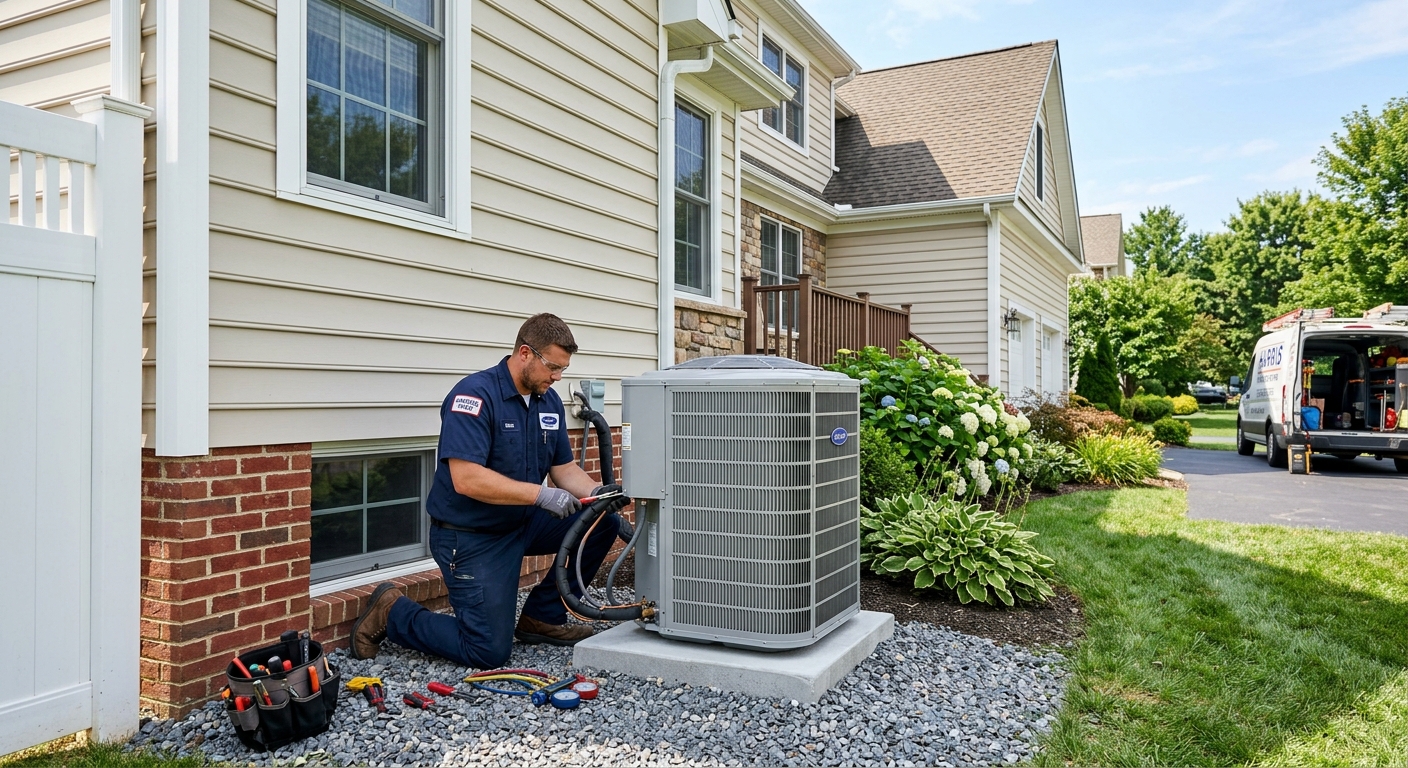
York heating and cooling prices by system type — 2026
In York, heating and cooling costs reflect both the local housing mix and our distinct Pennsylvania climate. Fewer than half of York’s households own their homes (43.5%), and just 21.8% are single-family houses (U.S. Census Bureau, ACS 2024). This means a large share of the area’s HVAC work is system replacement rather than first-time installs, often in older houses and rowhomes that weren’t built with air conditioning in mind. York City's large stock of pre‑1940 rowhomes drives frequent ductless and high-velocity retrofits for modern cooling, since retrofitting full-size ductwork is disruptive and often impractical. Many postwar township homes, particularly in East York, have basic ducted systems from initial construction, a sign that central AC replacement is typical there.
South-central PA is a heating-dominated climate, with around 5,200 heating degree days and only 1,250 cooling degree days. That shapes system recommendations: heating efficiency, frost protection, and reliable cold-weather performance matter more than blazing-hot summer capacity. Air source heat pumps now match or beat the old standard gas furnace-plus-AC in year-round comfort when properly sized. Central air or heat pumps only make sense if your ductwork is intact; otherwise, ductless mini-splits see frequent use for specific rooms or in homes with hot water heat.
| System |
Best for |
Efficiency |
Price range (installed) |
| Central AC replacement (existing ducts) |
homes with sound ductwork |
16–20 SEER2 |
$4,800–$11,500 |
| Air source heat pump (ducted) |
year-round heating and cooling |
8–10 HSPF2 |
$7,700–$16,500 |
| Cold-climate heat pump (ducted) |
heat pump as primary heat |
9–11 HSPF2 |
$12,500–$16,500 |
| Ductless mini-split (single zone) |
additions, rooms without ducts |
20–30 SEER2 |
$3,100–$6,700 |
| Full duct system installation |
homes with no existing ducts |
— |
$8,600–$17,000 |
Installed estimates for a typical York home. Equipment tonnage, duct condition and electrical capacity move these more than brand.
Retrofit versus replacement in York
In York, HVAC projects almost always mean replacement or significant retrofit work, not first-time installs. That’s because 88.6% of homes here were built before 1980 (U.S. Census Bureau, ACS 2024). Many York City rowhomes and older township houses never had ductwork built for central air—the original purpose was coal, oil, or gas heat with radiators or undersized duct furnaces. It’s common to find duct runs too small for modern cooling, return air grilles choked by old filter setups, and almost zero insulation by today’s standards. Window quality tends to be poor, especially in homes not yet renovated, which affects heating load more than folks realize.
Even in postwar subdivisions, especially in East York and surrounding townships, the first central air or forced-air furnaces were often sized according to 1960s–1980s heating-only needs—not for cooling, and seldom with today’s tighter construction or improved windows. Many of these suburban houses have electrical panels maxed out by kitchen appliance upgrades or older AC condensers, so converting to a heat pump may require a panel upgrade.
For any gas equipment, chimney or flue condition matters far more than most people think—older masonry liners may be unsafe or incompatible with today’s high-efficiency furnaces. The end result? In York, even a “routine” system replacement demands upfront investigation into ducts, insulation, windows, and available electrical and flue capacity before any contractor can honestly recommend what to install or quote a fair price.
The comfort problem that isn't temperature
South-central Pennsylvania isn’t just cold in the winter and muggy for a few weeks each summer—our most persistent comfort problem in York homes is severe dryness from heating, paired with summer humidity that never fully leaves stone basements and older brick buildings. The combination of 5,200 heating degree days and our freeze-thaw cycles drives the winter issue: forced-air heat dries the home, so people consider whole-house humidifiers. These do help, but only if properly maintained—standing water in a neglected unit becomes a hazard, not a benefit.
The opposite is true in July and August. An oversized air conditioner—common in undersized, leaky duct systems or old conversions—cools the air before removing enough moisture, leaving rooms clammy. Sizing matters more than “features,” and so does blower speed: a too-powerful fan can make humidity worse. High-MERV filters are sometimes upsold, but in old York duct systems, a higher filter rating can choke airflow and damage the blower. Where newer homes are tightly sealed, mechanical ventilation is a code requirement, but most older houses are drafty enough to make add-on ventilators unnecessary unless you’ve air-sealed or fully insulated as part of a bigger upgrade.
Skip expensive air cleaning devices, “UV lamps,” or micro-particle air filters unless you have a specific air quality health concern and have already addressed leaks, duct issues, and humidity levels. Focus on basic filtration, maintaining humidity between 30–50%, and right-sizing equipment to the structure—it works better and lasts longer.
Permits, licensing and inspections in York
Pennsylvania does not issue a statewide HVAC license for residential work. Instead, York area contractors must hold a Home Improvement Contractor (HIC) registration from the Pennsylvania Office of Attorney General for any job over $500. You can verify this at hic.attorneygeneral.gov. Every technician handling refrigerant must also hold an EPA Section 608 certification—this is federal and applies nationwide. Mechanical permits are enforced locally. In the City of York, installing or replacing central systems nearly always requires a mechanical permit from the Bureau of Permits, Planning and Zoning. In townships, requirements are similar for major equipment but often waived for thermostat swaps or window units, as those are not considered permanent systems.
While Pennsylvania’s Uniform Construction Code (UCC) governs installation standards (based on the IRC), each York County municipality enforces code through its own office. That’s why you’ll see differences in permit paperwork and inspection timing between York, Springettsbury, and outlying townships. Insurance and active workers’ compensation coverage are mandatory for any contractor with employees. You can check workers’ comp status using the state’s WCAIS system (wcais.pa.gov). Do not accept a quote without a written contract if the value is over $500—a legal requirement under the Home Improvement Consumer Protection Act, which also gives you a 3-day right of cancellation. For pre-1978 homes, ensure your contractor can meet the EPA Lead RRP Rule if any paint could be disturbed during the project.
Why your ducts may be the real problem in York
In York, especially in pre-1980 and prewar housing, the “central air” comfort problem almost always starts with ductwork, not the equipment itself. Duct leakage is rampant, and in older homes, as much as 20–30% of heated or cooled air never reaches its intended room. The culprit is often decades-old duct seams that were never sealed, poorly sized returns, or even missing duct runs in multi-story rowhomes. A duct blaster test quantifies leakage by pressurizing the ducts and measuring how much air escapes—an objective way to know if your system is worth upgrading or if the real fix is behind the walls and floors.
Sealing can work, but in homes with original 1940s–1970s ductwork, the runs are often undersized for air conditioning. Some York homes have only a single trunk with too few returns, leading to “one hot room” problems that new equipment alone won’t solve. Runs through unconditioned attics or crawlspaces lose massive amounts of energy all winter and summer, wasting every dollar spent on efficient furnaces or heat pumps. In York City’s pre‑1940 rowhomes, where ductless or high-velocity systems are often the only feasible solution, skipping a duct test is a waste of money.
Your money is best spent on a duct leakage test, then targeted sealing or upgrades, before you ever replace a furnace or AC. Swapping in high-efficiency equipment without fixing ducts just amplifies old problems. Test first—any reputable York contractor should know this and offer it up front.
Separating installers from equipment sellers
In York County, where HVAC contractor competition is high, the real difference isn’t in equipment brands—it’s how carefully your system is specified and installed. The same model heat pump installed two ways by two different crews will deliver completely different comfort and energy savings. Installation quality has a bigger effect on lifespan and reliability than any feature sheet or warranty offer.
For homeowners, this means checking credentials carefully. York area contractors must be registered as Home Improvement Contractors (HIC)—verify at hic.attorneygeneral.gov. Workers handling refrigerant must have an EPA Section 608 card. Don’t hesitate to ask for a copy. Ensure your quote includes a full load calculation (not just a size matched to your old unit), and that both indoor and outdoor equipment model numbers are named. Ask if commissioning—measuring airflow, confirming refrigerant charge, and documenting performance at startup—is included.
- HIC registration verified for jobs over $500
- EPA 608 certification for refrigerant work
- Active workers’ comp, check via WCAIS
- References from jobs in York or your township
- Load calculation provided (Manual J or equivalent)
- Clear model numbers for both indoor and outdoor units
- Electrical work scoped if heat pump or larger AC
- Ductwork condition and sizing assessed
- Commissioning with documented airflow and charge
- Written contract (required by PA HICPA)
- Permitting included in the quote
- Labour warranty period stated separately from equipment
Red flags in York are “lowest bid” offers with no site visit, vague scope, and no worker insurance. With York’s dense HVAC market, if an installer can’t supply at least a handful of local references and paperwork, keep looking.
Reading an installation proposal
In York, comparing HVAC proposals means digging past headline prices. A meaningful quote should name exact model numbers for both the indoor and outdoor units—a mismatched set won’t achieve rated SEER2 or HSPF2, so those efficiency numbers are meaningless without a matched pair. Make sure the quote includes sizing with a load calculation attached. Ductwork: has it been inspected for leaks or undersized returns? If you’re switching to a heat pump, is a panel upgrade scoped and priced? The line set (refrigerant piping): will it be replaced or reused with documentation?
Every quote should mention electrical work, condensate drainage, thermostat, permit fees, and commissioning—a written report of airflow and refrigerant charge measurements is standard. The labor warranty should be separate from the equipment warranty; the difference is who you'll call (and who pays) down the road. If all you see is “3-ton AC, $X,” comparison shopping is impossible. Insist on detail—if it isn’t documented, it’s not included.
| Line item |
What to look for |
Red flag if… |
| Equipment |
model numbers, indoor and outdoor matched |
brand name only |
| Sizing |
load calculation attached |
matched to the old nameplate |
| Ductwork |
condition assessed, sealing scoped |
not mentioned |
| Electrical |
circuit and panel capacity confirmed |
assumed adequate |
| Line set |
replaced or documented as reused |
silent |
| Commissioning |
measured airflow and charge, documented |
no startup report |
| Warranty |
labour years stated separately |
manufacturer only |
| Permit |
included and priced |
'not needed' |
Frequently asked questions — HVAC installation in York
Is a high-efficiency system worth the extra cost here?
In York, investing in a high-efficiency heat pump or air conditioner can pay back, but only in the right situation. Our region's 5,200 heating degree days mean heating costs dominate, so a high-efficiency (cold-climate) heat pump—at $12,500–$16,500 installed—can cut electric or fuel bills more than a basic system. That said, if your ductwork is leaky or your house is poorly insulated (common in pre-1980 York homes), those efficiency gains will be wasted. High efficiency should only follow a duct and insulation check. Also, natural gas is common in much of York, and if you already have high-efficiency gas heat, the step up to a premium heat pump won't save much. For most, “mid-tier” is the sweet spot; avoid overpaying for top-end unless your house or bills justify it.
How is a tax credit different from a rebate?
In Pennsylvania, including York, a tax credit reduces the taxes you owe at filing time—it's not cash in your pocket at install. For example, if you install a new ducted air source heat pump at $7,700–$16,500, a federal tax credit applies on your next return. A rebate, by contrast, is a lump sum or discount given back by the utility or manufacturer, usually within weeks of install. Tax credits sometimes require strict documentation, and you must owe enough tax to claim the full value. Rebates are first-come, first-served and can run out. Both can apply, but they're handled separately—a detail worth confirming with your York contractor so you set your budget and timing expectations.
Can I service my R-410A system after the refrigerant change?
Yes, R-410A equipment can still be serviced in York and across Pennsylvania, even as new systems slowly move to new refrigerants. The federal phase-down affects what can be manufactured or imported, not ongoing usage or repair. Parts and refrigerant for R-410A systems remain available, and local contractors must still hold EPA Section 608 certification to handle it. If your heat pump or AC was installed in the last 10–15 years and needs a repair, you won’t be forced to upgrade or switch refrigerants. If you’re replacing a system, today’s ducted AC or heat pump will arrive with an approved refrigerant, and you’ll pay in the $4,800–$16,500 range depending on type.
How much does a new HVAC system cost in York?
The cost in York depends mostly on whether you have working ducts or need a retrofit. A central AC replacement runs $4,800–$11,500 installed if you have good ducts already. If you need a fully ducted heat pump system for both heating and cooling, expect $7,700–$16,500. For houses without any ducts—especially York City rowhomes—a ductless mini-split for one zone (like a living room or attic) costs $3,100–$6,700, while a full-duct install jumps to $8,600–$17,000. Always get a written quote from a registered contractor, as old ductwork or electrical issues can price jobs higher than rough averages suggest.
Is natural gas available throughout York County?
Natural gas is common in the City of York, Springettsbury Township, and West Manchester Township, served by Columbia Gas of Pennsylvania. However, in the outlying rural portions of York County, propane and fuel oil are still prevalent, since gas mains don’t reach every development or farmstead. If you’re replacing your HVAC and want a gas furnace—typically in the $4,800–$11,500 band for AC and furnace combined—verify service with the local utility before planning. In newer subdivisions, gas is likely, but in older or more rural areas, heat pump or oil-to-electric conversions are the norm.
What is commissioning and why does it matter?
Commissioning in York HVAC work means the installer measures and documents that your new system is operating as designed. This includes checking airflow (CFM), refrigerant charge, static pressure, and temperature split, producing a startup report at installation. It’s more than a “switch-on”—it proves your system will actually achieve its SEER2 or HSPF2 rating, which is only true if the indoor and outdoor units are matched and the ductwork supports proper flow. In York’s dense housing market, commissioning separates a quality install from a box-drop replacement. With ducted systems running $4,800–$16,500, commissioning should be expected, not optional. Ask to see the commissioning report before final payment.
How long should an HVAC system last in York?
In our climate, you should expect 15–20 years from a central air conditioner or heat pump (mid-range systems between $4,800–$16,500). However, in York’s older homes with leaky or uninsulated ducts, damp basements, or tight closet installs, lifespan can be shorter due to moisture, dust, and poor airflow. Regular maintenance—especially filter changes, coil cleaning, and annual service—matters more than the “brand” for longevity. Ductless mini-splits usually last at least 12–15 years. Significant duct leaks, oversized equipment, or missed annual service will mean earlier failure, regardless of what any sales sheet promises.
Should I repair or replace my HVAC system in York?
If your system is under 12 years old and hasn’t failed repeatedly, repair may be worthwhile—especially if the price is well under 30% of replacement, which for central AC is $4,800–$11,500. For older systems, especially pre-2010 equipment or units using obsolete refrigerants, replacement makes more sense. In York’s older homes, if you’re having chronic comfort or humidity problems, or if your energy bills keep rising, a replacement gives you an opportunity to fix underlying duct, insulation, or sizing problems. Always weigh repair versus replacement with a registered, insured, local contractor—and avoid costly repairs on ancient equipment that’s one breakdown away from replacement anyway.
Do I need a permit to replace HVAC in York?
In the City of York and most townships, installing or replacing any central HVAC equipment—like a furnace, heat pump, or full AC—requires a mechanical permit. Only very minor work, like swapping portable window units or changing a thermostat, is usually permit-exempt. Permit fees and required inspections keep work up to code and safe for resale; they’re not a formality. Be wary if a contractor says a permit isn’t needed for work in the $3,100–$17,000 range. Always ask your contractor to include permit costs in the quote and supply copies of approved paperwork on completion.