HVAC costs in Bradford — 2026
Bradford’s HVAC decisions start with its houses: more than nine in ten homes here were built before 1980, and most residents own single-family homes (U.S. Census Bureau, ACS 2024). That means this is a town of retrofits and replacements, not blank-slate new builds. With so much pre-1940 housing in Bradford and Kane, the ductwork you have is often pieced together in stages, or sized for an old furnace and rarely sealed—the odds are good it needs work before upgrades.
This part of north-central Pennsylvania is a true heating market. Bradford faces around 6,300 heating degree days per year and just 750 cooling degree days, making reliable winter performance more important than absolute summer efficiency. If you plan to upgrade, focus on heat output and cold-weather resilience first—the highest-performing AC won’t make up for an underpowered or poorly distributed heating system.
Below are realistic installed prices for major system types in this market:
| System |
Best for |
Efficiency |
Price range (installed) |
| Central AC replacement (existing ducts) |
homes with sound ductwork |
16–20 SEER2 |
$4,400–$10,500 |
| Air source heat pump (ducted) |
year-round heating and cooling |
8–10 HSPF2 |
$7,100–$15,000 |
| Cold-climate heat pump (ducted) |
heat pump as primary heat |
9–11 HSPF2 |
$11,500–$15,000 |
| Ductless mini-split (single zone) |
additions, rooms without ducts |
20–30 SEER2 |
$2,800–$6,200 |
| Full duct system installation |
homes with no existing ducts |
— |
$8,000–$16,000 |
Installed estimates for a typical Bradford home. Equipment tonnage, duct condition and electrical capacity move these more than brand.
Ductwork: the part nobody quotes properly
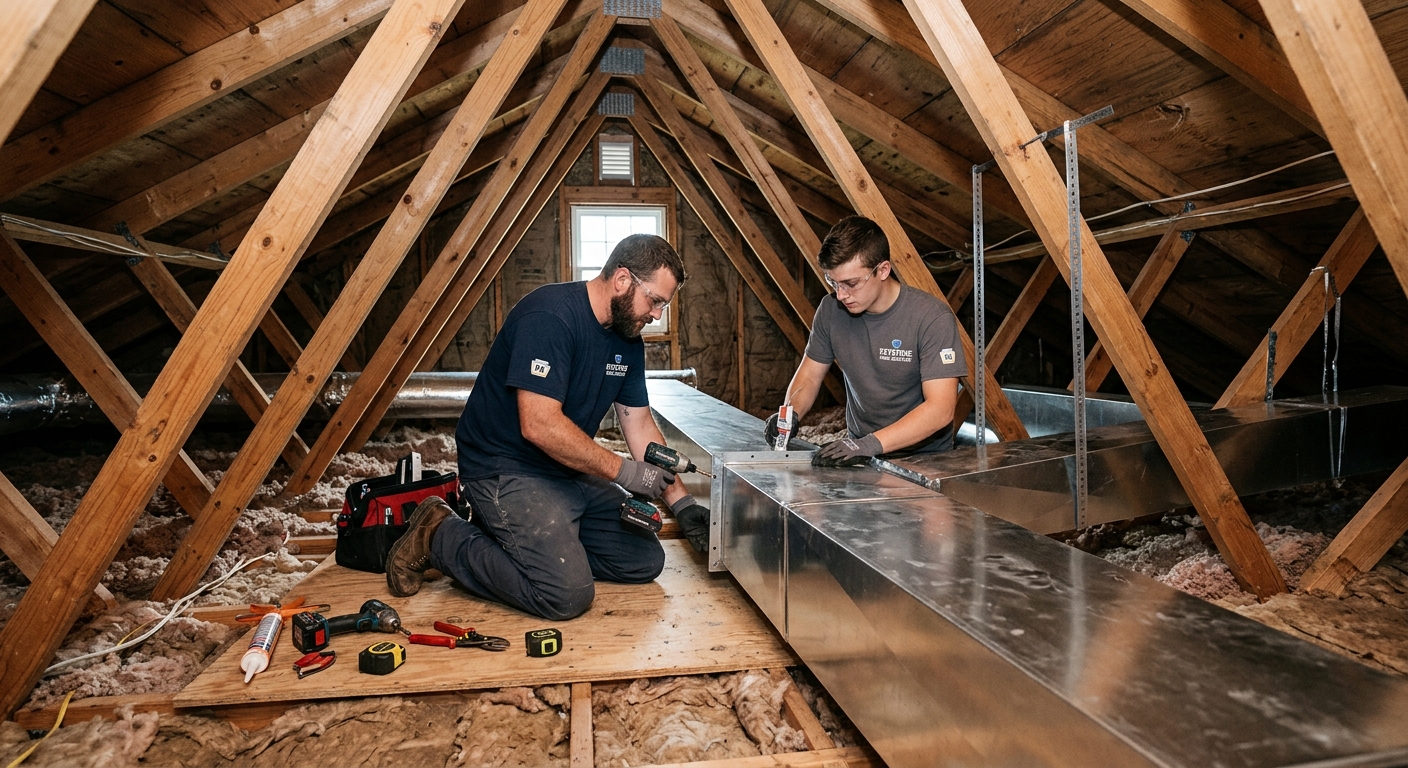
For Bradford and Kane’s many pre-1940 homes, ductwork is often a guessing game—sometimes retrofitted room by room, other times stretched and patched to fit a forced-air system that came later. Duct leakage is a common silent problem, with older, leaky metal runs losing 20% or more of your heated or cooled air to attics, basements, or crawlspaces. Sealing and testing—rather than guessing—can save more money than upgrading to high-end equipment.
The gold standard is a duct blaster test. This uses a calibrated fan to pressurize your duct system and measures how much air escapes. That number tells you how much energy is being wasted and where repairs matter most. In homes that started with gravity furnaces or where ducts were an afterthought, undersized supply and especially return ducts are common. It’s such a chronic problem in older Bradford houses that half the “it never heats right” calls end up being duct sizing or leakage—not the equipment at all.
Runs through unconditioned attics or crawlspaces lose even more heat when outside lows sit near 2 °F. In many retrofits, replacing or re-insulating these runs makes more sense than swapping a furnace or heat pump alone.
If you’re about to replace HVAC equipment, always test the ducts first. Fixing a leaky or out-of-balance system lets new gear actually deliver the comfort and efficiency it’s rated for. Ductwork is not an afterthought here—it’s often the problem you don’t see on the quote but pay for anyway.
Rebates and tax credits for Bradford homeowners
Bradford homeowners looking for HVAC incentives need to think in three layers: federal tax credits, local utility rebates, and state-backed programs. The federal tax credit—often discussed for heat pumps and high-efficiency air conditioners—reduces your tax bill for the following year, not your upfront cost. In contrast, a utility rebate cuts the invoice amount soon after installation, meaning you see savings right away.
National Fuel Gas serves most incorporated areas if you’re on natural gas, but many rural McKean County homes use propane or fuel oil—so check which utility applies to your location. Your first stop for actual incentives should be your electric (and, if applicable, gas) utility’s efficiency program web page. Because rebate program names and eligibility change every year, the only reliable way to see what’s on offer is to look directly up current programs. The ENERGY STAR rebate finder also tracks these by ZIP code for this area.
Don’t trust an article’s incentive dollar figure as a promise in Bradford—last year’s program may evaporate or change without warning. Treat what you read as a guide, not a guarantee. For anything significant, confirm with your utility and get details in writing before you sign a contract or commit to a system. That way, you know what really applies to your project, not just what was true last season.
Choosing an installer in McKean County
In McKean County, the quality of the installation matters far more than whose name is on the equipment. Identical systems can deliver very different comfort, efficiency, and lifespan based entirely on the skill and care of the installer. The rural market here means contractors often travel from larger cities, so detailed vetting is essential.
Always verify the installer’s Home Improvement Contractor (HIC) registration through the Pennsylvania Office of Attorney General. For refrigerant work, the technician—not just the company—must have a valid EPA Section 608 certification. Ask who will actually be on site. Your quote should spell out the exact make and model numbers—not just “3-ton unit”—and include a proper load calculation to size your new system. Commissioning matters: you want airflow, static pressure, and refrigerant charge measured at startup and documented for your records.
- Check HIC registration at hic.attorneygeneral.gov
- Confirm EPA 608 certification for on-site technician
- Request written contract if job is over $500 (state law)
- Make sure load calculations (Manual J) are included
- Ask for equipment brand and model, not just tonnage
- Get a detailed scope for ductwork, sealing, or changes
- Insist on startup measurements and commissioning report
- Verify workers' compensation on WCAIS (wcais.pa.gov)
- Ask for physical address and references from recent, nearby jobs
- Read through the three-day right of cancellation (required)
- Get warranty terms and registration information in writing
- Demand clear accountability—know which company is responsible if you have an issue
Red flag: In this thin market, if a contractor can start tomorrow or avoids paperwork requirements, be wary. It’s worth waiting for a job done right—rushed installs undercut long-term comfort and reliability in McKean County’s long winters.
Mechanical permits for HVAC work in Bradford
Pennsylvania does not license HVAC contractors statewide—there is no state-issued HVAC license for residential installs. Instead, residential HVAC work is regulated by local municipalities. In Bradford, mechanical and building permits are issued and enforced by the City of Bradford Office of Code Enforcement. The Pennsylvania Uniform Construction Code (UCC), which relies on the IRC, is the controlling code for residential work here.
Regardless of licensing, anyone handling refrigerant must be EPA Section 608 certified—this is a federal requirement, not affected by state or local jurisdiction. Installation of a furnace, AC, or heat pump in Bradford requires a local permit and usually inspection, both for the equipment itself and for electrical and gas supply as needed.
Insurance and workers’ compensation coverage are essential—and legally required if the contractor has employees. You can check for workers’ comp coverage using Pennsylvania’s WCAIS system (wcais.pa.gov). For any job over $500, state law mandates a written contract for your protection and requires a three-day right to cancel. Always verify these steps before work begins; reliable contractors here expect to walk through every permit and paperwork detail up front.
R-410A phase-down: repair or replace?
Under new refrigerant rules, manufacturers are now building residential systems for R-454B and R-32—lower-emission refrigerants—while R-410A is being phased down. What does this mean if your Bradford home has an R-410A air conditioner or heat pump? Service and repair are absolutely still legal, and the equipment is not obsolete or illegal just because the refrigerant is older.
You may notice, however, that the price of R-410A will rise as the supply tightens over the next several years. If your R-410A system is in good condition and leak-free, there is no need to consider replacement just to “future-proof”—a sound system may still have years of life left, and parts will remain available for quite some time. The only case where this changes is if you need a recharge due to a refrigerant leak. Here, the rising cost of R-410A can tilt the math toward replacement—especially on older, less efficient systems or when repairs run into the thousands.
In short: you do not need to replace a working R-410A system in Bradford, but for major leaks or failures, factor in refrigerant cost as a real part of the repair-versus-replacement decision. Otherwise, annual maintenance and prompt attention to performance issues will keep your older system running as long as possible.
Heat pump or furnace: what makes sense in Bradford
The core choice in Bradford is about winter: this region logs 6,300 heating degree days per year, with a winter design temperature of just 2 °F. Modern cold-climate heat pumps do operate well below freezing and deliver reliable heating for much of the season, but their output does drop as the thermometer falls. That’s the reason many homes—especially in towns like Bradford where the winter cold is extreme—pair a heat pump with a gas backup, or stick with a furnace alone where gas is available and affordable.
In central Bradford and Kane, natural gas is available, served by National Fuel Gas, making a gas furnace+AC combination practical and affordable for many. However, McKean County’s rural areas don’t have this option—in those townships, propane or fuel oil is the norm, and those fuels are often more expensive per BTU than electricity. Here, a heat pump may save you money over time (especially if you have a good building envelope), and the higher installation cost ($7,100–$15,000 for a ducted system) may be offset by lower operating costs.
If your existing furnace is old but your central AC is newer, or vice versa, you can replace just one piece—but in homes where the ductwork and controls are compatible, replacing both at once often qualifies for higher incentives and can deliver better overall comfort. Gas furnaces still make sense where gas is already on site, undersized ductwork or power supply limits heat pump options, or when backup heat is essential for critical loads in deep cold spells.
| Option |
Installed cost |
Operating cost here |
Best when |
Incentive eligible |
| Gas furnace + central AC |
$4,400–$10,500 |
lowest if gas available |
existing gas service, coldest zones |
often |
| Ducted heat pump (cold climate) |
$7,100–$15,000 |
lower than propane/oil |
good envelope, all-electric goal |
yes |
| Dual fuel (heat pump + gas backup) |
$11,500–$15,000 |
optimized by temp |
gas on site, deep cold spells |
yes |
| Ductless multi-zone |
$8,000–$16,000 |
lowest if no ducts, zoned |
no ductwork, zone control |
yes |
Frequently asked questions — HVAC installation in Bradford
Is a high-efficiency system worth the extra cost here?
In Bradford, because of the extended heating season and our old housing stock, high-efficiency equipment can make a real difference—but only when your ducts and home insulation are up to the task. For a furnace or heat pump, you’re looking at an upfront premium, but with 6,300 heating degree days each year, the energy savings add up quickly if your house doesn’t leak heat like a sieve. For central AC, moving from a base model to 18 SEER2 doesn’t move the needle as much as fixing leaky ductwork, but higher HSPF2 for heat pumps does pay off over time. Expect an install price in the $7,100–$15,000 range for a ducted heat pump. My advice: get a load calculation and honest duct assessment before you commit to pay for extra efficiency you may not see if the rest of your house lets the heat escape.
How much does a new HVAC system cost in Bradford?
For a typical Bradford home, replacing both furnace and central AC—or a full ducted heat pump system—lands in the $7,100–$15,000 range, depending on what you already have, equipment brand, and especially the condition and layout of your ductwork. Simply replacing an older AC with new, if your ducts are sound, can cost as little as $4,400–$10,500. Ductless options are on the lower end for single zones ($2,800–$6,200), but multi-zone setups are pricier. Full ductwork installation is the biggest wildcard, running $8,000–$16,000 when you have none. Always budget for possible extras—older Bradford homes often surprise us with new code requirements or extra duct repairs once work starts.
Why are my Bradford energy bills high with a new system?
Even the best new system can’t overcome old house quirks: the majority of Bradford homes were built before 1980, and many suffer from leaky or undersized ductwork, poor insulation, and single-pane windows. If your new furnace or heat pump seems to run non-stop or your bills aren’t dropping, it’s often the distribution rather than the equipment. Have your ducts pressure-tested—undetected leakage is common, especially in pre-1940 homes. Also confirm your installer actually sized the equipment using a calculation, not just square footage. Investing another $2,800–$6,200 for fixes like proper duct sealing or a mini-split in tough-to-heat spaces is often better value than a pricier system with the same old bottlenecks.
Do I need to be home during installation?
For most HVAC installations in Bradford, yes—at least for the beginning and end of the job. Contractors will need access to every room with a vent, your attic or crawlspace if ductwork or electrical service runs there, and any locked areas where equipment’s being placed. You don’t need to be there every minute, but someone should be present for key walkthroughs, questions, and final testing. For a typical heat pump or furnace changeout ($7,100–$15,000), expect 1–2 days on-site, depending on duct modifications and permit inspections. It’s also smart to be there at the end, so the tech can show you how to use your new system and answer any final questions.
What is SEER2 and how is it different from SEER?
SEER2 is the updated air conditioning efficiency rating required by the latest federal standards. It builds on the traditional SEER rating but uses tougher test conditions with higher static pressure to better reflect real-world performance—important when older ductwork is common, as it is in Bradford. For Bradford homeowners, the difference means today’s 16 SEER2 system will probably do better than an older 16 SEER on paper, since it’s tested under more realistic conditions, especially with older ducts found in so many pre-1940 homes. Expect a new high-SEER2 central AC to cost between $4,400–$10,500 installed, but remember: those numbers assume ducts are in decent condition.
How cold does it get in Bradford and does that affect heat pumps?
Bradford’s winter design temperature is 2 °F, and our heating season is long—over 6,300 heating degree days. Today’s cold-climate heat pumps are far better than what was sold a decade ago, holding useful capacity well below freezing. Still, as temperatures dip toward zero, their output drops and backup heat (either electric or gas) may be needed, especially in less efficient homes. If you’re looking at a ducted heat pump, costs run $7,100–$15,000. Most reputable installers will run a load calculation that includes local winter temperatures, and will design either all-electric or dual-fuel systems to keep you comfortable even on Bradford’s coldest mornings.
Do I need ENERGY STAR equipment to qualify for incentives?
Many utility and federal programs in Pennsylvania do require your system to meet ENERGY STAR standards—or sometimes an even higher tier of efficiency—to qualify for rebates or tax credits. That said, the rules change often, and what counts as qualifying today may not next year. In Bradford, it’s best to check the current requirements on your utility’s program page and the ENERGY STAR rebate finder before you buy. For reference, ductless mini-splits and cold-climate ducted heat pumps in the $2,800–$15,000 range often do qualify. Always get the eligibility in writing before signing, since a small paperwork error can mean missing out on hundreds or even thousands in incentives.
Who inspects HVAC work in Bradford?
Mechanical and building permits for HVAC work in Bradford are handled by the City of Bradford Office of Code Enforcement. After installation (of a new furnace, heat pump, or AC in the $4,400–$15,000 band), a code official will typically inspect the installation to ensure it meets the Pennsylvania Uniform Construction Code, which is based on the IRC. If you’re outside the city, local municipal offices or the state Department of Labor & Industry may handle enforcement. Permits and inspection aren’t just red tape—they help ensure your system is installed safely and legally, especially important for older homes with quirky existing wiring or venting.
Should I replace the furnace and AC at the same time?
In many older Bradford homes, replacing both furnace and AC together makes sense, especially if both are over 15 years old or if you want to upgrade to a heat pump. Doing both at once—at a combined installed cost of $7,100–$15,000—can qualify you for better rebates, ensure system compatibility, and avoid duplicated labor costs. However, if one unit is still in its prime, and money is tight, there’s no law saying you must replace both. Priority should always go to the system that’s most unreliable or expensive to run. Discuss this openly with your installer—they should map out pros and cons based on your Bradford home’s age, ductwork, and fuel options, not just quote a blanket package.