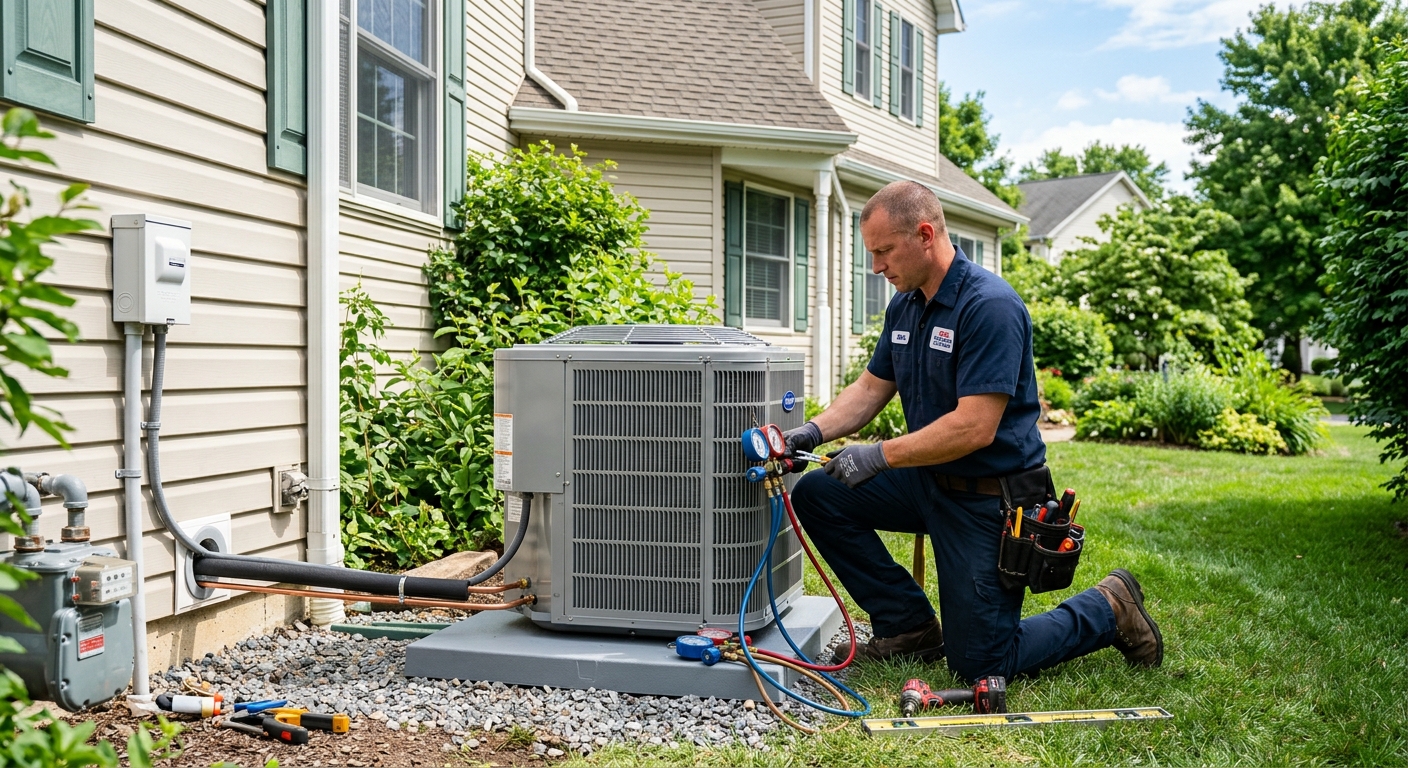
What a new HVAC system costs in Cranberry
Cranberry’s HVAC installations reflect its character as a rural, owner-heavy community where 70.2% of households own their homes and 68.9% of housing stock dates to before 1980 (U.S. Census Bureau, ACS 2024). That means most jobs here aren’t first-time installations in new builds — they’re replacements or retrofits, often complicated by old oil-boom era homes with odd-sized rooms, chopped-up basements, and a patchwork of previous upgrades. Custom ductwork and electrical panel improvements are normal, especially if your home has never had central air or needs to dump a mid-century gravity furnace.
Cranberry sits in the Lake Erie snow belt, with 6,200 heating degree days versus just 800 for cooling. That means this is a heating-dominated market: your HVAC decisions are really about what keeps you warm from November to April, and cooling is secondary. Homeowners here often need heating systems sized for 5 °F (the winter design low), not just a steamy August afternoon.
For homes with decent ducts, a straightforward central AC swap runs $4,700–$11,500. Ducted air source heat pumps, popular for all-electric upgrades, range from $7,500–$16,000, while cold-climate models that deliver strong heat below freezing start around $12,000. Mini-splits in single rooms or additions are less, from $3,000–$6,600. But if you need brand new ducts for an old house, budget more: $8,500–$17,000, depending on size, layout, and how much demolition you’re willing to patch.
| System |
Best for |
Efficiency |
Price range (installed) |
| Central AC replacement (existing ducts) |
homes with sound ductwork |
16–20 SEER2 |
$4,700–$11,500 |
| Air source heat pump (ducted) |
year-round heating and cooling |
8–10 HSPF2 |
$7,500–$16,000 |
| Cold-climate heat pump (ducted) |
heat pump as primary heat |
9–11 HSPF2 |
$12,000–$16,000 |
| Ductless mini-split (single zone) |
additions, rooms without ducts |
20–30 SEER2 |
$3,000–$6,600 |
| Full duct system installation |
homes with no existing ducts |
— |
$8,500–$17,000 |
Installed estimates for a typical Cranberry home. Equipment tonnage, duct condition and electrical capacity move these more than brand.
The central decision for a Cranberry homeowner
For Cranberry households, the most important HVAC choice is whether to run a furnace or commit to a heat pump. The facts here matter: our winter design temperature is 5 °F, with 6,200 heating degree days — a sure sign this is a heavy-heating climate. A decade ago, heat pumps in the Lake Erie snow belt fell short once the mercury dropped into the teens; today’s cold-climate models, though, reliably produce heat well into the single digits. They don’t “stop working” in true winter — but their output falls off as it gets colder, so a unit sized for a mild February might not keep up in January without backup.
If you have access to natural gas — available in Oil City and Franklin — the classic gas furnace plus AC combo is still the least-hassle, lowest-operating cost route for most detached homes, especially if your insulation or windows aren’t great. But in Cranberry Township and rural Venango County, where propane or fuel oil are the only alternatives, a heat pump can save real money and headache, since delivered fuels are pricier and less convenient.
There are cases where a gas furnace still wins: if you’re on municipal gas, want the fewest moving parts, or need robust high heat during the coldest week of January. Otherwise, an upgraded heat pump or a dual fuel system (heat pump with gas backup) are strong contenders — especially appealing for anyone hoping to cut fossil fuel use or avoid oil and propane deliveries.
| Option |
Installed cost |
Operating cost here |
Best when |
Incentive eligible |
| Gas furnace + central AC |
$4,700–$11,500 |
Low (w/natural gas) |
existing gas service, coldest zones |
Partial (sometimes) |
| Ducted heat pump (cold climate) |
$7,500–$16,000 |
Moderate (lower than oil/propane) |
good envelope, all-electric goal |
Yes |
| Dual fuel (heat pump + gas backup) |
$12,000–$16,000 |
Low (efficient, flexible) |
gas on site, deep cold spells |
Yes |
| Ductless multi-zone |
$8,500–$17,000 |
Low to moderate |
no ductwork, zone control |
Yes |
What size system does a Cranberry home need?
Getting the HVAC system size right is the single most important part of an installation in Cranberry. Bigger is not better: oversizing leads to short cycling, uneven temperatures, poor humidity control in summer, stress on components, and a system that wears out early. Rooms end up too cold or hot and the utility bill climbs, because the system cannot run long enough to do its job properly.
The only correct way to size is with a Manual J load calculation. This means using your exact home’s measurements, insulation levels, window type and orientation, air leakage, and local climate data — including Cranberry’s 5 °F winter design temperature — to figure out how much heating and cooling you need on the coldest (and hottest) days you’re likely to see. If a contractor gives you a quote based solely on square footage or just matches the rating on your old unit, you should question whether they’re passing old mistakes down the line.
When evaluating bids, ask: “Did you perform a Manual J calculation, and can I see the results?” Quality contractors will have this document and explain its numbers. It’s the best sign they’re treating your house like yours, not just another cookie-cutter replacement.
What a Pennsylvania HVAC contractor must hold
In Pennsylvania, there’s no statewide licensing system for HVAC contractors doing residential work. Local municipalities decide what’s required for jobs like heat pump installation and furnace replacement. For example, in Oil City, most central system jobs require a mechanical permit, while parts of rural Venango County, including Cranberry Township, may have little oversight for replacements unless the project triggers electrical changes or structural work.
Every installer in Pennsylvania handling refrigerants must hold EPA Section 608 certification — this is a federal requirement, not a state or county one, and it applies to anyone who cuts into a system containing refrigerant. Mechanical permits and inspections usually come from the municipal office, and it’s up to your contractor to pull the permits and schedule inspections where needed.
Pennsylvania does require Home Improvement Contractor registration for jobs over $500, issued by the Office of Attorney General. You can check registration status at the state’s verification site. State law also requires written contracts above $500 and mandates a three-business-day cancellation window. For worker safety, all employers must have workers’ compensation insurance, which you can verify through the WCAIS database. Don’t sign a contract without seeing proof.
How to vet an HVAC contractor in Cranberry
A correctly installed mid-tier system will outperform a poorly installed high-end one every time. The brand on the box matters less than the person bolting it together and commissioning it for your house. In Cranberry’s market, many contractors come in from Erie or Meadville and may not know the details of aging Venango County homes.
To choose wisely, check the basic legal boxes first. Verify active Home Improvement Contractor registration using the state registry for Pennsylvania. Confirm that anyone handling refrigerant actually holds EPA Section 608 certification — ask to see the card, not just a company letterhead. A legitimate quote should specify model numbers and efficiency ratings, not just a generic 3-ton “heat pump.” If the contractor doesn’t include a Manual J load calculation, odds are they’re skipping other steps, too.
Insist on commissioning — this means the installer measures airflow and refrigerant charge at startup and provides you with documented results for your records. Good contractors do this as part of their process.
- Check HIC registration through hic.attorneygeneral.gov
- Ask for EPA Section 608 certification proof
- Request a Manual J load calculation result for your home
- Insist on specific model numbers and efficiency ratings in the quote
- Ask about commissioning procedures and documentation after install
- Request proof of workers’ compensation insurance (use WCAIS)
- Demand a written contract (required above $500 by PA law)
- Inquire about who pulls and closes permits locally
- Ask how warranty calls are handled (in this thin contractor market, support matters)
- Get at least two detailed written bids for comparison
- Look for references from similar homes in Venango County
- Be wary if “travel surcharges” are buried or unexplained
Red flags in Venango County include vague bids, a refusal to provide proper licensing or insurance details, and out-of-town firms unfamiliar with local ductwork challenges. Given the rural density, availability doesn’t equal quality; pay attention to the details.
Retrofit versus replacement in Cranberry
Most Cranberry homes are not modern tract houses, but pre-1940 or pre-1980 structures (68.9% built before 1980) built for oil or coal heat, not central air. Many have retrofit ductwork, and some have none at all if they’re coming from radiant or baseboard systems. If your home already has forced-air ducts, odds are those were sized for furnace output, not for efficient air conditioning, which can leave rooms too warm in summer or starved for airflow in heat pump mode.
Electrical panels in these older houses are another sticking point. All-electric conversions, such as swapping oil or propane for a heat pump, almost always need at least one new dedicated circuit and sometimes a whole panel upgrade — not a small job in an old basement or crawlspace. Chimneys and flues used by older gas or oil furnaces should be inspected before simply swapping units, since deteriorated brick or clay liners can be a hazard.
If central air came later, duct runs may be tight or routed in ways that create hot and cold spots. Unless your home is a newer suburban build, plan for some custom sheet metal, patching and possibly new returns or transitions. These factors can nudge you toward ductless mini-splits or drive up the cost of whole-house duct retrofits — especially if you want modern filtration or zoning.
Filtration, humidification and ventilation
Cranberry’s climate, dominated by cold winters and brief humid summers, means you’ll battle dryness in January and sticky air in July. Winter air here is bone-dry — adding a whole-house humidifier helps, but only if you’re willing to maintain it: these units need regular pad changes and cleaning, or they end up breeding scale and mold. Summer brings short but muggy spells that push existing AC to its limits — especially if the system is oversized, which cools quickly without dehumidifying the air.
For filtration, a MERV 8 filter is fine for most houses; high-MERV (11+) filters catch smaller particles but can restrict airflow and stress older blowers. Don’t let anyone sell you an expensive “high-efficiency” filter or electronic gadget without confirming your duct and fan can support it.
Mechanical ventilation is rarely critical in Cranberry’s older, leaky homes, but new or tightly sealed houses may need a dedicated fresh air supply. ERV/HRV units are worth considering only if your energy bills or window condensation suggest real issues. Most UV lights, ozone generators, and “air scrubbers” just aren’t worth the upcharge in this region unless you have specific respiratory needs.
Frequently asked questions — HVAC installation in Cranberry
What is EPA Section 608 certification?
EPA Section 608 certification is a federal credential required for anyone who handles refrigerants used in air conditioners, heat pumps, and refrigeration systems. In Cranberry and throughout Pennsylvania, it’s not optional — it’s illegal for a contractor to connect gauges, cut into refrigerant lines, or recharge a system unless they or the direct technician are certified under this rule. This protects both the environment and your system, as proper refrigerant handling prevents leaks and contamination. If you’re getting a heat pump or central AC replaced (costing anywhere from $4,700–$16,000 here), always ask to see the actual 608 card for the installer, not just a business card or verbal assurance. It’s a specific credential, not covered by general HVAC training or state contractor registration.
How much does a furnace replacement cost in Cranberry?
For a straightforward gas furnace swap in Cranberry, where natural gas is available mainly in Oil City and Franklin, the total installed cost usually lands between $4,700–$11,500. That figure includes labor, a new furnace, and all required connections, assuming your existing ductwork and venting are in fair shape. If you’re running propane or fuel oil in the rural townships, furnace costs don’t change much, but efficiency, fuel costs, and venting can complicate things. For homes with older or deteriorated flues, add extra for chimney liner repair or direct vent conversion. Keep in mind that modern gas furnaces need compatible thermostats and safe electrical circuits — sometimes a hidden cost in homes that predate 1980, which make up most of Cranberry’s housing stock.
When is the best time of year to replace HVAC in Cranberry?
In Cranberry, the best time to schedule a major HVAC installation or replacement is during the shoulder seasons — late spring (April to early June) or early fall (September through October). That’s when local contractors aren’t swamped with emergency furnace calls or AC breakdowns, and you’re more likely to get dates (and prices) that suit you. Firms traveling in from Erie or Meadville may waive travel surcharges or offer price breaks to fill their calendars. Avoiding peak cold (January–February) and hottest weeks (late July) gives you better lead time and reduces the chance of delays if supply chains tighten. Most price bands — such as $7,500–$16,000 for a full heat pump install — don’t fluctuate wildly, but slow seasons mean more careful work and attention from the crew, which matters for tricky Venango County homes.
Do older Cranberry homes need ductwork replaced?
Many Cranberry homes, especially those built before 1980, have ductwork that was either sized only for heating or added later in a haphazard retrofit. You may not need a complete duct replacement, but most homes benefit from sealing leaks, adding returns, or upsizing restrictive runs. If you’re changing to a heat pump (especially a cold-climate model costing between $12,000–$16,000 installed), check whether your current ducts can handle the required airflow and static pressure. Leaky, undersized, or poorly insulated ducts will cost you in comfort and efficiency, and could shorten equipment life. A smart contractor will inspect your ducts before quoting a replacement — and steer you toward mini-splits or a full duct redo only if your existing system won’t cut it.
What is SEER2 and how is it different from SEER?
SEER2 is the updated federal efficiency standard for residential air conditioners and heat pumps in the U.S. It uses more demanding test conditions to better reflect real-life operation, including restrictions found in many older Cranberry duct systems. While “SEER” was based on precise lab setups, SEER2 includes external static pressure, making it harder for equipment to achieve high numbers — so SEER2 ratings are slightly lower but much more realistic. When you shop in Cranberry, the central AC and heat pumps you’ll see will range from 16–20 SEER2 ($4,700–$16,000 installed for most systems). A new system with a SEER2 of 17 is a step up from a SEER 13 unit from two decades ago, and will noticeably lower cooling costs if you can give it good ducts and a proper install.
Do I need dual fuel in northwestern Pennsylvania?
Dual fuel systems — a heat pump plus a gas furnace for backup — make the most sense in Cranberry if you have access to natural gas and you want year-round efficiency without losing deep-winter heating capacity. They’re less advantageous if you rely on propane or oil, given fuel prices and delivery hassles. With our winter design low of 5 °F and 6,200 heating degree days, a modern cold-climate heat pump covers most winter days, but switching to gas during the single-digit spells keeps you fully comfortable. Expect dual fuel setups to cost about $12,000–$16,000 installed here. Go this route if you want all-electric comfort as much as possible but need assurance on the very coldest nights.
Does my utility offer a heat pump rebate in Cranberry?
In Cranberry and greater Venango County, rebates depend on your electric utility. Most homes are served by Penn Power or Penelec, both subsidiaries of FirstEnergy. These companies have, in recent years, offered rebates for Energy Star certified heat pumps and sometimes for high-efficiency central air conditioners. For a typical ducted installation (ranging from $7,500–$16,000), rebates have varied from a few hundred up to $1,000, but you’ll want to check current utility programs before committing — eligibility often hinges on equipment ratings (SEER2/HSPF2), who does the install, and registration submittal after the fact. Oil City and Franklin sometimes have local add-ons. Always confirm before you sign, as rebate rules can change year to year.
Why do HVAC quotes in Cranberry vary so much?
Quotes for an HVAC replacement in Cranberry (say, a heat pump or central AC, in the range of $4,700–$16,000) often vary by several thousand dollars even for what seems like the same job. Reasons include travel surcharges from firms based in Erie or Meadville, the unpredictable condition of old home ductwork, whether panel upgrades or new returns are needed, and if the contractor is including (or skipping) commissioning, permits, and warranty coverage. Older homes here almost always present surprises once the old unit is out, so contractors price for risk. Cheaper quotes often skip crucial work like proper load sizing, new pads or disconnects, or detailed start-up. Don’t compare only bottom lines — ask what’s actually included, especially if two quotes differ by several thousand dollars.
How long should an HVAC system last in Cranberry?
In Cranberry’s climate, a well-installed modern central air conditioner or heat pump will last about 15–20 years, while a furnace often runs 18–25 years with regular service. These numbers assume yearly maintenance and that the original installation followed best practices — including proper sizing and duct configuration. Older Venango County homes can be harder on equipment due to dust, insulation gaps, and older wiring or panels, which may reduce lifespan unless properly upgraded. A typical central AC or ducted heat pump, which costs $7,500–$16,000 installed here, should give you at least 15 trouble-free seasons if you keep up with filter replacement and annual check-ups from a contractor who understands this region’s specific heating demands and duct challenges.