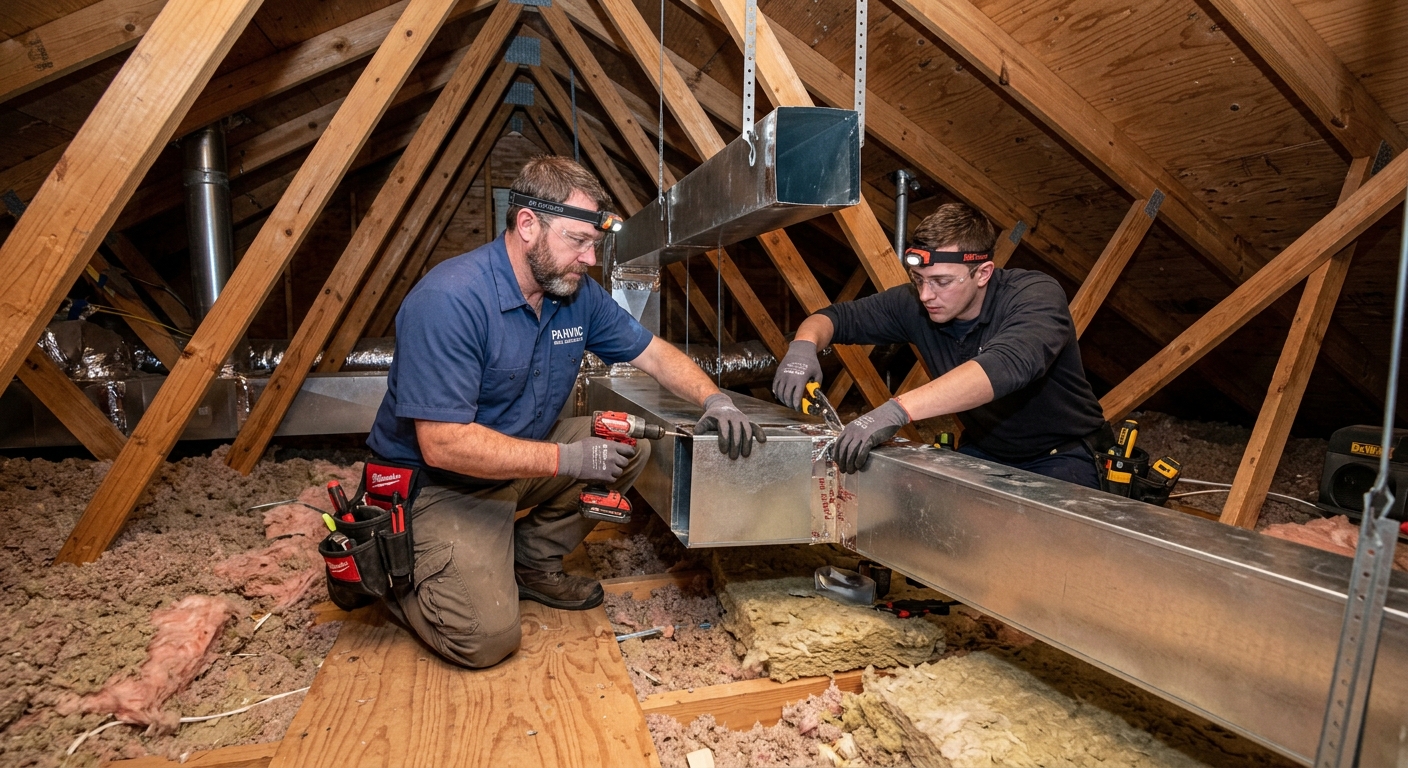
Derry heating and cooling prices by system type — 2026
Derry sits in the center of Dauphin County, where homeownership stands at 65.1% and over half the homes were built before 1980 (U.S. Census Bureau, ACS 2024). That adds up to a market focused on replacing aging systems, not just adding cooling to older homes that never had it. Large tracts of post‑1950 suburban homes, especially near Colonial Park and Swatara Township, typically have existing ductwork. This tips most projects to replacement of split-system air conditioners or upgrading to more efficient heat pumps, rather than full gut installs.
South-central Pennsylvania is a heating-dominated climate, with 5,200 heating degree days dwarfing the 1,250 cooling degree days. For most Derry homeowners, heating is the bigger piece of the bill and should be the first priority for comfort and savings. Still, summers are humid enough that AC runs steady from June into September, so system efficiency on both sides matters.
Below is what you can expect to pay in 2026 for professionally installed systems in Derry. All prices reflect the installed cost, not just the equipment:
| System |
Best for |
Efficiency |
Price range (installed) |
| Central AC replacement (existing ducts) |
homes with sound ductwork |
16–20 SEER2 |
$5,200–$12,500 |
| Air source heat pump (ducted) |
year-round heating and cooling |
8–10 HSPF2 |
$8,200–$17,500 |
| Cold-climate heat pump (ducted) |
heat pump as primary heat |
9–11 HSPF2 |
$13,500–$17,500 |
| Ductless mini-split (single zone) |
additions, rooms without ducts |
20–30 SEER2 |
$3,300–$7,200 |
| Full duct system installation |
homes with no existing ducts |
— |
$9,300–$18,500 |
Installed estimates for a typical Derry home. Equipment tonnage, duct condition and electrical capacity move these more than brand.
Reducing the net cost of a Derry installation
Most Derry homeowners have three possible ways to knock down the up-front price of a new HVAC system: federal tax credits, utility rebates, and state-level programs. It’s important to know how each applies—and why every homeowner needs to check exact requirements and deadlines.
The federal tax credit for high-efficiency heat pumps, air conditioners, and select other qualifying equipment is a dollar-for-dollar reduction of your income tax due the following year. It won’t reduce the amount you pay at installation, but come tax time, it can save you hundreds to a couple thousand dollars, depending on the system.
Utility rebates—offered by companies like PPL Electric Utilities and UGI Utilities in most of Dauphin County—work differently. These programs, if available, may offer rebates that lower the invoice, or refunds after installation. Rebates are typically paid after proof of installation and energy rating. Unlike tax credits, their value can change yearly and often depend on funding and what type of system you install.
State-level savings (when available) get layered on top, but Pennsylvania’s main role for home HVAC is making sure contractors are registered and codes are enforced.
To find current offers: check PPL Electric Utilities or UGI Utilities’ online efficiency program pages, or use the ENERGY STAR rebate finder. Program names and amounts shift every year. Don’t rely on numbers from ads—a proper bid should help you confirm your actual eligibility right before you sign.
Reading an installation proposal
If you get three HVAC quotes in Derry, chances are each will look completely different. The most useful proposals are the ones that let you compare apples to apples, not just brands and lump-sum prices. For any central system, both indoor and outdoor unit model numbers should be listed—this is the only way you'll know you’re getting a matched pair, which is what delivers the rated efficiency. The tonnage (system size) must be backed by a load calculation. If a proposal just copies the size off your old unit, it’s not based on your actual house.
Look out for line-set replacement—some jobs can reuse the existing refrigerant lines, others can’t. Electrical work should spell out if your panel has enough capacity, or if an upgrade is needed and included in the price. Condensate drainage and a new thermostat should be clear line items. A mechanical permit and start-up (commissioning) report show that the work is being done to code and inspected. The labor warranty is always separate from the equipment warranty, and it matters a lot for the first few years.
A quote listing only a brand and a price doesn’t tell you what it covers. Here’s a rough guide:
| Line item |
What to look for |
Red flag if… |
| Equipment |
model numbers, indoor and outdoor matched |
brand name only |
| Sizing |
load calculation attached |
matched to the old nameplate |
| Ductwork |
condition assessed, sealing scoped |
not mentioned |
| Electrical |
circuit and panel capacity confirmed |
assumed adequate |
| Line set |
replaced or documented as reused |
silent |
| Commissioning |
measured airflow and charge, documented |
no startup report |
| Warranty |
labour years stated separately |
manufacturer only |
| Permit |
included and priced |
'not needed' |
Duct condition, leakage and sealing
In Derry’s post‑1950 suburban homes, especially around Colonial Park and Swatara Township, the presence and condition of ductwork is a legacy of when air conditioning and gas furnaces became standard. But just because ducts are installed doesn’t mean they’re working efficiently, or that they were sized or sealed correctly. Duct leakage is the hidden thief in older homes—uncapped joints, rusted seams, or even gaps in the attic and crawlspace can lose 20% or more of conditioned air before it reaches your rooms. That’s money literally lost through the cracks.
A “duct blaster” test pressurizes the duct system and measures leakage, expressed as CFM at a set pressure. This pinpoints how much air escapes before the registers, so you know whether sealing can restore performance or if you’re throwing good money after bad by just swapping equipment. Duct sealing with mastic or aerosol is often enough unless the ducts are rusted through or poorly sized.
Undersized returns are another invisible problem—if your ducts were installed strictly for a small furnace decades back, your heating and cooling efficiency suffers, and indoor comfort drops. Ducts running through unconditioned attics or crawlspaces are subject to heat loss and condensation—sealing and insulating these runs is essential, not optional.
My best advice: have the duct system tested before signing off on a new system, not after. Otherwise, you risk a high-efficiency unit crippled by the bottleneck in your attic or basement.
Manual J and the tonnage question
In Derry and across Dauphin County, nothing will affect your heating and cooling comfort, and your utility bills, as much as getting the equipment size (tonnage) right. Oversizing is not a “safe” move—it guarantees short cycling, rooms that won’t dehumidify properly, temperature swings, and units that burn out well before their time.
Proper sizing calls for a Manual J load calculation. This calculation is unique to your home: it accounts for insulation, window area, air leaks, duct losses, number of occupants, orientation to the sun, and more. Generic rules of thumb like “one ton per 500 square feet” are off by several factors—especially in homes built before 1980, where leaks, insulation, and upgrades vary block to block.
The calculation is pegged to Derry’s winter design temperature—12 °F, as set by code—because the equipment needs enough output to hold your setpoint during the coldest typical snap. If a contractor copies the nameplate tonnage off your last system instead of running a load calculation, they’re just repeating someone else’s guess, and possibly their mistake.
Always ask: “Did you run a Manual J calculation, and can I see it?” The answer should not be a simple square footage table or the number on your old unit.
Gas, electric or both in south-central Pennsylvania
In Derry and the wider south-central Pennsylvania region, the choice between gas, electric heat pump, or a hybrid system pivots on our local climate: 5,200 heating degree days and a winter design temperature of 12 °F mean that heating is the dominant load, and your system must keep up when it’s truly cold. Not long ago, heat pumps were dismissed for this part of the state, but the newer cold-climate varieties now maintain solid output deep into the teens or single digits.
Nevertheless, capacity does drop as the temperature falls. That’s where dual fuel (heat pump with gas backup) systems make sense—the heat pump carries the load in mild weather and transitions to gas as temperatures fall below what the electric side can handle efficiently.
Natural gas is widely available in Derry and surrounding suburban parts of Dauphin County (UGI Utilities), but the outer rural townships still rely on propane or oil. Where there’s piped gas, the math is still close between high-efficiency furnaces and cold-climate heat pumps; if you’re on propane or oil, a heat pump often saves more and avoids tank fills.
A gas furnace remains the right move if you already have a stable gas hookup and want absolute peace of mind in the harshest winter week—a small but real difference when the thermometer plunges. Here’s how the core options compare for Derry:
| Option |
Installed cost |
Operating cost here |
Best when |
Incentive eligible |
| Gas furnace + central AC |
$5,200–$12,500 |
lower with existing gas |
existing gas service, coldest zones |
varies by system |
| Ducted heat pump (cold climate) |
$8,200–$17,500 |
often lower, all-electric |
good envelope, all-electric goal |
typically yes |
| Dual fuel (heat pump + gas backup) |
$13,500–$17,500 |
lower than straight electric |
gas on site, deep cold spells |
often yes |
| Ductless multi-zone |
$9,300–$18,500 |
zone by zone efficiency |
no ductwork, zone control |
single- and multi-zone both can qualify |
Permits, licensing and inspections in Derry
Pennsylvania does not issue a statewide HVAC contractor license for residential work. All residential installations and replacements in Derry fall under the Pennsylvania Uniform Construction Code (UCC), which is enforced by Dauphin County municipalities individually. For example, Harrisburg has its own mechanical permit process, and Derry homes generally require municipal mechanical permits and an inspection for major HVAC work.
If your contractor handles refrigerants (central air and heat pumps), EPA Section 608 certification is federally required—this rule applies in every state, regardless of local licensing. For contracts over $500, your contractor must hold Pennsylvania’s Home Improvement Contractor registration, which is issued by the Office of Attorney General. You can and should verify if a contractor’s registration is active at hic.attorneygeneral.gov.
Workers’ compensation insurance is mandatory for any HVAC employer, covered by Pennsylvania’s private and self-insured market. Always ask for proof and check coverage status using the WCAIS system (wcais.pa.gov). Never let a contractor start any work in Derry without a written contract, as required by the Home Improvement Consumer Protection Act (HICPA). On older homes (built before 1978), federal lead-safe practices also apply.
Frequently asked questions — HVAC installation in Derry
Do I need a permit to replace HVAC in Derry?
There is no blanket answer for all of Dauphin County, but in Derry, most central HVAC replacements (like furnace, AC, or heat pump replacements) do require a mechanical permit from your local municipal office. For Harrisburg addresses, the City Codes Administration enforces this rule, and surrounding townships like Derry run their own permitting offices. Smaller tasks, such as swapping out filters or changing thermostat batteries, don’t require permits. Expect your installer to handle the paperwork and include the cost and permit number in your contract. The permitting requirement helps ensure your contractor follows the Pennsylvania Uniform Construction Code and schedules inspections. For a typical system replacement priced $5,200–$12,500, always look for an itemized permit line on the bid.
Which utility serves Derry?
Most homes in Derry are served by PPL Electric Utilities for electricity and UGI Utilities for natural gas. These two companies cover much of Dauphin County’s suburban ring, although rural edges may only have access to propane or oil for heating. Knowing which utilities serve your property is important when considering HVAC upgrades, both for rebate eligibility and to estimate your operating costs, especially between gas and electric systems. For a new central AC install, the power supply comes from PPL Electric; if you choose gas heating, UGI is your likely gas supplier. Installation costs in this area run $5,200–$12,500 for most replacements.
What is a Manual J load calculation?
A Manual J load calculation is the accepted standard in Derry and across Pennsylvania for determining the heat gain and heat loss of your specific home. It factors in the size of each room, window quality, insulation, duct losses, and sun orientation. The result tells your contractor the exact capacity in BTUs (or tons) that’s required for proper comfort and efficiency. Skipping this step or sizing off a rule of thumb leads to poor comfort, higher bills, and short cycling. If you’re spending $8,200–$17,500 on a new heat pump or system, insist on seeing this calculation attached to your quote; otherwise, you could be repeating a decades-old sizing error from a previous install.
How much does a new HVAC system cost in Derry?
Installed cost in Derry depends heavily on your home’s age, duct condition, and whether you need both heating and cooling. For a straightforward replacement using existing ductwork—say, just a new central air conditioner—the price typically lands between $5,200–$12,500. Heat pump replacements with ductwork in good shape usually run $8,200–$17,500. Homes needing a full new duct system pay most, with totals from $9,300–$18,500. Prices move more on installation complexity than brand. Always have your installer verify electrical and duct conditions early so there are no surprises.
What HVAC tax credits are available to Derry homeowners?
Derry homeowners can take advantage of federal income tax credits for qualifying systems—including efficient heat pumps, furnaces, and central air—under current federal programs. Credits apply after you file taxes for the year you installed the system, meaning you pay full price at installation and get the tax credit (a direct reduction of what you owe) after submitting your return. Local utilities like PPL Electric and UGI may also offer rebates, which reduce bills more quickly, but program details change annually. For a new ducted heat pump priced at $8,200–$17,500, these incentives can add up. Always check the current rebate pages or ask your installer for up-to-date eligibility.
How much does ductwork add to an HVAC installation?
If your Derry home lacks usable ductwork, adding a full new duct system is a major component of project cost—typically $9,300–$18,500 installed, depending on size, number of runs, attic or crawlspace access, and layout complexity. For many post‑1950 homes in Derry, replacing just the system (using existing ducts) is closer to $5,200–$12,500. Ductwork includes supply and return runs, registers, and insulation—your contractor should assess every line for leakage or sizing errors. Sometimes sealing or minor repairs are enough; you shouldn’t pay for full replacement unless testing and inspection show it’s required.
Do I need to be home during installation?
For most HVAC installations in Derry, the homeowner, or at least an adult decision maker, should be home at project start and finish. Installers will need interior access for the thermostat, ductwork, electrical panel, and sometimes visible inspections from the local code authority. That said, for longer projects—like a new heat pump installation costing $8,200–$17,500—you can usually arrange to be out during portions of the day. Just be sure to agree on how you’ll handle lock-up and communication. Being present at walk-through and final inspection ensures all promised work is complete and lets you get direct instructions on operation.
Why does my system short cycle?
Short cycling—when the AC, furnace or heat pump turns on and off rapidly—happens for several common reasons in Derry homes. The leading cause is an oversized system, usually installed by matching the size of the old equipment rather than running a current load calculation. Other triggers can be thermostat misplacement, bad sensors, or airflow issues from dirty filters or duct restrictions. Besides causing comfort swings and higher bills, short cycling shortens equipment life—meaning you risk burning out an $8,000 system well before its time. If you’re quoted for a replacement in the $5,200–$12,500 range, always demand a load calculation and ductwork inspection to avoid repeating the same mistake.
Should I replace the furnace and AC at the same time?
For Derry homes where both furnace and AC are near end-of-life, a combined replacement can make a lot of sense. New matched systems usually deliver higher efficiency, qualify for the best rebates, and often lower the overall install cost compared to separate jobs. Plus, you save on future labor and downtime. However, if your furnace is fairly new or your existing equipment is performing perfectly, you don’t need to spend extra just for the sake of matching. Always ask your installer to verify remaining life and condition. If the quote for both components is $5,200–$12,500, check labor, equipment, and warranty breakdown—sometimes replacing both together gives a better comfort and value payoff.