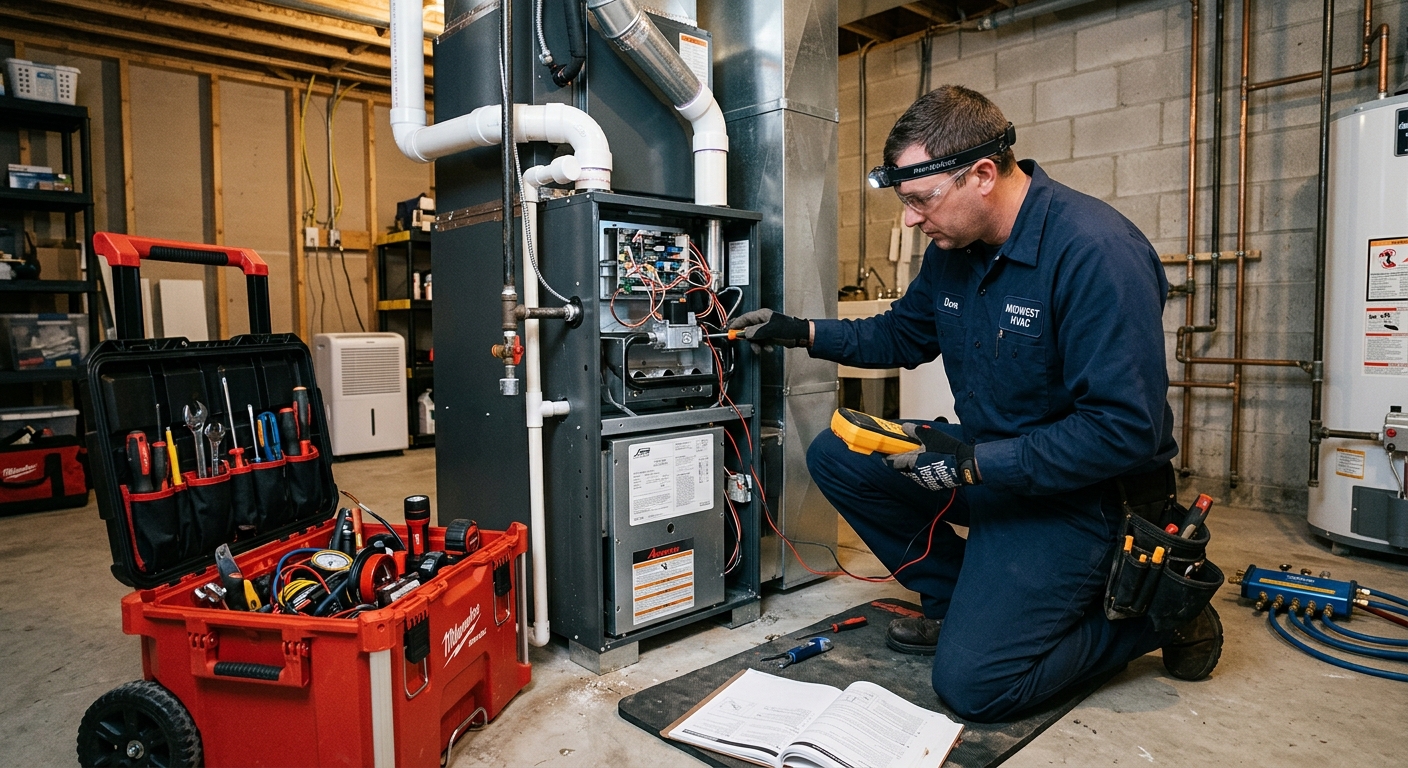
Economy heating and cooling prices by system type — 2026
Economy, Pennsylvania is a community with a remarkably high homeownership rate (93.0%) and most of its homes were built before 1980 (67.4%) (U.S. Census Bureau, ACS 2024). That means the HVAC work here is a mix: some replacement of old central systems, lots of retrofits for homes that never had ducts, and more ductwork replacement than in newer suburbs. Aliquippa and Beaver Falls, just up the road, are full of pre-1960 mill worker homes, so Economy homeowners often call about poor ductwork or rooms that never cooled right in the first place.
Our climate in southwestern Pennsylvania leans heavily toward heating. With 5,600 heating degree days and just 1,050 for cooling, the main HVAC load is keeping homes warm through long, freezing winters. Still, humid, muggy stretches mean air conditioning matters for comfort. This shapes system choices and efficiency priorities.
If your home came with forced air, central AC or a heat pump uses existing ducts—assuming they’re sized and sealed right. Many older homes, though, need substantial duct upgrades or go ductless with mini-split systems, especially for additions and rooms never connected to the main system.
| System |
Best for |
Efficiency |
Price range (installed) |
| Central AC replacement (existing ducts) |
homes with sound ductwork |
16–20 SEER2 |
$5,200–$12,500 |
| Air source heat pump (ducted) |
year-round heating and cooling |
8–10 HSPF2 |
$8,200–$17,500 |
| Cold-climate heat pump (ducted) |
heat pump as primary heat |
9–11 HSPF2 |
$13,500–$17,500 |
| Ductless mini-split (single zone) |
additions, rooms without ducts |
20–30 SEER2 |
$3,300–$7,200 |
| Full duct system installation |
homes with no existing ducts |
— |
$9,300–$18,500 |
Installed estimates for a typical Economy home. Equipment tonnage, duct condition and electrical capacity move these more than brand.
Refrigerant rules and your existing system
Starting in 2025, new residential systems must use refrigerants like R-454B or R-32, which have a lower global warming potential than R-410A. This change is driven by federal mandates to phase down high-GWP HFC refrigerants. For an Economy homeowner with a working R-410A system, this means you can continue using and servicing what’s already in place—your system does not become illegal or unserviceable.
However, as manufacturers shift production to the new refrigerants, R-410A is gradually getting more expensive. Over time, this will impact repair costs if your current system develops a significant leak. You can still get R-410A and have repairs made, but expect parts and especially refrigerant to rise in price. At some point, if you’re facing a major repair—like a coil or compressor replacement that includes refilling a lot of refrigerant—the total cost may make replacement a more sensible call.
There’s no requirement to pre-emptively replace your HVAC just because of the refrigerant. If your system is cooling and heating well, keep it. But if it springs a leak, knowing this background helps when weighing repair costs versus installing a new system under the new standards.
Permits, licensing and inspections in Economy
In Pennsylvania, there’s no statewide HVAC or mechanical license for residential contractors. Instead, contractors need Home Improvement Contractor (HIC) registration for residential jobs over $500, which is issued at the state level and applies statewide. You should always verify this registration at the official site referenced in the state rules. Mechanical permits for new or replacement HVAC work are required by the local Economy Borough or township government—not from the state. This keeps code inspection local, and each municipality may have its own process for applications, fees, and inspections.
EPA Section 608 certification is a federal requirement for anyone handling refrigerants. Any contractor installing, repairing, or replacing your air conditioner or heat pump must have this certification regardless of local or state licensing. It’s standard in the industry and non-negotiable under federal law.
Pennsylvania also requires HVAC contractors with employees to carry workers’ compensation insurance, verified through the WCAIS system named in the state’s framework. Always ask for proof. Residential permitting and inspection in Economy are handled by your borough—not a state inspector. In summary: Verify HIC registration, workers’ comp insurance, and EPA 608 certification, and confirm your contractor will handle the required local mechanical permits and schedule inspections with the municipal office.
Filtration, humidification and ventilation
Our southwestern Pennsylvania winters are long and dry, with outdoor air frequently below 8 °F and a heating season that dominates the year. It’s common for homes in Economy to see overly dry indoor air—low humidity leads to dry skin, cracking in woodwork, and static electricity. Once summer hits, humidity can make even mild days feel uncomfortable indoors. Each problem calls for a different approach.
Whole-house humidifiers can ease winter dryness, but they require regular cleaning and annual maintenance to avoid mold buildup and clogged water panels. In cooling season, a properly sized air conditioner or heat pump should dry the air as it runs. If your system is oversized, it won’t run long enough to dehumidify effectively—more isn’t better here. Some contractors push add-on dehumidifiers, but for most homes, an upgrade is only needed if you’re seeing persistent summer mold or musty smells.
Air filtration is another spot where overselling is common. Higher MERV filters remove more particulates, but can overload older blower motors. Match the filter rating to your blower’s capacity—MERV 8 is usually sufficient for most Economy homes. Mechanical ventilation, such as HRVs or ERVs, is worth considering in newly constructed homes or after a big weatherization project. Otherwise, most houses here leak enough naturally that mechanical ventilation upgrades rarely pay off.
Why your ducts may be the real problem in Economy
In Economy and especially in nearby Aliquippa and Beaver Falls, many homes were built before 1960 and have a mixed bag of ductwork. Some didn’t have ducts at all until central air was retrofitted decades later; others have duct networks that were built for an old gravity furnace, not today’s high-efficiency systems. In these homes, the real source of discomfort and high bills often isn’t the heating or cooling equipment—it’s the ductwork.
A duct blaster test measures leakage in your duct system. In older homes, leaks can send 25% or more of your heated or cooled air into unconditioned attics, crawlspaces, or even inside walls. This is throwing money away every month. Sealing existing ducts can solve a lot, but if the runs are too small, there’s only so much you can fix—undersized return ducts restrict airflow and create noisy, inefficient systems. Ducts running through unconditioned spaces also sap efficiency, letting hot or cold air bleed out before it reaches your rooms.
Aliquippa and Beaver Falls homes from the mill era are notorious for ductwork that was never sized right for central AC, just forced-air heat. Many were never sealed at all. Before you spend thousands on new equipment, get your ductwork pressure-tested and inspected. Sometimes a $600 duct sealing job will make more difference than a full replacement system. Test first, and spend money where it will actually deliver comfort and efficiency.
Repair or replace your Economy system?
Deciding whether to repair or replace your HVAC system in Economy starts with the system’s age, what’s actually broken, and whether your money would be better spent fixing ductwork or insulation instead. I’m not in the business of talking anyone into unnecessary replacements—most issues in the first 10 years can and should be repaired for far less than a new system.
If your system is older (15+ years), or you’re facing a major part failure like a compressor or a cracked heat exchanger, replacement starts to make more sense—especially since those are expensive and sometimes unsafe to repair. High refrigerant prices for older R-410A systems can also tip the balance.
Don’t bank on efficiency alone paying you back. Our climate has just 1,050 cooling degree days, so even big efficiency gains on AC might add up slowly, unless your heating is a heat pump running all winter. The only non-negotiable points for replacement: a cracked heat exchanger (serious safety risk), or a dead compressor on a system beyond warranty.
| Situation |
Recommendation |
Typical cost |
Reasoning |
| Under 10 years, single component failure |
Repair |
$300–$1,200 |
Well within system life; most repairs are efficient and cost-effective. |
| 10–15 years, repair over a third of replacement |
Consider replacing |
$5,200–$12,500 |
At this age, big repairs often don’t pay—look at the long-term cost. |
| 15+ years, any major failure |
Replace |
$5,200–$12,500 |
Limited life remaining; replacement will be needed soon regardless. |
| Cracked heat exchanger, any age |
Replace immediately |
$5,200–$12,500 |
Unsafe to operate—a system with a cracked heat exchanger can leak carbon monoxide. |
| Compressor failure past warranty |
Replace |
$8,200–$17,500 |
Cost to replace compressor is close to new system, with no new warranty on remaining parts. |
| Working system, high bills |
Test ducts and envelope first |
$300–$800 |
Leaky ducts or poor insulation are often the culprits—not always the equipment. |
Maintenance that actually extends system life
The essentials that keep an HVAC system going for decades in Economy are simple, and many of the expensive “add-ons” aren’t worth your money. Change your air filter at least every 2–3 months during the heating or cooling season; choose a MERV 8 filter unless your system is designed for something higher. Higher ratings can choke airflow in older units. Clean both the indoor and outdoor coils yearly—dirt blocks heat transfer, costing you comfort and efficiency.
Flush the condensate drain each spring, even if it seems clear. Clogs here will quickly waterlog the system or lead to mold. Checking refrigerant charge should not mean just “topping up.” If your system is losing refrigerant, it has a leak—adding more without repair is not real maintenance and is a waste of money.
Annual service plans can be useful if they offer priority scheduling and real inspections, but be wary: many are just prepaid filter changes at a markup. Skip a service contract if it doesn’t include at least a full safety check, coil cleaning, and a clear list of what’s covered. Schedule your maintenance in spring or early fall—before heat waves or cold snaps flood every shop with emergencies.
Frequently asked questions — HVAC installation in Economy
Does Pennsylvania license HVAC contractors?
In Pennsylvania, there is no statewide HVAC license for residential contractors. Instead, any residential HVAC job over $500 requires that the contractor holds a Home Improvement Contractor (HIC) registration, managed by the Attorney General’s office—regardless of where in the state you live. In Economy, borough code enforcement handles local permits and inspections, so you want a contractor with a valid HIC registration (verify at hic.attorneygeneral.gov) and EPA Section 608 certification for refrigerant work. For commercial HVAC, requirements change, but for homeowners replacing a system, these rules apply. Expect to see HIC registration, proof of insurance, and compliance with local permitting for almost any installation in the $5,200–$12,500 range.
How much does a furnace replacement cost in Economy?
Furnace replacement prices in Economy fall in the same range as central air installations, since most jobs combine both systems or share the same contractor workflow. For most homes, replacing a furnace—assuming ductwork is present and sound—runs from $5,200–$12,500 installed. Factors that move this price up are the need for new ductwork, converting from oil or electric to gas, or upgrading your electrical system to modern code. Callout or travel charges are rare within borough limits, but some rural Economy addresses do see mild surcharges. Always get several bids and avoid low-ball quotes that skip permitting or ignore the duct system's real condition.
How far ahead should I schedule in Economy?
For major HVAC work in Economy, you should schedule your installation at least 2–4 weeks ahead during spring or fall, and closer to 4–6 weeks ahead if you’re aiming for summer or winter peak. In this part of Beaver County, reputable contractors can book up fast, especially if your job requires a full duct replacement or work in an older, pre-1980 home (67.4% of local housing stock per the Census). Emergency replacements—like a furnace failure in January—may prioritize safety, but for routine jobs plan for reasonable lead times, especially when costs can be in the $5,200–$12,500 range.
What does a ductless mini-split cost in Economy?
A ductless mini-split (single zone) in Economy typically comes in at $3,300–$7,200 installed. Single-zone means one outdoor compressor and one indoor head—ideal for finished attics, additions, or spaces where running new ducts isn’t realistic. Multi-zone systems cost more, but for most homeowners needing comfort in just one problematic space, this is the price range. Always ask about electrical panel capacity, as older homes may need upgrades. Equipment selection and the ease of running lines through plaster-and-lathe or brick walls affect labor costs more than brand. Ductless is especially popular in homes built before 1980, which make up most of Economy’s stock.
Should I replace the furnace and AC at the same time?
In Economy’s housing stock, built largely before 1980, the furnace and AC often reach retirement age together—usually after 15–20 years. Replacing both at once can make sense if both are failing, if you want the highest system efficiency, or if rebates tie them together. However, there’s no rule saying you must. If your AC fails in July but the furnace is only 8 years old, it usually pays to just fix or replace the one. The full-system replacement cost would be in the $8,200–$17,500 range for a heat pump or dual replacement. Always have both units inspected before making a call and get honest bids that spell out what’s being replaced.
How does southwestern Pennsylvania's climate affect system sizing?
Our Economy winters are cold and long (5,600 heating degree days), so heating loads drive system sizing and selection. Cooling is important during muggy stretches, but oversized air conditioners do a poor job dehumidifying—a chronic comfort problem for local homes. System sizing needs to be tailored for heavy winter use, with ducts and returns sized right for actual airflow needs. Newer high-efficiency systems, even ductless mini-splits in the $3,300–$7,200 range, can keep up if matched to local conditions, but always demand a heat load calculation (Manual J) to make sure you’re not oversizing based on guesswork.
Does my utility offer a heat pump rebate in Economy?
The local electric utility serving Economy is Duquesne Light Company, and rebates for high-efficiency heat pumps have run off and on over the past few years. Offers often change year to year and can depend on system type, efficiency rating, and whether you’re upgrading from electric resistance or oil. For 2026 installations, check with Duquesne Light directly or ask your contractor to confirm eligibility for the job—a qualifying heat pump install might earn you a few hundred dollars back on a system in the $8,200–$17,500 range. Beware of claims of “guaranteed” rebates—always get written confirmation.
What is SEER2 and how is it different from SEER?
SEER2 is the new federal standard for measuring air conditioning efficiency, replacing the old SEER rating as of 2023. SEER2 uses a more realistic and rigorous testing protocol, with higher static pressure that simulates how ductwork typically adds resistance in real homes, such as those in Economy. This means SEER2 numbers are lower, so don’t be alarmed—an older system rated 16 SEER might only show as 14 SEER2, or even less. When comparing quotes in the $5,200–$12,500 installed range, use SEER2 for apples-to-apples efficiency. It’s a fairer basis for what you’ll really see in your utility bills.
Why are my Economy energy bills high with a new system?
High bills after a new system install in Economy often aren’t about the equipment itself—most new ACs and heat pumps are efficient by default. The bigger issues are leaky or poorly sized ductwork, old insulation, or an undersized return. In Economy’s older homes, ducts may leak 25% of your conditioned air before it even reaches a vent. Before replacing expensive equipment, invest $300–$800 in testing and sealing ductwork or improving insulation. Even a system at the upper price band—$12,500—won’t perform well with bad ductwork. It’s almost always worth finding and correcting these problems first.