What a new HVAC system costs in Falls
Falls is part of Bucks County’s post-1960 suburban corridor, where most single-family homes have been heated and cooled with forced air systems for decades. With 75.4% of residents in owner-occupied homes and 81.6% of the housing built before 1980 (U.S. Census Bureau, ACS 2024), most HVAC work here involves replacing or upgrading aging equipment rather than first-time installations. These tract homes often have existing ductwork, though whether it’s still up to par depends on what’s been replaced over the years.
If your house was built after 1960 (as many in Bensalem, Middletown, and Falls were), it’s likely you have a basic duct system, but you may still face issues like unsealed joints or undersized returns. That’s why full duct system replacements and upgrades happen often alongside HVAC equipment changeouts in these neighborhoods.
Climate drives sizing and payback here: Bucks County sees 4,800 heating degree days and 1,450 cooling degree days annually. This means heating is the dominant energy expense, though sticky, humid summers also stress AC systems. As a result, most Falls homeowners choose a system that provides both efficient heat and reliable cooling, with replacement of older central AC and upgrades to heat pumps being top priorities.
| System |
Best for |
Efficiency |
Price range (installed) |
| Central AC replacement (existing ducts) |
homes with sound ductwork |
16–20 SEER2 |
$5,400–$13,000 |
| Air source heat pump (ducted) |
year-round heating and cooling |
8–10 HSPF2 |
$8,600–$18,500 |
| Cold-climate heat pump (ducted) |
heat pump as primary heat |
9–11 HSPF2 |
$14,000–$18,500 |
| Ductless mini-split (single zone) |
additions, rooms without ducts |
20–30 SEER2 |
$3,500–$7,600 |
| Full duct system installation |
homes with no existing ducts |
— |
$9,700–$19,500 |
Installed estimates for a typical Falls home. Equipment tonnage, duct condition and electrical capacity move these more than brand.
What you can actually claim on a heat pump here
Homeowners in Falls can benefit from three main tiers of incentives when they install an efficient heat pump: federal tax credits, potential utility rebates, and, at times, limited state-level offers. The most stable is the federal tax credit for approved high-efficiency heat pump systems, which lets you claim a percentage of the equipment and installation costs on your federal tax return. Keep in mind, a tax credit doesn’t lower your installation invoice up front—it reduces what you owe when you file your taxes the following year.
On the utility side, Falls is served by PECO Energy Company for both electric and natural gas. PECO sometimes offers rebates on qualifying high-efficiency HVAC upgrades, but these programs and their payout amounts tend to change every year. To find current details, your best sources are your utility’s energy efficiency or rebate program webpage and the ENERGY STAR rebate finder. These resources give up-to-date rebate eligibility and amounts; don’t rely on numbers from old articles.
As for state programs, Pennsylvania’s major residential HVAC incentives come through utility-driven channels. Unlike some states, there isn’t a persistent state-funded rebate or grant for HVAC equipment upgrades. Always confirm your options on your utility’s official page before you make buying decisions. Remember, rebates provide an up-front price cut, while tax credits shift the savings to tax time. Neither is automatic—every program has paperwork that must be filled out.
The refrigerant change and what it means for repairs
In Falls and across Bucks County, new residential HVAC units have transitioned from R-410A refrigerant to lower global warming potential (GWP) alternatives like R-454B and R-32. This is due to regulatory phase-downs targeting high-GWP hydrofluorocarbons. If your heat pump or central air unit is only a few years old, chances are it already uses R-410A, which remains completely legal to service, recharge, or repair.
What’s changing is the long-term economics: as R-410A production is tapered down nationally, the price for recharging a leaking system is expected to climb. For a homeowner with a tight, trouble-free unit, there’s no reason to get rid of it early. But if you run into a major refrigerant leak on older R-410A equipment out of warranty, the steep cost of refrigerant might tip the decision toward a full replacement instead of repair. This shifts the “fix or replace?” math, especially on a system over a decade old.
Crucially, you do not have to replace an existing, working R-410A system just because of the new refrigerant standards. Technicians in Falls can continue to service these for many years. The change mainly affects what’s available and cost-effective when it’s time for a replacement, and you can expect nearly all new systems going forward to use a new refrigerant blend.
Permits, licensing and inspections in Falls
In Pennsylvania, there is no state-level HVAC trade license for residential work. Instead, Falls homeowners should know that all HVAC contractors must carry Home Improvement Contractor (HIC) registration for jobs over $500—a basic consumer protection, but not a technical exam. Local municipalities, not the state, enforce mechanical codes and issue the necessary permits for installation or major replacement of HVAC systems. If you live in Falls, you’ll need a mechanical permit and inspection for most central HVAC system installations or replacements.
Always confirm your contractor’s EPA Section 608 certification, which is required by federal law for anyone who handles refrigerants during installation, servicing, or disposal. This is non-negotiable and is separate from any Pennsylvania requirements. For liability and worker protection, proper workers’ compensation insurance is mandatory for HVAC employers in this state; you can check current coverage status through WCAIS at wcais.pa.gov. Verifying these credentials is not just paperwork—it protects you financially and ensures you’re hiring someone who meets both local and federal standards.
Before signing, check HIC registration on hic.attorneygeneral.gov and confirm written contracts for any job over $500—the law is on your side here. For pre-1978 homes, federal EPA Lead RRP rules apply, so ask your contractor if they are certified if any disturbance to painted surfaces is planned.
Efficiency ratings and what they mean for your bill
Three main efficiency ratings matter for heating and cooling: SEER2 (Seasonal Energy Efficiency Ratio 2) for cooling, HSPF2 (Heating Seasonal Performance Factor 2) for heat pumps, and AFUE for furnaces. SEER2 and HSPF2 replaced the old SEER and HSPF metrics with stricter outdoor test conditions; newer numbers won’t match older articles. SEER2 tells you how much cooling output you get per unit of electricity, while HSPF2 measures heating efficiency.
Here in Bucks County—with 4,800 heating degree days and 1,450 cooling degree days—heating, not cooling, drives most utility bills. That means HSPF2 is the most important number if you’re considering a heat pump, while super-high SEER2 ratings offer diminishing payback. Most Falls households will do best with heat pumps in the 8–10 HSPF2 and 16–20 SEER2 range: high enough for real annual savings compared to older equipment, but not so expensive that the upgrade never pays off in a climate where you run the heat for months and only need heavy AC a few weeks per year.
There’s usually little financial reason for the very highest SEER2 units, unless you like to keep your system running nonstop in July or your home is unusually hard to cool. Pay for higher HSPF2 if staying warm on a budget is the top goal.
Duct condition, leakage and sealing
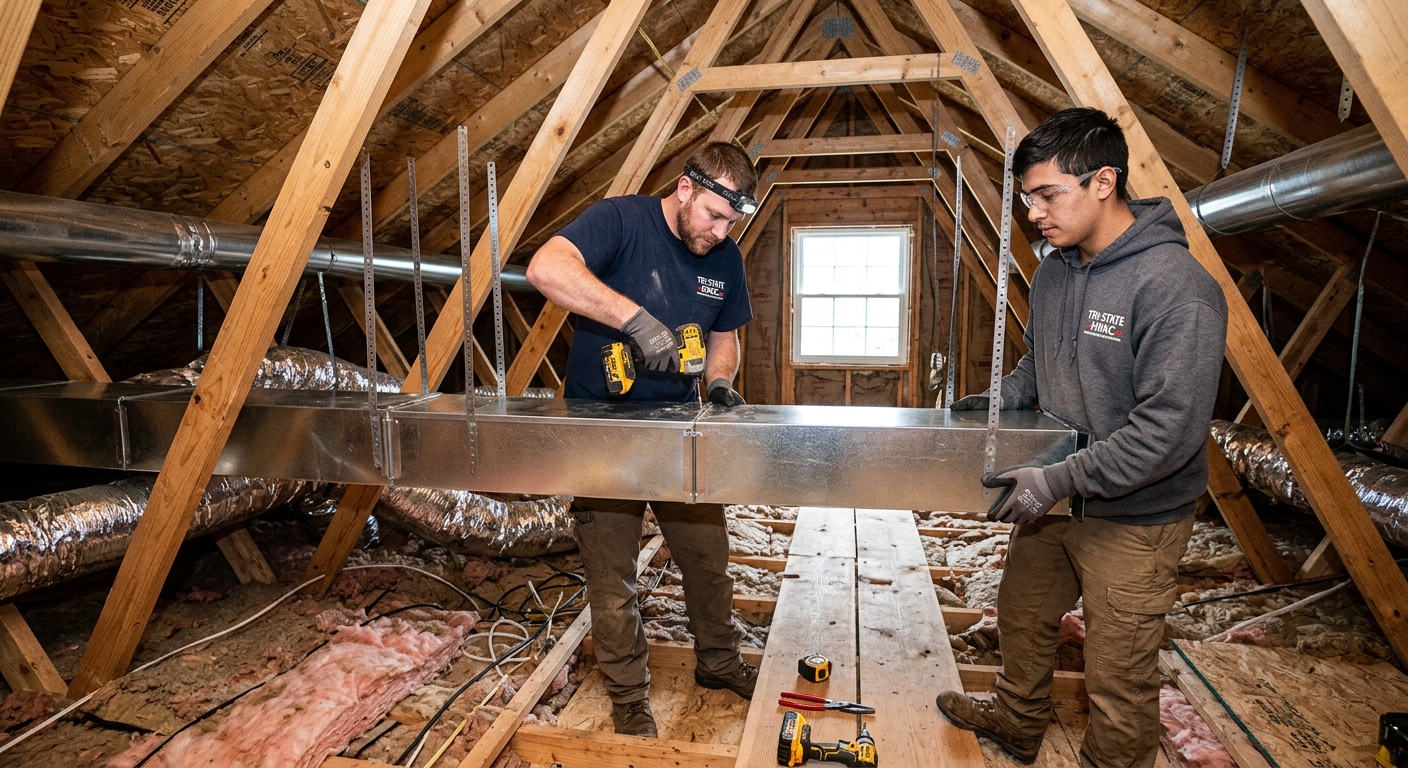
In Falls, the real wild card in your HVAC upgrade isn’t just the new unit—it’s the ductwork hidden above the ceiling or behind the walls. In post-1960 Bucks County homes, central forced-air was standard, but construction quality varied and most ducts were only sealed with tape (if at all). After decades of expansion, contraction and the odd handyman fix, duct leakage in older homes often wastes 20% or more of conditioned air, driving up both heating and cooling bills.
A duct blaster test is the gold standard for finding out just how much air you’re losing. It pressurizes your duct system, measuring leakage that even experienced installers can’t see by eye. If your system is leaking, air sealing—using mastic, aerosolized sealant, or proper insulation—can recover much of the efficiency lost without replacing all your ducts. In the common post-1960 tract homes of Falls and Bensalem, returns are often undersized, which chokes air delivery to key rooms. That also means your new system won’t run properly unless those returns are upgraded at the same time.
If your ducts run through attics or crawlspaces, poor insulation and open seams steal comfort year-round. The honest advice for Falls homes: before signing off on a new HVAC unit, have your ductwork tested and inspected. If you get leaks under control and size returns right, you’ll get more years (and lower bills) from whatever equipment you install.
When ductless is the right answer
Ductless mini-splits are most useful in Falls homes when you’re dealing with an addition, enclosed porch, finished attic, or a room that the original ductwork never reached. They also shine in older homes where adding new ductwork would mean major repairs to finished walls and ceilings—common in housing that predates the central air push of the sixties and seventies. Even many post-1960 homes in the Bensalem and Middletown corridor have rooms that were never comfortably cooled by the main system.
For a single room, a one-to-one (single-zone) mini-split gives superior comfort, efficiency, and responsiveness at a lower cost than a big multi-zone system. Multi-zone setups with several indoor heads on one outdoor condenser save space, but often deliver less capacity per room and can feel less dialed-in than single-zone units—especially when rooms have very different needs. Head placement on walls or ceilings matters for aesthetics, and you’ll need to plan for how to route the condensate and refrigerant lines to avoid visible trunking.
If a room you need to condition is far from existing ducts—or if your home simply never had central air—ductless is often the right answer even if owners haven’t considered it. In Falls, upgrades and additions mean ductless is common, whether homeowners realize they’re in the classic mini-split market or not.
Frequently asked questions — HVAC installation in Falls
Does my utility offer a heat pump rebate in Falls?
For residents of Falls, PECO Energy Company is your electric utility, and it occasionally runs rebate programs for qualifying heat pump installations. The catch is that the amounts, eligibility, and even program names often change from year to year. Before making a purchase, check PECO’s official energy efficiency rebate page and the national ENERGY STAR rebate finder online for up-to-date details. Rebates are usually deducted up front from the invoice or delivered as a check after installation. For example, a ducted heat pump installed in Falls typically costs $8,600–$18,500 depending on the size and type, and a utility rebate could take a small chunk off that total, provided your contractor submits the paperwork accurately. Don’t rely on old figures—a quick call or online search with PECO will tell you what’s currently available.
When is the best time of year to replace HVAC in Falls?
In Falls and throughout Bucks County, early spring and early fall are the most strategic times to schedule HVAC replacement. Demand for both heating and cooling work is lower, so contractors have more availability and sometimes faster permit processing from local offices. If you wait until peak season—July for AC or January for heating—you risk longer waits and emergency premiums. Planning ahead is especially important if you need a full duct system replacement, which in Falls runs $9,700–$19,500 installed; large jobs aren’t quick. Do your permits and equipment decisions during the milder weather if you can—a little planning avoids both heat wave and cold snap headaches.
How much does ductwork add to an HVAC installation?
In Falls homes, especially those built before the late 1970s, old or missing ductwork is common. Adding a new full duct system to an older house (or a major remodel) can add anywhere from $9,700–$19,500 to your project—often as much as the equipment itself. Factors driving the price up include layout complexity, finished ceilings and walls, and the need to upgrade or add returns. For homes with ductwork in fair-to-good shape, repairs and sealing are usually only a small fraction of that price. That’s why it’s smart to have your installer assess your ducts for leaks, insulation, and size before assuming a full duct replacement is needed.
What MERV filter rating should I use?
In Falls, you want to balance air quality, equipment protection, and airflow. A MERV 8 to 11 pleated filter offers solid dust and pollen protection for most households without overworking your system. Higher MERV ratings (13 and up) trap smaller particles but can restrict airflow—especially in older Bucks County duct systems not designed for high-resistance filters. If you have respiratory issues, pets, or allergies, you may want to try a MERV 11 or 13, but only if your equipment and ducts can handle it. For most Falls homes, which typically see moderate dust and pollen but also have ductwork that may never have been updated, a MERV 8 is safe and effective. This keeps your air clean without making your blower work overtime and risking system wear.
What is EPA Section 608 certification?
EPA Section 608 certification is a federal requirement for anyone handling refrigerants, like R-410A or the newer blends, during HVAC installation, repair, or disposal. In Falls and the rest of Pennsylvania, technicians working on your heat pump or central AC must have this credential, regardless of what the state or municipality requires for contractor registration. It shows the installer knows how to properly handle, recover, and dispose of refrigerant without releasing it into the environment. Even though Pennsylvania doesn’t run a statewide HVAC licensing board, make sure anyone working on your system has their Section 608 card—this is required for legal and responsible work, and you’re entitled to ask.
Can a heat pump heat my house without backup?
Yes, modern cold-climate heat pumps are designed to provide reliable heat without the need for a gas or electric backup—especially in Falls, where the typical winter design temperature is 14 °F. However, performance drops as it gets colder, so it’s critical your installer sizes the unit for full heating load on the coldest days. Many Falls homes opt for a cold-climate ducted heat pump, which costs $14,000–$18,500 installed. That said, electric strip backup or your existing furnace can help during extreme cold snaps. For most Falls residents, a properly sized heat pump can run as your primary source all winter, with or without a backup system kicking in on the rare single-digit night.
How often should I change my filter?
For most Falls homes, changing your HVAC filter every 60 to 90 days is a safe routine. If you have pets, allergies, or run your system heavily during peak summer and winter, swap it out every 30 to 45 days. Older Bucks County homes with ductwork that may never have been sealed or upgraded can pull in more dust, so check filters monthly your first season to find your home’s sweet spot. Neglecting this quick task can strain your blower, lower efficiency, and shorten the life of components—particularly true if you’ve just invested in a new system costing $8,600–$18,500. Clean filters keep air moving and protect your investment, even if they aren’t glamorous.
How much does a new HVAC system cost in Falls?
For a typical single-family home in Falls Township, a new central air conditioning system (replacing what you already have) generally lands in the $5,400–$13,000 range, including installation and all permits. Adding a ducted heat pump will run higher—usually $8,600–$18,500 installed. Ductless mini-splits start at $3,500–$7,600 for a single room. These ranges cover most real jobs in Falls, where the 1960s-1980s suburban housing stock shapes duct conditions and equipment choices. Final totals depend heavily on ductwork upgrades, electrical panel size, and how much existing equipment can be reused.
Do older Falls homes need ductwork replaced?
Many Falls homes—especially those built before 1980—have ductwork that’s leaking, uninsulated, or simply too small for today’s high-efficiency HVAC systems. Full duct replacement is recommended when testing shows high leakage, visible damage, or poor airflow even with cleaning and sealing. Replacement is a significant investment, with most Falls duct systems costing $9,700–$19,500 installed. However, if your ducts are only losing a moderate amount of air, targeted sealing and adding insulation can restore performance without a full tear-out. The key is a duct blaster test and a thorough inspection before the new equipment goes in—replacing expensive HVAC gear without addressing bad ducts is a wasteful move best avoided.