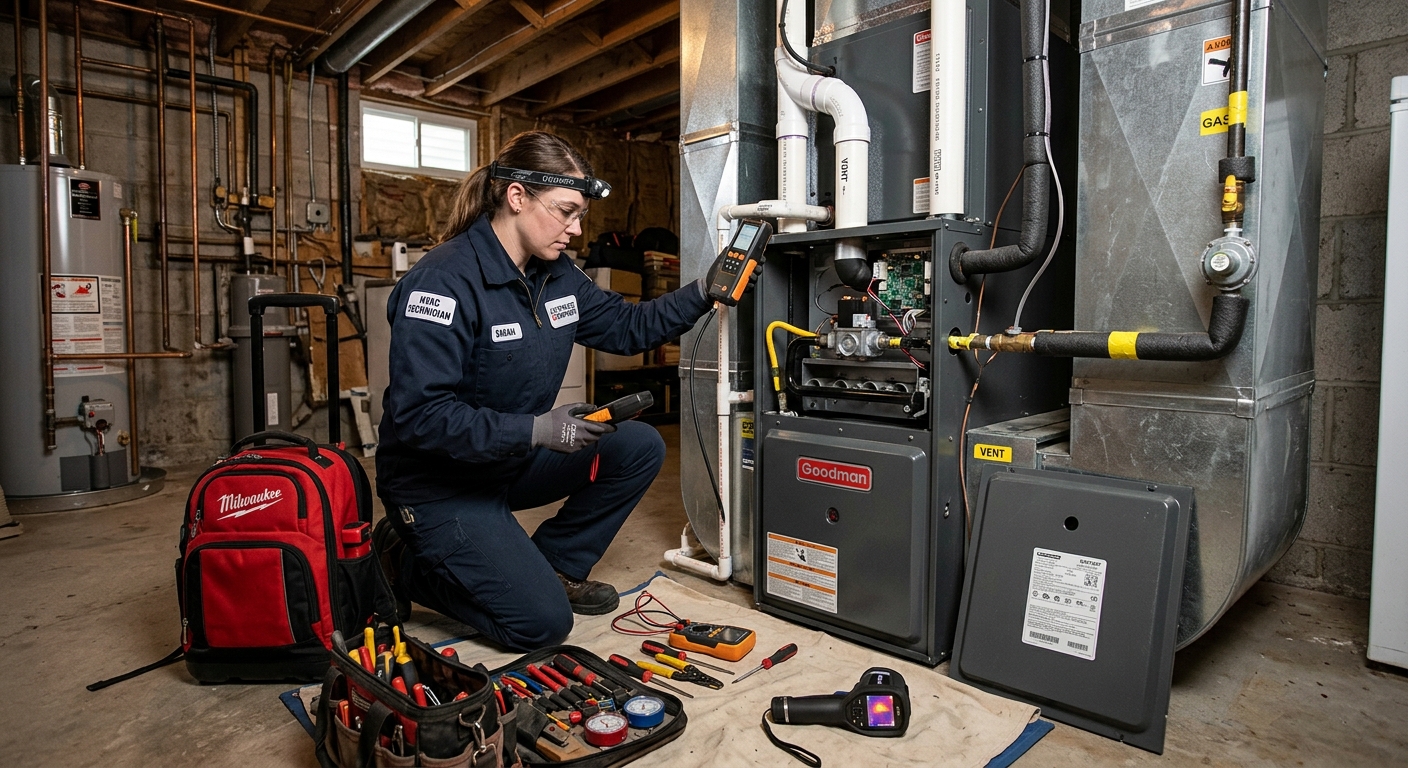
HVAC costs in East Coventry — 2026
East Coventry sits squarely in a replacement market. With a homeownership rate of 81.5% and more than half the housing stock built before 1980 (U.S. Census Bureau, ACS 2024), most of the forced-air systems put into Chester County developments between 1970 and 2000 are now near the end of their service lives. Existing ductwork is the rule, not the exception, and it shapes your options: in most homes, replacement means upgrading a full-sized central AC or furnace rather than starting from scratch.
This part of southeastern Pennsylvania is a heating-dominated climate. The area averages about 4,800 heating degree days per year, compared to just 1,450 cooling degree days. This means your dollar is better spent thinking first about heating capacity and efficiency—it’s a real winter market. Cooling matters, especially during humid summers, but the bulk of your energy bill is heating.
Whether you lean toward a heat pump, central AC, or a mix of ducted and ductless, your choices in East Coventry are influenced by your home’s structure and the state of the ducts. Multi-zone ductless mini-splits are practical in some scenarios, but most homes are still served by upgrading the equipment that matches the original layout.
| System |
Best for |
Efficiency |
Price range (installed) |
| Central AC replacement (existing ducts) |
homes with sound ductwork |
16–20 SEER2 |
$5,600–$13,500 |
| Air source heat pump (ducted) |
year-round heating and cooling |
8–10 HSPF2 |
$9,000–$19,000 |
| Cold-climate heat pump (ducted) |
heat pump as primary heat |
9–11 HSPF2 |
$14,500–$19,000 |
| Ductless mini-split (single zone) |
additions, rooms without ducts |
20–30 SEER2 |
$3,600–$7,900 |
| Full duct system installation |
homes with no existing ducts |
— |
$10,000–$20,500 |
Installed estimates for a typical East Coventry home. Equipment tonnage, duct condition and electrical capacity move these more than brand.
Mini-splits and zoning in East Coventry homes
Mini-split systems excel in the places East Coventry homes most often need help: converted spaces, finished basements, room additions, or upstairs bedrooms that the original duct layout never served properly. If you want air conditioning in a back addition, kitchen extension, or a third-floor room (many homes built before 1980 share this quirk), a ductless unit is the simplest, cleanest solution.
Single-zone mini-splits have a clear use: one outdoor unit, one indoor “head,” and a straightforward install. If you try to run several zones off a single outdoor unit, you save on wiring and condensing units outside but may lose efficiency and performance—multi-zone systems often leave one or more rooms uncomfortable, especially in winter. Unless space or aesthetics are a problem, separate single-zone systems are more predictable.
Placement matters. Heads on exterior walls near a drain simplify condensate handling and minimize exposed lines. Some object to the appearance of wall-mounted heads; recessed ceiling cassettes or slim ducted units are possible, but raise the cost and complexity.
Decades-old homes in Chester County, especially those built before the region-wide adoption of central air, are strong candidates for ductless. Trying to add ducts to finished plaster almost always costs more and delivers less comfort than targeted mini-split systems. Even in homes with aging forced air, supplementing with ductless in hard-to-reach spots can be the right call.
Choosing an installer in Chester County
In East Coventry and across Chester County, the most important factor in any HVAC project is not the brand—it’s the quality of the installation. The same piece of equipment will last twice as long and operate far more efficiently when installed and commissioned correctly. As you weigh installers, verify not just their paperwork but how they do the work.
Start with the contract. No residential job over $500 should proceed without a written agreement, as required by Pennsylvania law. Check that the company holds valid Home Improvement Contractor (HIC) registration (verify at hic.attorneygeneral.gov), carries workers’ compensation insurance for the crew (check at wcais.pa.gov), and that every technician handling refrigerant holds EPA Section 608 certification.
Your quote should include a load calculation (not just a guess based on square footage), model numbers matched for both indoor and outdoor units, and details on how the system will be commissioned—meaning tested for proper airflow and refrigerant charge. If you don’t see these things in writing, keep looking.
- Valid HIC registration (hic.attorneygeneral.gov)
- Proof of workers’ compensation insurance (wcais.pa.gov)
- EPA 608 refrigerant certification for all techs
- Load calculation performed, not estimated
- Written contract for any job over $500
- Model numbers for both units, not just brand and size
- Scope includes electrical, condensate, permitting
- Commissioning at start-up, with results provided
- Clear labor and equipment warranties, separately spelled out
- References from local jobs (not just company reviews)
- Lead paint procedures if pre-1978 work is involved
- Transparency on who manages municipal permits
With a dense pool of contractors covering greater Philadelphia, Chester County homeowners have choices—but not every company will take the time for the details that ensure long-term comfort and energy savings. If someone wants to skip the paperwork or gives only a handshake estimate, it’s a sign to move on.
Repair or replace your East Coventry system?
Many East Coventry homeowners wonder if they should patch up an aging HVAC or bite the bullet and replace. It’s not always a sales pitch—sometimes the numbers truly do point to repair.
Start with age. If your system is under ten years old and the fix is under 20% of full replacement, repair usually wins. Over 15 years, any major fault (like the compressor or heat exchanger) makes replacement logical—especially since older refrigerants are disappearing and new equipment runs far more efficiently.
The two situations where replacement isn’t optional are a cracked heat exchanger (a carbon monoxide risk) or a failed compressor once the warranty is up. In these cases, repairing simply isn’t safe or cost-effective, and there are no silver-bullet fixes. Otherwise, look at the repair cost as a percentage of replacement—you rarely want to spend more than a third patching up old equipment.
One last check: don’t chase efficiency. If your bills are high, have someone test your ducts and insulation first, rather than replacing equipment that may not be the root of the problem. In a heating-heavy climate like East Coventry, air leaks and poor insulation can move your bills more than the efficiency jump from a new system.
| Situation |
Recommendation |
Typical cost |
Reasoning |
| Under 10 years, single component failure |
Repair |
$300–$1,200 |
Most issues are minor; repair is cost-effective |
| 10–15 years, repair over a third of replacement |
Consider replacing |
$5,600–$13,500 |
Diminishing returns; avoid throwing money at aging equipment |
| 15+ years, any major failure |
Replace |
$5,600–$13,500 |
Past reasonable service life; costly repairs unlikely to last |
| Cracked heat exchanger, any age |
Replace immediately |
$5,600–$13,500 |
Carbon monoxide risk cannot be ignored |
| Compressor failure past warranty |
Replace |
$9,000–$19,000 |
Core failure; repair cost is not justified |
| Working system, high bills |
Test ducts and envelope first |
$300–$800 |
Leaks and insulation gaps often bigger than equipment savings |
Comparing HVAC estimates in East Coventry
Not every estimate is apples to apples. When you get quotes in East Coventry, look for specifics: both indoor and outdoor unit model numbers (these must be matched to earn their efficiency ratings), tonnage confirmed with a load calculation (not just what’s already in the house), and details about whether the lineset will be replaced or simply reused. Electrical upgrades should be scoped—some panels in older homes are undersized for new heat pumps.
Understand what’s included in the project: is there a new thermostat, is permitting handled by the contractor, and, crucially, will you get a written commissioning report showing measured airflow and refrigerant charge? Warranties should be split between labor from the installer and the equipment from the manufacturer.
A line-item quote is your only real protection—just seeing a “brand” and a big number is meaningless. When comparing, make sure each estimate lists how your existing ductwork will be handled, whether you get a new condensate line, and what you’re on the hook for if the inspector wants something improved before signoff.
| Line item |
What to look for |
Red flag if… |
| Equipment |
model numbers, indoor and outdoor matched |
brand name only |
| Sizing |
load calculation attached |
matched to the old nameplate |
| Ductwork |
condition assessed, sealing scoped |
not mentioned |
| Electrical |
circuit and panel capacity confirmed |
assumed adequate |
| Line set |
replaced or documented as reused |
silent |
| Commissioning |
measured airflow and charge, documented |
no startup report |
| Warranty |
labour years stated separately |
manufacturer only |
| Permit |
included and priced |
'not needed' |
Filtration, humidification and ventilation
East Coventry winters are long and dry, and summers stickier than many realize. In a heating-heavy climate with moderate freeze-thaw cycles, the practical issues are dryness from forced-air heat and the risk of summer humidity that even new central ACs can overshoot.
Here's a straight answer: if your air conditioning is oversized, it may fail to remove humidity properly—even as it cools the space. That leaves your home uncomfortable and makes mold more likely. Sizing, not just SEER2, is what matters for real-world comfort.
Whole-house humidifiers are helpful through our January–March low humidity, but they need regular cleaning and annual pad replacement to avoid mineral buildup and bacteria. If you want serious allergy relief, look for filters rated at MERV 11 or higher—but make sure your blower motor can handle the increased resistance, or you could actually harm system airflow.
Selling add-ons is common, but not every ventilation or air purification gadget delivers value. Mechanical ventilation is needed in modern, well-sealed homes but oversold in many existing Chester County homes that leak plenty on their own. In most cases, investing in tighter ducts and better filtration does more for air quality than UV lights or ionizers.
Permits, licensing and inspections in East Coventry
Pennsylvania does not license HVAC contractors at the state level for residential work. Instead, Home Improvement Contractor (HIC) registration is required for any contract over $500, covering Chester County and East Coventry. This is not a qualification exam but a consumer protection regulation tied to contract law. Always check credentials at hic.attorneygeneral.gov before signing.
Municipalities enforce the Pennsylvania Uniform Construction Code (IRC-based), so mechanical permits and inspections are handled locally. Central HVAC replacement in most towns, including those around East Coventry, requires a permit, particularly if the job touches the ductwork, electrical, or gas lines. The contractor should pull the permit; the final inspection ensures code compliance and safe operation.
Anyone handling refrigerant must have EPA Section 608 certification, regardless of state rules, and this applies to all types of refrigerant work. For insurance, verify not only liability coverage but that every person on-site is covered by valid Pennsylvania workers’ compensation insurance. Use the WCAIS database (wcais.pa.gov) to confirm. If your house was built before 1978 and work involves disturbing painted surfaces, insist on a contractor trained to the EPA Lead Renovation, Repair and Painting (RRP) Standard.
Frequently asked questions — HVAC installation in East Coventry
Is an annual maintenance plan worth it?
For most East Coventry homeowners, a good annual maintenance plan is worth the money—but only if it's executed professionally and includes real preventive maintenance, not just a filter swap. Our region’s climate works systems hard year-round, with freezing winters stressing heat components and humid summers putting load on condensate drains and coils. Cleaning, safety checks, refrigerant pressure measurement, and airflow tests help prevent expensive repairs. Most plans are in the $300–$800 range and should include both a pre-winter and pre-summer visit. It’s not mandatory for warranty coverage, but regular service keeps your equipment running longer and can spot issues before they knock you out of heating or cooling entirely. Just be wary of aggressive upsell tactics—stick with a locally established firm that handles tune-ups, not endless add-ons.
What is commissioning and why does it matter?
Commissioning is the process of ensuring your new East Coventry HVAC system is operating as designed, not just installed and switched on. That means verifying proper airflow, safe refrigerant charge, and matching control settings to your equipment—not “just making cold air.” In Chester County’s variable climate, measurements at start-up catch problems like undersized ducts, incorrect thermostat wiring, or refrigerant leaks that can otherwise go years undetected. The commissioning report is your proof that the job was finished to standard, not merely “good enough.” Many equipment issues start with an untested installation. When you’re paying $5,600–$13,500 or more, getting a written report and test results is not optional—it is what separates a quality local contractor from a shortcut artist.
Is natural gas available throughout Chester County?
Natural gas is widely available in the denser townships of Chester County such as West Chester, Tredyffrin, and West Goshen, all served by PECO Energy. In contrast, East Coventry and other western or rural areas are much more likely to use propane or heating oil, especially where development happened before gas mains were extended. This affects your replacement options and cost estimates—a natural gas furnace install may fall into the lower end of the $5,600–$13,500 range, while heat pumps or oil-to-gas conversions are often more. Before planning any replacement, confirm your specific utility service, as even houses on the same block can be split between gas and tank fuels.
How much does ductwork add to an HVAC installation?
Adding new ductwork is usually the single biggest cost variable in East Coventry, and is required for homes without central air or as part of large additions. Expect $10,000–$20,500 for a full duct system installation in a typical local house. If your existing ducts just need sealing or minor repair, costs drop sharply. But retrofitting ducts into finished spaces (especially older homes with plaster walls) is invasive and can drive the price higher than a ductless or mini-split system, which usually starts at $3,600–$7,900 for a single zone. Always get a duct assessment with your estimate—duct condition moves the total more than the brand of equipment.
What is EPA Section 608 certification?
EPA Section 608 certification is a federal requirement for anyone in East Coventry who installs, repairs, or disposes of equipment that could release refrigerants. This includes all modern central AC, heat pump, and mini-split installations using R-410A or other regulated substances. Certification is specific to refrigerant handling—it’s not a general HVAC “license”—and protects air quality by ensuring only trained technicians manage potentially harmful chemicals. Every installer working with your system should carry their card; don’t be shy about asking to see it. If you’re spending $9,000–$19,000 on a new system, this is one credential that cannot be skipped, regardless of state or local licensing rules.
Is a heat pump a good choice for East Coventry winters?
For most homes in East Coventry, a ducted heat pump—especially cold-climate models—can absolutely handle our average winter design temperature of 14°F. The technology has improved to the point where new systems operate reliably and efficiently even through our 4,800 heating degree days per year. Expect to pay between $9,000–$19,000 for an installed unit, with specialized cold-climate models on the higher end. If your house is drafty or under-insulated, sealing and weatherization matter just as much as equipment choice. In rural sections or homes without natural gas, a heat pump is often the most economical and future-proof option—but make sure your installer sizes the system with a true load calculation.
How much does a new HVAC system cost in East Coventry?
A full central air conditioning replacement for a typical East Coventry home with existing ducts will cost between $5,600–$13,500, with most homeowners ending up just under $9,000 depending on system size and duct condition. If you need a ducted heat pump for all-electric heating, you're in the $9,000–$19,000 range. For homes without central ducts, adding a full system starts at $10,000 and can approach the higher end with difficult layouts or plaster retrofits. Ductless mini-split systems for single rooms or additions generally run $3,600–$7,900 per zone. Final costs are shaped as much by your existing electrical and duct setup as by which brand you choose.
Can I service my R-410A system after the refrigerant change?
Yes, you can still have your R-410A system serviced and recharged in East Coventry even though new equipment is transitioning to lower-GWP refrigerants. Licensed technicians with EPA Section 608 certification can legally work with R-410A, and supplies will be available for years. If your system is under 15 years old and working well, there’s no need to rush into replacement just because the rules are changing. If you do replace, expect heat pump or AC options between $5,600–$13,500 for central systems or $3,600–$7,900 for a ductless unit. Don’t let anyone pressure you into an early upgrade; maintenance and repairs on R-410A systems remain standard in the local market.
Are duct sealing and insulation eligible for incentives?
Duct sealing and insulation can be some of the most cost-effective upgrades in East Coventry homes, especially given our high heating degree days and prevalence of older duct systems. While incentive programs come and go, most major utility and state energy programs treat duct sealing, smart thermostats, and weatherization as rebate-eligible when paired with high-efficiency HVAC installs. Sealing and insulating ducts typically falls in the $300–$800 range if done at the time of equipment replacement. Check current programs through PECO Energy and Pennsylvania Clean Energy channels before signing a contract—these rebates can help offset the initial investment and deliver year-round comfort.