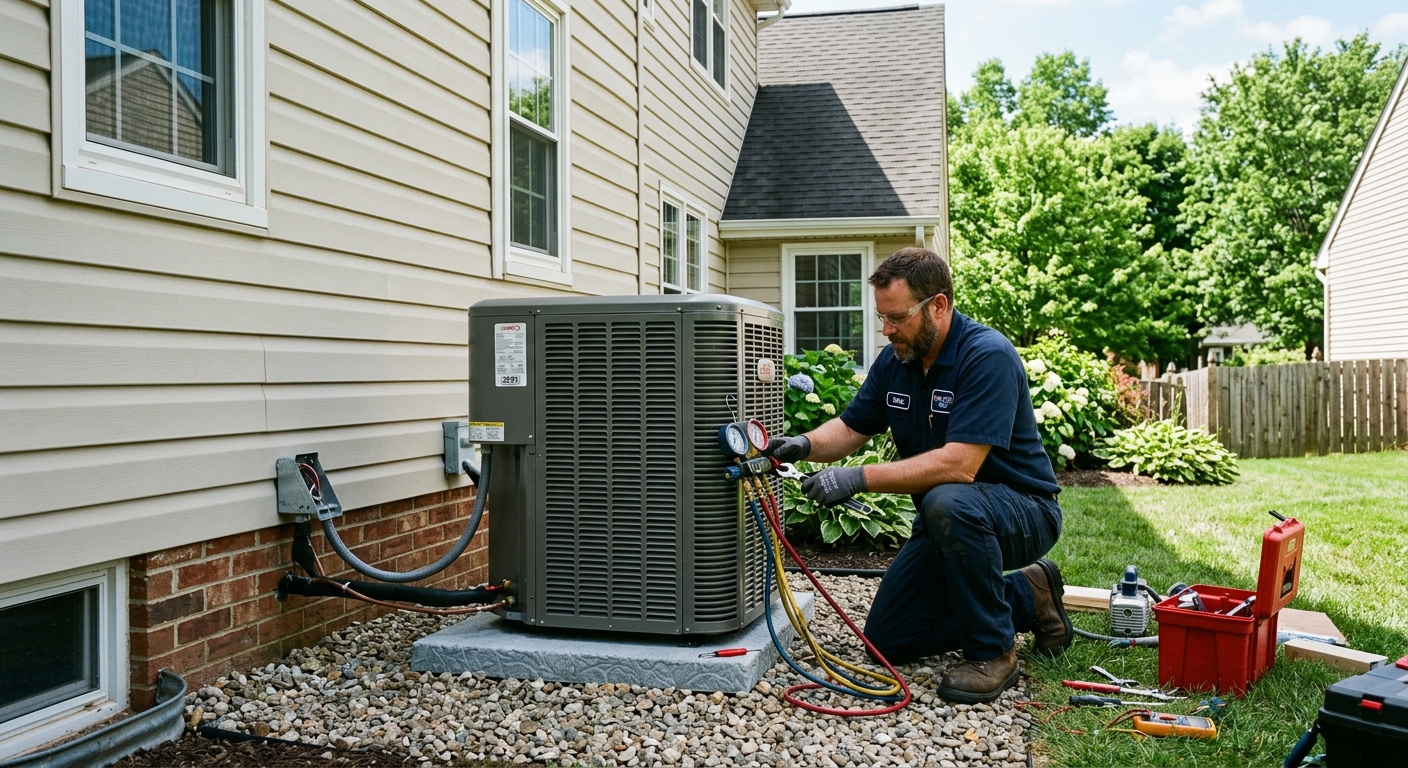
HVAC costs in Findlay — 2026
Findlay’s HVAC installation and replacement costs fall in line with typical Allegheny County numbers — but the reasons come straight from the way homes are built and lived in here. With a homeownership rate of 72.0% and almost half of local homes built before 1980 (U.S. Census Bureau, ACS 2024), you are likely dealing with a long-standing house and likely older ductwork, electrical panels, and insulation. This is a replacement-and-retrofit market, not ground-up new construction. Nearly all single-family homes have some sort of forced-air system already, but many of those ducts were sized for a big old furnace and may not be tight or insulated to today’s standards.
Heating is the top priority. Southwestern Pennsylvania’s winters are long and can be harsh: we see about 5,600 heating degree days but only 1,050 cooling degree days per year. That means sizing for cold-weather reliability is critical — and why many homes still stick with gas or even oil heat, especially where ducts were designed only for a furnace and not for the lower supply temperatures of a heat pump. If your ductwork is old or marginal, any price for a new system should plan for a possible duct upgrade or sealing. Retrofits sometimes hit electrical limits, as many pre-1960 homes have 100-amp panels or less, complicating the switch to heat pumps or higher-end ACs. Below, find what typical systems cost in Findlay for 2026:
| System |
Best for |
Efficiency |
Price range (installed) |
| Central AC replacement (existing ducts) |
homes with sound ductwork |
16–20 SEER2 |
$5,100–$12,000 |
| Air source heat pump (ducted) |
year-round heating and cooling |
8–10 HSPF2 |
$8,200–$17,500 |
| Cold-climate heat pump (ducted) |
heat pump as primary heat |
9–11 HSPF2 |
$13,500–$17,500 |
| Ductless mini-split (single zone) |
additions, rooms without ducts |
20–30 SEER2 |
$3,300–$7,100 |
| Full duct system installation |
homes with no existing ducts |
— |
$9,200–$18,500 |
Installed estimates for a typical Findlay home. Equipment tonnage, duct condition and electrical capacity move these more than brand.
Sizing: why bigger is worse
The single most common and costly mistake in HVAC installation around Findlay is oversizing the equipment. Many homeowners think a bigger system means better comfort, but in reality, it’s the opposite. An oversized unit cycles on and off in short bursts ("short cycling"), which leads to poor humidity control, uneven temperatures, noisy operation, and higher energy bills. Over time, this constant cycling shortens the lifespan of your system. Oversizing isn’t a safety margin; it’s a defect that only costs more in the long run.
Proper sizing always starts with a Manual J load calculation, which considers your home’s square footage, insulation, window types, orientation, and occupancy. The shortcut many contractors use — sizing off the old unit’s nameplate, or a “tons per square foot” rule — is not reliable, especially in Findlay’s older homes where insulation or windows may have been updated (or not). Every generation of equipment and every upgrade changes the true load.
This market’s winter design temperature is 8 °F. That means your heat load calculation must ensure your system keeps the house at the set temperature on a night when it’s 8 degrees outside. Don’t let a contractor quote a system without running the numbers specific to your house, not just your zip code. The right question to ask is, "Did you run a load calculation, and can I see the report?" If all you get is, “We’re matching the old system,” they’re just repeating past mistakes, which were probably oversized in the first place.
Ductwork: the part nobody quotes properly
If your home in Findlay is older — and almost half are, with pre-1960 construction dominating — the ductwork may matter more than the equipment itself. Most contractors ignore it in their quotes. In practice, older ducts often leak enough air to make your new furnace or heat pump work overtime: a duct blaster test can measure precisely how much conditioned air escapes before ever reaching a room. The leaks can easily waste 20–30% of the system’s output.
Sealing and insulating ducts that run through unconditioned crawlspaces or attics is one of the best investments in comfort and efficiency. On the other hand, if ducts were sized only with an old, oversized furnace in mind, supply and return sizes — especially returns — often choke off airflow for new, more efficient equipment or heat pumps, which require more airflow at lower supply temperatures. Chronic under-sizing on the return side is a common, invisible comfort killer.
Many pre-1960 houses never had central AC ductwork at all, or were retrofitted in the ‘70s or ‘80s with minimal attention to sizing or sealing. If your Findlay home’s ducts are old or questionable, ask for a duct leakage test before replacing any equipment. Test before, not after. Sealing is much cheaper than full replacement, but only a test will tell you if replacement is needed — not just a contractor’s guess by looking.
Reducing the net cost of a Findlay installation
The actual cost you pay for a new HVAC system in Findlay can be lowered by three types of incentives: federal tax credits, utility rebates, and state-level programs — but there’s no single “standard” amount, and the value changes every year. Federal tax credits (like for heat pumps or high-efficiency furnaces) typically reduce what you owe the IRS the following year, not the invoice from your contractor. Utility rebates — for Findlay, that’s through Duquesne Light Company for electric or Peoples Gas for natural gas — typically come as a cash rebate or bill credit, often weeks or months after you submit paperwork. You pay the full price up front and get reimbursed later.
For state-level programs and the latest rebate details, do not trust generic online numbers, as programs and eligibility change annually. Go to your actual utility provider’s efficiency or rebate page (Duquesne Light or Peoples Gas) for the most accurate, up-to-date incentives. The ENERGY STAR rebate finder is a good backup resource. If an article or quote gives you a specific dollar amount, treat it as a ballpark figure, not a promise. Always check with your utility and the manufacturer for current qualifications before you sign a contract.
What a Pennsylvania HVAC contractor must hold
Pennsylvania does not issue a statewide HVAC license for residential work. Instead, residential contractors must register as a Home Improvement Contractor with the Pennsylvania Office of Attorney General if the contract is over $500 — something you can verify directly (see the FACTS section for the link). Some municipalities require their own mechanical permits; in Allegheny County, the City of Pittsburgh handles its own HVAC permitting, while elsewhere it depends on your town or township.
No Pennsylvania-wide HVAC or electrical license exists. For refrigerant work — such as with any central AC or heat pump installation or replacement — every technician needs a federal EPA Section 608 certification. You can and should ask to see this if refrigerant lines are involved. Contractors with employees must also carry workers’ compensation insurance, which you can verify through the WCAIS system noted above. Always request proof of current HIC registration, insurance, and workers’ compensation before signing any contract.
Permits and final inspections for new or replacement HVAC work are almost always required within city limits and often elsewhere. An honest contractor will pull the permit and include it on the estimate. Pennsylvania’s Home Improvement Consumer Protection Act also means you’re entitled to a written contract and three business days to cancel — know your rights and don’t be rushed into a quick signature.
Heat pump or furnace: what makes sense in Findlay
Findlay’s heating needs are substantial, with a winter design temperature of 8 °F and 5,600 heating degree days per year. That’s a climate where reliable heat is non-negotiable for several months. Cold-climate heat pumps now perform well enough to handle most heating needs, even below freezing, but their capacity drops as outdoor temperatures fall — this is why understanding the local design temperature matters so much. Dual-fuel systems (heat pump with gas furnace backup) exist mostly for markets like southwestern Pennsylvania, where chilly snaps can push any heat pump to its limit.
In Allegheny County, natural gas is widely available, but there are still pockets in rural areas running on propane or fuel oil. Where you have gas, cost per BTU almost always favors a high-efficiency furnace, especially in older homes with existing ductwork sized for furnace airflow and supply temperatures. For homes without reliable or affordable gas, or if you’re planning to electrify, modern heat pumps make sense — but they may require a ductwork upgrade or even more electrical capacity than a furnace replacement. If you only have baseboard or electric resistance now, the efficiency gains from a heat pump are even more dramatic.
A gas furnace is still the right call if your house is already on natural gas, your electric panel is maxed out, or your ducts favor higher-temperature supply. Heat pumps are compelling for all-electric goals, but need the right supporting ductwork and electrical setup.
| Option |
Installed cost |
Operating cost here |
Best when |
Incentive eligible |
| Gas furnace + central AC |
$5,100–$12,000 |
lowest heat cost with gas service |
existing gas service, coldest zones |
partial |
| Ducted heat pump (cold climate) |
$8,200–$17,500 |
lowest cost with all-electric |
good envelope, all-electric goal |
yes |
| Dual fuel (heat pump + gas backup) |
$13,500–$17,500 |
lower than resistance backup |
gas on site, deep cold spells |
yes |
| Ductless multi-zone |
$9,200–$18,500 |
highest efficiency, zone control |
no ductwork, zone control |
yes |
Comparing HVAC estimates in Findlay
Not all HVAC quotes are created equal, and in Findlay, the differences matter. Every proper estimate should list model numbers for both the indoor and outdoor units; mismatching these often voids lab-tested efficiency. Tonnage should be backed by a load calculation with your address and insulation included. Electrical work — is the panel up to the task, or will you need an upgrade (common in pre-1960 houses)? Line sets (the copper piping for refrigerant) should be identified as either replaced or documented for safe reuse. Thermostat, condensate handling, permitting, and a written commissioning/airflow/charge report should appear on any real estimate. Warranties come in two parts: manufacturer (equipment) and labor (the installer’s workmanship). If only one is named, ask for both.
Quotes that mention only a brand and a price provide no basis for comparison, and leave you vulnerable to scope gaps and hidden extras. Insist on a detailed line-item estimate, and don’t be afraid to ask what’s missing.
| Line item |
What to look for |
Red flag if… |
| Equipment |
model numbers, indoor and outdoor matched |
brand name only |
| Sizing |
load calculation attached |
matched to the old nameplate |
| Ductwork |
condition assessed, sealing scoped |
not mentioned |
| Electrical |
circuit and panel capacity confirmed |
assumed adequate |
| Line set |
replaced or documented as reused |
silent |
| Commissioning |
measured airflow and charge, documented |
no startup report |
| Warranty |
labour years stated separately |
manufacturer only |
| Permit |
included and priced |
'not needed' |
Frequently asked questions — HVAC installation in Findlay
How much does a furnace replacement cost in Findlay?
In Findlay, the cost for a standard gas furnace replacement, when paired with a central air conditioner and using existing ductwork, typically ranges from $5,100–$12,000. Most homeowners land near the middle of this range, with higher prices reflecting upgraded efficiency, complex duct modifications, or electrical work. If your ductwork is sound and your existing gas lines are adequate, you’ll stay closer to the lower end. The wide range is mainly due to the age of homes in Findlay; with almost half built before 1980, surprises behind walls are common. Always insist on a line-item proposal, so you know what’s included, and be wary of lowball bids—they often skip critical pieces like duct sealing. Remember, costs for equipment alone are only part of the total; labour, permits, and commissioning are just as important to budget for.
How cold does it get in Findlay and does that affect heat pumps?
Findlay’s winter design temperature is 8 °F, and we get about 5,600 heating degree days each year. This means your heating system has to reliably keep up even when it’s single digits outside, not just in the shoulder seasons. Modern cold-climate heat pumps are up to the challenge and can supply useful heat well below freezing, but their capacity falls off as the outside air gets colder—so proper sizing and supporting ductwork is crucial. For older homes, that may mean some duct modifications or a dual-fuel setup with a gas backup. If you’re considering a ducted cold-climate heat pump, installed costs typically run $13,500–$17,500. In summary: yes, Findlay’s winters matter, but today’s equipment can handle it with the right planning.
What is commissioning and why does it matter?
Commissioning is the process every HVAC contractor should do immediately after installation—measuring airflow, refrigerant charge, and start-up performance to make sure your new system actually delivers the efficiency and comfort it promised. In Findlay’s older homes, even a perfectly installed furnace or heat pump won’t work right if duct leakage or low airflow are left unchecked. A proper commissioning report should be part of your final paperwork. Without it, your 18 SEER2 or 10 HSPF2 system may behave like an 8 SEER clunker. A commissioning step is always included in high-quality installations, whether you’re paying $5,100–$12,000 for a system or more. Never accept “We ran it and it works” as proof—insist on the data.
How often should I change my filter?
In Pennsylvania, including Findlay, most homeowners with standard 1" pleated filters should check and change their filter every one to three months—more often if you have pets, smoke, or ongoing renovation dust. Many houses here have older systems or ductwork, so filters can load up quickly, stressing your furnace or air handler and raising energy bills. A clogged filter can even cause your system to shut down for safety. If you’re running a high-efficiency or media filter (such as a 4" model), check the manufacturer’s instructions—these can go longer, but only if no unusual dust or airflow issues happen. Considering that a replacement air source heat pump or high-efficiency furnace can cost $8,200–$17,500, spending a few dollars on filters is cheap insurance.
Do I need dual fuel in southwestern Pennsylvania?
Dual fuel (combining a heat pump with a gas furnace backup) is especially practical in Findlay. Our weather sees stretches of single-digit lows—the 8 °F design temperature is reached almost every winter—and while cold-climate heat pumps perform well, their output declines as temperatures drop. If you have access to natural gas, dual fuel gives you the efficiency of a heat pump most of the year, but the reliable heat of a furnace on the coldest nights. Installed costs for dual fuel systems here range from $13,500–$17,500. Dual fuel is often the best financial and comfort option if you want to use less gas without giving up backup protection, especially in older homes with marginal ductwork or questionable electrical service.
What HVAC tax credits are available to Findlay homeowners?
Findlay homeowners are typically eligible for federal tax credits on high-efficiency HVAC equipment such as heat pumps and certain central ACs or furnaces. These credits reduce your federal tax bill for the following year, not your upfront payment. Local utility rebates from Duquesne Light Company or Peoples Gas may also be available, offering cash back after installation and paperwork. Because incentive programs change yearly and by product, don’t rely on numbers from generic articles. Instead, check your utility’s efficiency program page and the ENERGY STAR rebate finder for the latest. For instance, it’s common to see incentives for ducted heat pumps in the $8,200–$17,500 install range, but the rebate specifics shift yearly. Always confirm the requirements and amounts before you buy to avoid disappointment.
Do I need a permit to replace HVAC in Findlay?
In Findlay, a permit is required for new HVAC installation, replacement, or major alteration in city limits and often in surrounding municipalities. The purpose is to ensure safety, code compliance with the Pennsylvania Uniform Construction Code (UCC), and proper documentation of refrigerant handling. Your contractor should handle the permit and include any fees in the written quote. Never trust a quote that claims a permit isn’t needed—it’s a red flag. Permit costs are usually bundled with the job, whether you’re paying $5,100–$12,000 for a standard AC/furnace replacement or more. Always ask to see the final inspection sign-off before you make the last payment.
How much does ductwork add to an HVAC installation?
Full duct system installation is a major cost in Findlay, often equal to or even more than the HVAC equipment itself—especially in homes with no existing ducts or those needing extensive retrofitting due to pre-1960 construction. As of 2026, a typical full duct install runs between $9,200–$18,500 in this market. This covers all the supply and return branches, registers, connections, and sealing. In many retrofit jobs, careful duct sealing, repair, or modest replacement of returns adds $1,000–$3,000 to the project but pays for itself in comfort and lower bills. Always ask for a ductwork leakage test before settling on full replacement; sometimes all you really need is sealing and insulation.
What does HSPF2 measure?
HSPF2—or Heating Seasonal Performance Factor 2—is how the newest generation of air source heat pumps are rated for heating efficiency. It’s the total amount of heating provided over a winter, divided by the electricity used, under the more realistic 2023 test protocols. For Findlay, where 5,600 heating degree days mean significant heating demand, a high HSPF2 rating (9–11 for cold-climate models) means your heat pump will deliver more heat for every dollar spent on electricity. System choices with HSPF2 ratings at the upper end—like those in the $13,500–$17,500 installed range—will cut winter bills, especially if you’re converting from electric resistance or oil heat. Don’t compare old HSPF numbers to HSPF2: the scale changed, and newer numbers are stricter.