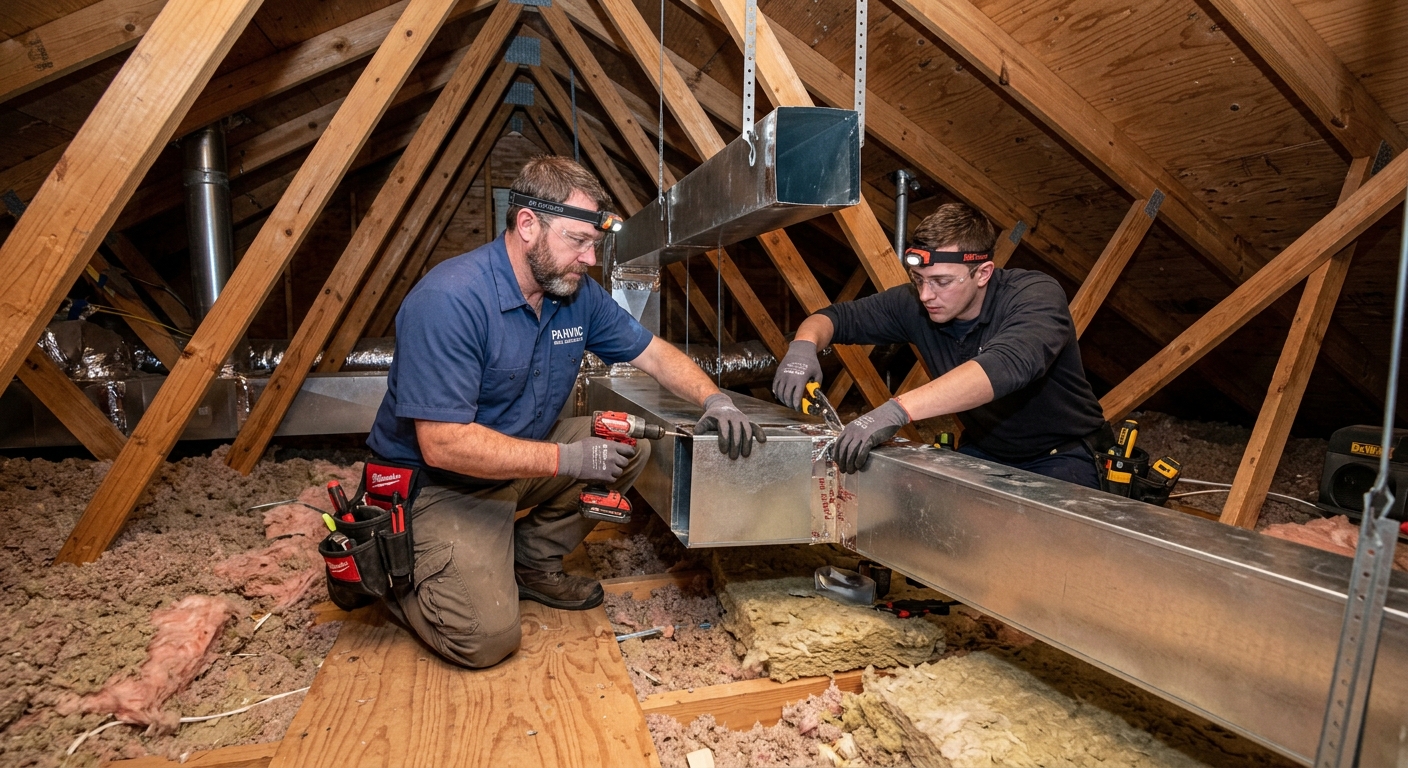
Tyrone heating and cooling prices by system type — 2026
Tyrone’s real-world HVAC costs are shaped by old homes and how they’re built. With a homeownership rate of 56.2% and 86.3% of homes built before 1980 (U.S. Census Bureau, ACS 2024), this is a retrofit and replacement market, not a new-construction one. Most houses aren’t laid out for modern ductwork, because Blair County’s housing is heavily wood-frame stock from 1900–1940, predating central air and standard ducts. If your current system works, it’s probably been retrofitted at some point — and if you’re looking to upgrade, there’s a good chance a lot of your dollars go toward making new equipment fit a tricky space or streetside lot.
Our climate here is squarely heating-dominated. With 6,300 heating degree days and a winter design temperature of 2 °F, heating costs and reliability matter more than those seven sticky weeks in July and August (only 750 cooling degree days). That also means systems are sized for heat first, then cooling. In Tyrone, the best value often comes from heat pumps and efficient furnaces that can handle a long, icy winter — and from being clear up front on the condition (or absence) of your ductwork.
| System |
Best for |
Efficiency |
Price range (installed) |
| Central AC replacement (existing ducts) |
homes with sound ductwork |
16–20 SEER2 |
$4,500–$10,500 |
| Air source heat pump (ducted) |
year-round heating and cooling |
8–10 HSPF2 |
$7,200–$15,000 |
| Cold-climate heat pump (ducted) |
heat pump as primary heat |
9–11 HSPF2 |
$11,500–$15,000 |
| Ductless mini-split (single zone) |
additions, rooms without ducts |
20–30 SEER2 |
$2,900–$6,300 |
| Full duct system installation |
homes with no existing ducts |
— |
$8,100–$16,000 |
Installed estimates for a typical Tyrone home. Equipment tonnage, duct condition and electrical capacity move these more than brand.
When ductless is the right answer
Ductless mini-splits are the best solution for rooms or houses where regular ductwork either never existed or costs too much to add. In Tyrone and Blair County, this includes a lot of older homes and converted attics, basements, or additions. With so much 1900–1940 housing, many homes never had central air to begin with, and retrofitting new ducts usually means destroying walls or historic plaster. For a small space, a single-zone ductless system is almost always the cleanest option — quick install, minimal intrusion, and energy bills that reflect the room you actually use.
When comparing single-zone and multi-zone setups, remember: one outdoor unit driving several indoor heads (multi-zone) may sound neat, but it often underperforms compared to a couple of separate single-zone systems, especially for heating. Multi-zone systems can have trouble balancing comfort and humidity room to room, and they're less efficient when you’re only conditioning one or two areas at a time. Placement matters too — high up on a wall is typical, but you will have a box in plain sight, and condensate (the water the system pulls out of the air) still needs to drain somewhere, often with an external pump.
In Blair County’s old housing stock, where shoehorning in new ductwork is expensive and disruptive, mini-splits give comfort without a major remodel. If you’re only conditioning one space, or the existing system leaves a room always hot or cold, ductless is usually the purest value for the dollar. If you’re looking at a multi-zone for the whole house, get numbers for a couple of single-zone installs too; sometimes, it’s the more comfortable and efficient approach.
What size system does a Tyrone home need?
System sizing is hands down the biggest thing a contractor can get wrong — and the most common. Oversized systems don’t just waste power; they cycle on and off too quickly, wear out their parts, cause temperature swings and leave your Tyrone home sticky in summer because the AC doesn’t run long enough to pull out humidity. An 'extra ton for safety' is not safer; it’s a design flaw.
The only right way to size is a Manual J load calculation. This method crunches your home’s square footage, insulation, window types, how much sun you get, and even the winter design temperature — for us, that’s 2 °F. That means your contractor should be picking equipment that will keep you warm and safe at our coldest, not just eyeballing square footage or copying the old system’s label, which might have been oversized or undersized from day one.
If your installer doesn’t mention doing a load calculation, or can’t show you the write-up, that’s your cue to ask: “Did you run a Manual J, and can I see it?” Anyone sizing just from the old nameplate or a rule of thumb is betting your house looks like every other house. In Tyrone, where most homes date back to before 1940, every structure is different. Smart sizing means better comfort, lower bills, and fewer headaches — and it costs nothing to ask for it.
Comparing HVAC estimates in Tyrone
Getting two or more HVAC quotes for your Tyrone home is smart, but those numbers mean nothing unless you know what’s included. You need to see model numbers for both indoor and outdoor units — a mismatched system won’t deliver its rated performance. Check that the quote includes system sizing with the actual load calculation, not just a guess off your old equipment. Ductwork assessment is crucial, especially in older Blair County homes that have been retrofitted multiple times. Electrical upgrades, thermostat, condensate handling (especially with new high-efficiency or ductless), and line-set replacement versus reuse all belong in print.
Permitting, startup checks (commissioning report), and labor warranty should appear separate from the manufacturer’s warranty. If you don’t see these in a written quote, you can’t compare apples to apples. A quote that only names a brand and a single price isn’t worth your time — you need every line item spelled out.
| Line item |
What to look for |
Red flag if… |
| Equipment |
model numbers, indoor and outdoor matched |
brand name only |
| Sizing |
load calculation attached |
matched to the old nameplate |
| Ductwork |
condition assessed, sealing scoped |
not mentioned |
| Electrical |
circuit and panel capacity confirmed |
assumed adequate |
| Line set |
replaced or documented as reused |
silent |
| Commissioning |
measured airflow and charge, documented |
no startup report |
| Warranty |
labour years stated separately |
manufacturer only |
| Permit |
included and priced |
'not needed' |
The comfort problem that isn't temperature
In Tyrone, we feel the problem every winter: air gets bone-dry when it’s 2 °F outside and the furnace is running. The long heating season (6,300 degree days) means static shocks, cracked woodwork and dry skin are common unless you address winter humidity directly. In summer, there are only about 750 cooling degree days, but humidity spikes during those weeks and an AC has to run long enough to actually pull moisture out.
If your air conditioner is oversized, it will cool the house fast but shut off before it really dehumidifies — making the house feel clammy even with the thermostat set low. A properly sized system matters more than any add-on. Whole-house humidifiers help in winter, but they need cleaning or they’ll cause other issues. Upgrading filters beyond MERV 8 or so means checking that your blower can actually handle the resistance, or you’ll cut airflow and burden the system.
If your house was built tight or heavily air-sealed in a retrofit, mechanical ventilation can help, but most older Tyrone homes do not need expensive add-ons like UV lights or “air scrubbers.” Add-ons are frequently oversold in this market, especially electronic upgrades that promise “lab-grade air” for a price that could pay for an actual duct repair. If you want better air quality, routine filter changes and humidity control do more than most gadgets.
Permits, licensing and inspections in Tyrone
In Pennsylvania, there is no statewide HVAC trade license for residential work. What you do need is a contractor with a Home Improvement Contractor (HIC) registration from the Pennsylvania Office of Attorney General if your contract exceeds $500. Always verify their HIC number using the state site. Blair County municipalities — including Altoona and Tyrone’s surrounding townships — each run their own mechanical permitting offices, so local permits and inspections are always part of the job.
Even without a state license, every HVAC installer working with refrigerant must have an EPA Section 608 certification — a federal requirement that applies everywhere, not just here. Mechanical permits are enforced locally, sometimes by the borough, sometimes by the city or township, and always included in a contract that’s worth signing. Written contracts are required by state law on home improvement over $500, and homeowners have a three-business-day cancellation right.
Don’t just accept “insured” on faith. Pennsylvania requires mandatory workers’ compensation coverage for all HVAC employers, which you can confirm through WCAIS. For jobs in houses built before 1978, make sure your contractor complies with the EPA Lead RRP Rule — something that applies to much of Blair County’s housing. Bottom line: you don’t get a state HVAC license, but the paperwork for each job is still crucial in Tyrone.
Running the numbers on Tyrone's climate
When you’re told a high-efficiency system saves money, the calculation comes down to climate, efficiency, and your actual utility rate. Tyrone’s climate is heating-dominated: 6,300 heating degree days vs. 750 cooling. The winter design temperature is just 2 °F, so a large share of your bill goes to heating, with the bulk of that cost falling on electric or fuel use depending on your system.
Here’s the basic method: The efficiency rating converts energy into delivered heat or cooling (for example, a heat pump with 9 HSPF2), and degree days tell us about your annual heating or cooling load. You find your electric rate on your Penelec bill if you’re in most of Blair County. Multiply annual kWh by your rate ($/kWh) for annual electric cost. For fuel systems, multiply annual BTUs needed by the fuel's cost per BTU.
An example: If your house needs 40 million BTUs of heat per year (just a placeholder—your actual number depends on a load calc), a heat pump at 9 HSPF2 uses about 4,440 kWh for that load. At, for example, a 15-cent per kWh rate, that’s about $666 annually. Swap in your real rate and your home’s actual load to update this math with your bill. But remember — these numbers break down fast if your ductwork leaks or is uninsulated. A high-efficiency system connected to bad ducts can cost more to run than a mid-tier unit on solid ducts. Before chasing the highest efficiency sticker, fix your duct losses first; otherwise the promised savings aren’t real.
Frequently asked questions — HVAC installation in Tyrone
How long should an HVAC system last in Tyrone?
The typical lifespan of an HVAC system in Tyrone is 12 to 18 years for central air and furnaces, with heat pumps sometimes on the lower end due to heavier yearly use. Tyrone’s long heating season (6,300 heating degree days) means your heating equipment works hard, but regular maintenance goes further here than brand alone. Many homes here dating to before 1940 have upgraded repeatedly, so system age can vary block by block. Don't push past 20 years for safety and efficiency — older equipment costs more on the bill and may not meet current code, especially if you’re replacing in a 1900–1940 wood-frame house. When you budget for a replacement, expect a central AC with existing ducts to run $4,500–$10,500.
How cold does it get in Tyrone and does that affect heat pumps?
Tyrone’s winter design temperature is 2 °F, which means any heat pump here is working against harsh real cold. Standard heat pumps can struggle during these deep cold snaps — you’ll still have heat, but output drops and backup heat (electric resistance or a fuel furnace) may kick in. Cold-climate ducted heat pumps, built for these conditions, keep efficiency up even below freezing. For most of Blair County, a modern cold-climate heat pump is a real option — these systems start at $11,500–$15,000 installed — but the contractor must specify its performance at low temperatures and recommend backup if your house can’t meet full load at 2 °F.
What does a heat pump cost installed in Tyrone?
The installed cost of a ducted heat pump in Tyrone typically falls between $7,200–$15,000, and cold-climate models for primary heat cost $11,500–$15,000. These ranges depend on the size of your old system, ductwork upgrades, and sometimes electrical panel changes — especially in Blair County homes built before 1980. If you only need to condition one room or addition, a ductless mini-split can cost much less, often $2,900–$6,300 per zone installed. Most older Tyrone homes will see a wide range on quotes because new ductwork or electrical service may be required.
Can a heat pump heat my house without backup?
Whether a heat pump can heat your Tyrone home by itself depends on both the equipment chosen and the house’s insulation. In a Blair County winter, with a design temperature of 2 °F, only true cold-climate rated heat pumps should be trusted as a lone heat source — and then only if a contractor’s Manual J load calculation shows the unit can cover your full heating needs at low temps. Many older homes here have weak insulation or leaky windows, so backup electric heat strips or keeping your old furnace as a secondary source is often the wise call. Cold-climate models installed here start at $11,500–$15,000; always get the system’s performance at low temp in writing.
Why do HVAC quotes in Tyrone vary so much?
HVAC quotes in Tyrone often swing by thousands of dollars — not just because of brand, but because of what is (and isn’t) included. Blair County’s older homes drive costs for new ductwork, electrical upgrades, condensate drains and code-required permits. Some contractors include all those line items; others only price the equipment and leave surprises for later. Always ask for model numbers, attached load calculations, and line-by-line scope; never accept a quote that is just a brand and a lump sum. For example, a full duct system install here costs $8,100–$16,000, so double-check what’s in the fine print.
Do I need a permit to replace HVAC in Tyrone?
Yes. In Tyrone and the rest of Blair County, all HVAC installations and replacements require a mechanical permit, with inspection enforced by each municipality. State law doesn’t license HVAC at the trade level for residential work, but that does not mean you skip local permits. Contractors must have valid HIC registration for jobs over $500 and EPA Section 608 certification for refrigerant handling. Make sure your installer pulls the necessary permits, includes them in your contract, and provides documentation — never trust any outfit saying it's “not needed." Permit costs are usually rolled into quotes of $7,200–$15,000 for a ducted heat pump or similar job.
What size HVAC system does my Tyrone home need?
Sizing should never be a guess in Tyrone’s old and varied housing stock. The right way to determine system size is a Manual J load calculation — taking into account your square footage, insulation, windows, and our winter design temperature of 2 °F. Do not accept a quote that sizes your new system solely off the nameplate of an old furnace or AC; that repeats old mistakes. Proper sizing means a more comfortable home, lower energy bills and lasting equipment. Replacement costs in Tyrone range from $4,500–$10,500 for a central AC to $7,200–$15,000 for a ducted heat pump, but what matters most is that the capacity matches your actual heat load.
How is a tax credit different from a rebate?
A tax credit directly reduces the amount of income tax you owe to the IRS or PA Revenue, and you usually file for it the following tax year. A rebate, on the other hand, is a cash-back or instant discount, often from your utility or manufacturer, applied right after purchase or installation. In Tyrone, most heat pump installs between $7,200–$15,000 may be eligible for both, depending on specific energy efficiency ratings. Always ask your contractor which incentives are available for your zip code, and how they apply — sometimes a “rebate” is post-installation and requires paperwork. Make sure any quote claiming to include incentives spells out how and when you’ll actually receive the money.
What is commissioning and why does it matter?
Commissioning means checking and documenting that your HVAC system, after install, actually runs to spec: correct refrigerant charge, airflow, and thermostat operation. For Tyrone homes — most built well before the current code era — commissioning is the difference between an efficient new system and one that never performs as promised. A proper commissioning report is your proof that the new installation is working to the manufacturer's numbers, not just “blowing air.” Especially at the price points here ($4,500–$15,000 depending on system), you should expect the contractor to provide a written record of checks and startup readings. If your quote or completed job lacks a startup or commissioning report, you’re not getting full value.