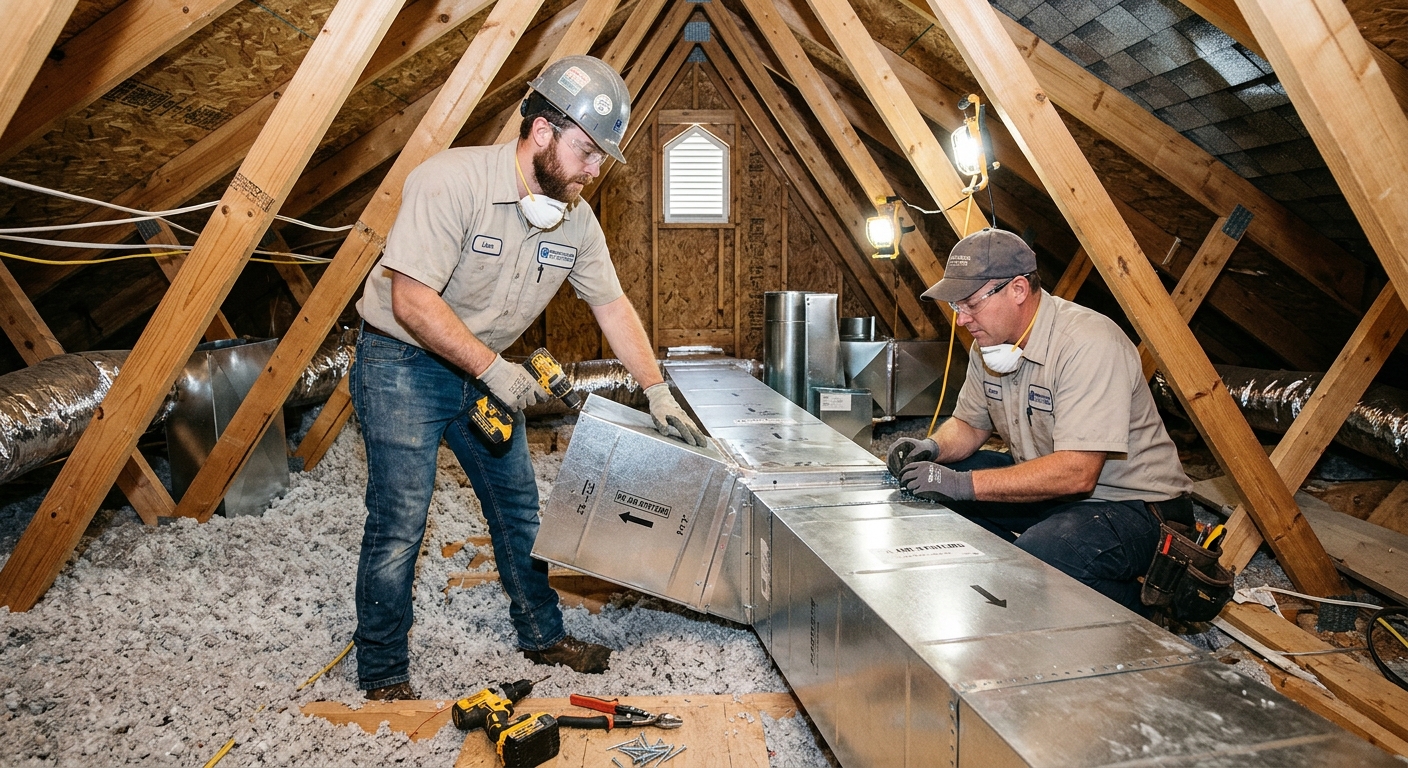
HVAC costs in Upper Allen — 2026
Upper Allen has a high homeownership rate and a sizable stock of homes built before 1980 (U.S. Census Bureau, ACS 2024). This means most calls here are for replacing aging central air and heating systems, not first-time installs. The same pattern holds in nearby Hampden and Silver Spring, where post-1960 suburban expansion brought in split systems and ductwork. In these neighborhoods, houses generally already have central ductwork—though not always in perfect shape after decades of use.
Central Pennsylvania’s 5,200 heating degree days signal a heating-dominated climate, with winters that can hit 12 °F. Cooling degree days, at 1,250, matter, but heating is the lead concern. That means choices like air source heat pumps have to perform in serious winter, and even a new air conditioner is often installed with one eye on the furnace or heat pump it shares ductwork with.
| System |
Best for |
Efficiency |
Price range (installed) |
| Central AC replacement (existing ducts) |
homes with sound ductwork |
16–20 SEER2 |
$5,200–$12,500 |
| Air source heat pump (ducted) |
year-round heating and cooling |
8–10 HSPF2 |
$8,400–$17,500 |
| Cold-climate heat pump (ducted) |
heat pump as primary heat |
9–11 HSPF2 |
$13,500–$17,500 |
| Ductless mini-split (single zone) |
additions, rooms without ducts |
20–30 SEER2 |
$3,300–$7,300 |
| Full duct system installation |
homes with no existing ducts |
— |
$9,400–$19,000 |
Installed estimates for a typical Upper Allen home. Equipment tonnage, duct condition and electrical capacity move these more than brand.
Mechanical permits for HVAC work in Upper Allen
Pennsylvania does not issue a statewide HVAC license, and there's no single state board overseeing the trade. Instead, residential HVAC work falls under the Pennsylvania Uniform Construction Code (UCC) based on the IRC, and enforcement happens at the municipal level. In Upper Allen, that means your township code office, not Harrisburg, decides if your contractor needs a permit for HVAC installation or replacement. Each municipality within Cumberland County—including Upper Allen—runs its own code enforcement.
Any contractor who handles refrigerant must hold an EPA Section 608 certification. This is federal law, not state or local, so it applies no matter who you hire in Pennsylvania. Most jobs—especially replacement or installation—require a mechanical permit and an inspection to close out the job, even if you’re just swapping a system with identical specs.
For consumer protection, Pennsylvania requires contractors doing residential jobs over $500 to be registered as Home Improvement Contractors (HIC) with the Office of Attorney General. You can verify registration at hic.attorneygeneral.gov. Workers' compensation insurance is also mandatory for any employer; check compliance at wcais.pa.gov. A written contract is required, and by law, you get three business days to cancel after signing. These measures help filter out uninsured or unregistered crews—never skip this check.
Service plans: worth it or not?
Most annual service plans bundle a basic tune-up, a filter replacement, and a checkout for your system. What really matters is that your filter gets changed at the right interval (every 1–3 months) and with a MERV rating that fits your blower—too restrictive and you'll stress an older fan motor. Coil cleaning and unclogging the condensate line keep major problems at bay, but these are jobs you can often schedule separately if you’re on the ball.
The critical check is refrigerant: proper maintenance means verifying the charge is correct, not just topping up a leaking system year after year. If a tech adds refrigerant every visit, there’s a leak that needs locating, not “maintenance.”
Are service plans worth it? Sometimes. If you get priority scheduling during breakdowns, a real annual inspection, and a discount on major repairs, it can pay off. But plans that skip meaningful checks or push unnecessary “cleanings” are a waste. In Upper Allen, schedule your tune-up in spring or fall, before contractors get slammed with no-cool or no-heat emergencies. Never prepay for years ahead—year-to-year is as far as you should go.
Mini-splits and zoning in Upper Allen homes
Ductless mini-splits make real sense in Upper Allen, especially for additions, converted garages, finished attics and basements, or the stray bedroom your central system never quite reached. In parts of Cumberland County where the housing stock still predates central air, such as in some older neighborhoods of Hampden or Silver Spring, ductless is often the simplest retrofit because it means no cutting into finished plaster or snaking modern ducts into old framing.
Single-zone systems—one indoor head and one outdoor unit—cost less up front $3,300–$7,300 and deliver targeted comfort. As you add indoor units to a single outdoor condenser in a multi-zone design, total installation costs go up and per-zone performance can drop; sometimes, two separate single-zone systems outperform a single multi-zone. Where you place the indoor head matters for efficiency and aesthetics—the look doesn’t suit everyone, and condensate from each head must drain properly to avoid mold and water damage.
With so much housing built during the post-1960 tract wave, many Upper Allen homes already have full ductwork—making central system replacement straightforward. But in rooms never served or additions built before everyone put in central air, ductless is the only clean solution, saving mess and cost.
Retrofit versus replacement in Upper Allen
Upper Allen’s home stock, like much of Cumberland County, reflects two big waves: a third of homes predate 1980, but many were built during suburban booms in the 1960s and after (U.S. Census Bureau, ACS 2024). If your house is in a 1970s subdivision, you likely have at least original ductwork. Whether it’s sized for both heating and cooling is another story—many systems were sized for heating only, leaving rooms stuffy in July.
Older homes can have under-insulated attics, single-pane windows, or minimal wall insulation. If electric panel capacity is low (main fuse boxes or undersized circuits), running a modern heat pump or adding air conditioning may call for an upgrade. Chimney and flue condition matter for gas furnace replacements—masonry that’s seen 50 winters can crack, and relining may be required.
For newer suburban homes, it’s usually about replacing the original, builder-grade HVAC. If your furnace or AC is from the late 1990s, you’re at or past its expected lifespan. These original units were often generously oversized to avoid call-backs—meaning replacements are a chance to rightsize for actual loads and boost comfort, not just duplicate what’s there out of habit.
The comfort problem that isn't temperature
Upper Allen’s climate brings two big challenges: winter dryness and sticky summer humidity. With winters dropping to 12 °F and humidity swings typical of central Pennsylvania’s freeze-thaw cycles, temperature control is half the game.
Oversized air conditioners are a hidden enemy: they drop temperature fast but don’t run long enough to pull out summer humidity, leaving the air clammy. Whole-house humidifiers can relieve dryness in winter, but require regular pad changes and attention—neglected, they can build up mold or mineral scale and even leak into ductwork.
On filtration, a MERV 8–11 filter strikes a reasonable balance between trapping dust and not stressing most residential blowers; higher MERV may require a more powerful fan or retrofitting the return. Mechanical ventilation makes sense in tightly sealed newer houses, avoiding stale air and indoor pollutants. But add-ons like UV lights or portable air cleaners are oversold—homeowners rarely get measurable benefit from these unless backed by a specific diagnosis or known allergy risk.
Manual J and the tonnage question
In Upper Allen, the right sizing of your system is the most important thing a contractor does. Too large, and the unit short cycles—turning on and off in rapid bursts—leading to uneven temperatures, poor humidity control and a unit that wears out early. Many homeowners (and some contractors) believe oversizing is a “safety margin,” when it's really a defect.
True sizing for Cumberland County homes uses a Manual J load calculation, not a rule of thumb per square foot. Manual J accounts for window quality, insulation, duct leakage, home orientation and more—aligned to the 12 °F winter design temperature. This calculation ensures you get year-round comfort, not just a system that meets a guess.
Always ask, “Did you run a Manual J, and can I see the report?” If a contractor bases sizing on your old system’s nameplate, they’re guessing—or copying someone else’s old error. Given how many homes in Upper Allen were built during boom years, it’s common to find units that were oversized to avoid call-backs, not to fit your real needs today. Fix it now and you improve comfort, control bills, and extend equipment life.
Frequently asked questions — HVAC installation in Upper Allen
Is an annual maintenance plan worth it?
Most Upper Allen homeowners will find value in a decent annual maintenance plan—especially if your system is out of warranty or sized close to the heating or cooling load. A plan that covers a basic inspection, proper cleaning, and a tune-up is worth it, but avoid contracts that promise little more than a filter change you could do yourself. Repair discounts and priority service during busy seasons (like our Central PA winter cold snaps) can tip the balance. However, expensive multi-year prepayments often aren’t needed; go contract by contract each year. For what you’ll pay in Upper Allen, a single emergency call could easily cost you more than the annual plan price. For reference, even a minor AC repair can run several hundred dollars, and a replacement system here starts at $5,200–$12,500 installed.
Do I need to be home during installation?
It’s best for at least one person to be home when the installation crew first arrives, to confirm access, discuss work zones, and point out any special requirements—like pets, gates, or finished areas needing extra care. After the initial walkthrough, clients in Upper Allen often head to work or run errands while reputable crews work in the background. For whole house HVAC installations and especially full duct replacement $9,400–$19,000, expect several check-ins throughout the process. You’ll need to be present before final sign-off, especially if a code official will inspect the finished job. Plan for some noise and a few hours without heating or cooling. Always secure valuables and alert the crew to any home security measures.
What MERV filter rating should I use?
In most Upper Allen homes, a MERV 8 to MERV 11 filter is the safe sweet spot for both performance and blower longevity. While higher MERV ratings trap finer particles, many existing HVAC blowers—especially those from the original tract development era—aren’t designed to push air through the additional resistance. If you install filters above MERV 11 without matching the blower strength, you risk reduced airflow and can even freeze the AC coil or overheat the furnace. For households with allergies or health concerns, ask about upgrading to a deeper filter cabinet or a variable-speed blower. Remember, a well-fitted MERV 8–11 filter, changed on time, does more good than a neglected high-MERV filter every six months. Filter replacements are regularly included in service plans, which in Upper Allen run less than a single call for AC replacement $5,200–$12,500.
What HVAC tax credits are available to Upper Allen homeowners?
Upper Allen homeowners may be eligible for certain federal tax credits when installing high-efficiency heat pumps, air conditioners, or certain advanced controls. However, Pennsylvania itself doesn’t offer a state-level credit or rebate unique to HVAC installs. The available federal incentives depend on system efficiency—look for ENERGY STAR-rated ducted heat pumps or central AC with at least 16–18 SEER2 and 8–10 HSPF2. Always confirm eligibility for current credits before purchase. Remember, the savings are based on equipment installed, which for a quality ducted heat pump in Upper Allen would mean a total cost between $8,400–$17,500. Save all paperwork, and ask your contractor to provide model numbers and efficiency documentation needed for tax forms at filing time.
How much does a new HVAC system cost in Upper Allen?
The price landscape in Upper Allen, as in all of Cumberland County’s I-81 corridor suburbs, is shaped by replacement demand. Most central AC replacements—where you already have good ductwork—land between $5,200–$12,500. For a ducted air source heat pump that handles both heating and cooling, expect $8,400–$17,500. Ductless mini-splits, typically used in additions or rooms never served by the main system, install for $3,300–$7,300 per zone. Full duct system installations, sometimes needed in older homes or large remodels, cost $9,400–$19,000. Factors moving cost up or down include system tonnage, the state of your ductwork, new electrical needs, and your choice of efficiency features, not so much the brand label on the box.
Who inspects HVAC work in Upper Allen?
Mechanical permits and code inspections for HVAC work in Upper Allen are handled by your township’s code enforcement office—not a centralized state board or agency. The actual inspector is a local code official who checks that the installation meets the Pennsylvania Uniform Construction Code (UCC), which is based on the IRC. All substantial replacements and new system installations, including central AC, heat pumps, and new duct runs, require a final inspection before you pay your last bill. If you’re adding refrigerant lines, handling refrigerant, or dramatically altering the system, federal law also requires an EPA Section 608-certified technician for that part. Always ask your contractor about the exact inspection steps; for a heat pump install $8,400–$17,500, you should expect a final walkthrough before the permit is closed out.
How much does a furnace replacement cost in Upper Allen?
While furnace-only replacements aren’t always listed on published price bands, the cost in Upper Allen aligns closely with entry-level central AC swaps when ducts are already present—think $5,200–$12,500 for a quality installation. That range assumes you’re not bundling furnace and AC (which brings a package discount) and that your gas or propane lines, flues, and electrical supply are in serviceable shape. If there’s major ductwork repair, vent relining, or a need to add modern smart controls, expect the price to edge up. Pricing across Cumberland County often tracks gas availability: homes with easy access to UGI Utilities’ mains can have more options and sometimes lower installation cost than rural properties on fuel oil or propane.
How cold does it get in Upper Allen and does that affect heat pumps?
In Upper Allen, winter design temperatures drop to 12 °F—a legitimate challenge for standard ducted heat pumps. Traditional units sometimes struggle below 20 °F, drawing heavy power and needing supplemental electric heat strips to keep up. Newer cold-climate heat pumps, engineered for our climate, reliably provide heat down to 5 °F or lower, albeit with some efficiency loss. For most of Cumberland County, heat pump system prices run from $8,400–$17,500, with cold-climate rated models sitting in the higher end of that band. When planning a replacement, make sure the chosen unit is rated for performance at our actual regional lows, not just “mild” climates—this is not the place to cut corners on sizing, backup heat, or proper controls.
Is a heat pump a good choice for Upper Allen winters?
Yes—if you choose the right equipment. Modern cold-climate ducted heat pumps, properly sized using a Manual J calculation, provide year-round comfort in Upper Allen’s heating-driven climate. Our region still faces deep-winter lows down to 12 °F, but high-performance heat pumps handle these conditions with only short intervals where auxiliary heat (electric resistance) may be needed. Many homeowners see lower total energy use, especially if their old furnace was inefficient or their AC was failing. Upfront installed cost for a cold-climate ducted heat pump in Upper Allen is typically $13,500–$17,500. For older homes with poor insulation or leaky ducts, some supplemental or backup heat is still smart, but for most suburban houses post-1960, a modern heat pump works well for both heating and cooling.