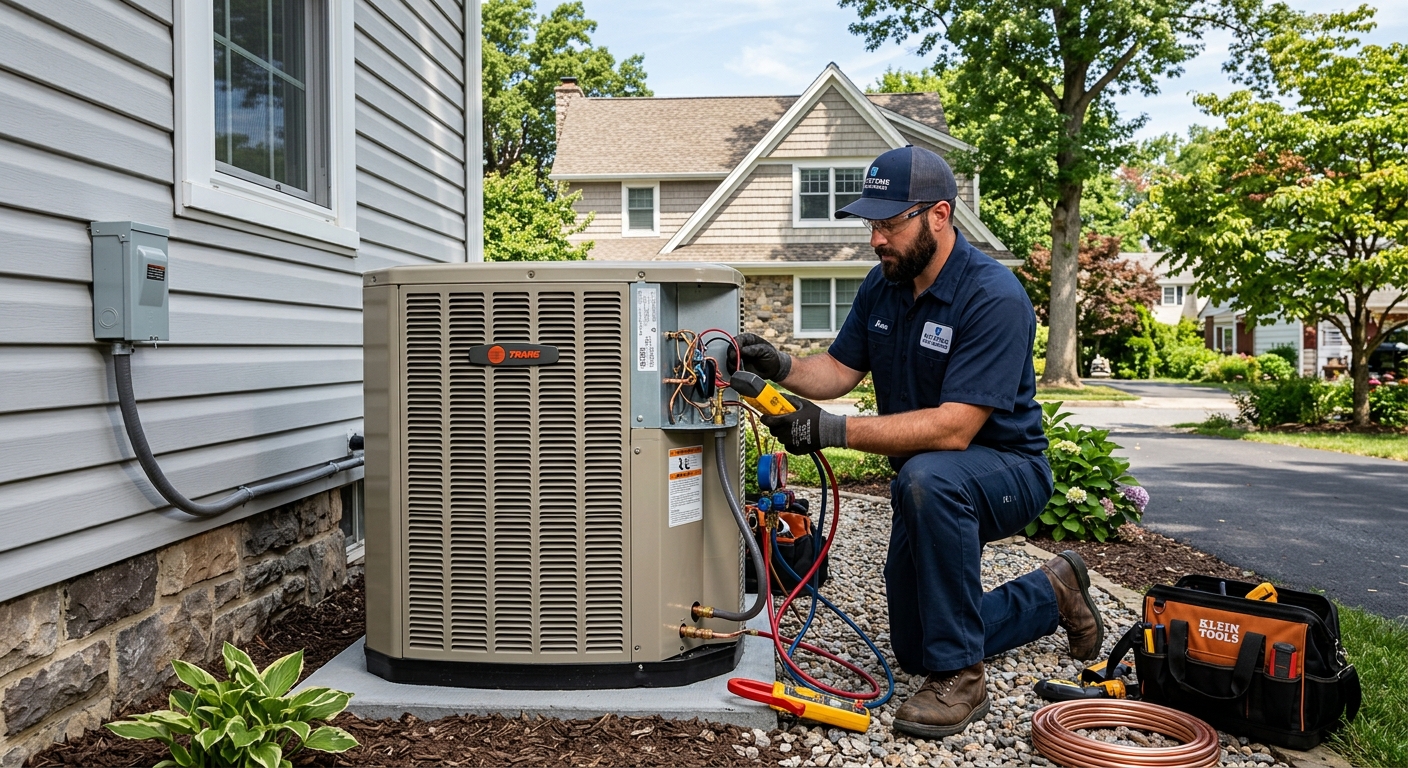
What a new HVAC system costs in Upper Milford
Upper Milford, with its 89.9% homeownership rate and over half its homes built before 1980 (U.S. Census Bureau, ACS 2024), is mostly a replacement market. Many homes here already have some form of forced air or hydronic heat, but the age and quality of existing ductwork varies widely. The large swath of 1960–1990 suburban tracts in areas like South Whitehall and Upper Macungie means frequent change-outs and duct reworks as original systems reach the end of their lifespan. In these neighborhoods, retrofitting is common, but so are complete duct system installations for homes that started with baseboard heat or had poorly sized ducts installed with builder-grade equipment.
Our local climate is heating-dominated, with 6,100 heating degree days outpacing just 850 cooling degree days and a winter design temperature of 4°F. That means sizing and investment emphasis should tilt first toward winter performance and distribution. Air conditioning is not an afterthought, but the reliability and efficiency of your heating source carries more long-term weight in Upper Milford than in warmer areas.
| System |
Best for |
Efficiency |
Price range (installed) |
| Central AC replacement (existing ducts) |
homes with sound ductwork |
16–20 SEER2 |
$5,400–$13,000 |
| Air source heat pump (ducted) |
year-round heating and cooling |
8–10 HSPF2 |
$8,700–$18,500 |
| Cold-climate heat pump (ducted) |
heat pump as primary heat |
9–11 HSPF2 |
$14,000–$18,500 |
| Ductless mini-split (single zone) |
additions, rooms without ducts |
20–30 SEER2 |
$3,500–$7,600 |
| Full duct system installation |
homes with no existing ducts |
— |
$9,800–$19,500 |
Installed estimates for a typical Upper Milford home. Equipment tonnage, duct condition and electrical capacity move these more than brand.
Rebates and tax credits for Upper Milford homeowners
Upper Milford homeowners can draw on three types of incentives for a new HVAC system: federal tax credits, utility rebates, and state-level programs. The federal tax credit, usually linked to the equipment's efficiency, lets you claim a portion of the project cost on your tax return, lowering your tax owed the following year. This does not put cash in your hand now, but can take the sting out of your next filing. By contrast, rebates from utility companies like PPL Electric Utilities and UGI Utilities, if your home is served by these providers, can reduce your upfront invoice—sometimes as an instant discount or a check back after installation and documentation.
State-level programs are often budget-dependent and change year to year. Because rebates aren’t guaranteed and may run out mid-year, it’s always best to check current availability before signing a contract. Program names, qualifying equipment, and payout amounts change annually, so any published number is just a ballpark. Start by checking your electric or gas utility’s efficiency program page, and use the ENERGY STAR rebate finder online for national updates that include local offers.
One important distinction: a rebate is direct cash back, while a tax credit offsets your liability after you file taxes. Both can defray the cost, but they impact your cash flow in different ways. Always ask your contractor for the most up-to-date links to eligible programs, but verify independently since rules and budgets reset on fiscal and calendar cycles.
Manual J and the tonnage question
Nothing affects your comfort and long-term bills more than proper sizing of your HVAC system. In Upper Milford, oversizing is the most common—and avoidable—mistake. Contrary to some beliefs, bigger is not safer. An oversized system short cycles, turns on and off too frequently, costs more, delivers uneven temperatures, and seldom removes enough humidity. This leads to uncomfortable rooms and a system that wears out before its time.
The industry standard for correct sizing is a Manual J load calculation. This process looks at your home’s square footage, insulation, window type, orientation, air leakage, and local weather, including our winter design temperature of 4°F. Rules of thumb or just copying the old unit’s size typically means inheriting old errors—sometimes one from 30 years ago, when insulation and window performance were lower.
The right question to ask any contractor is: “Did you run a Manual J load calculation, and can I see it?” Every reputable installer should be able to hand it over. If you’re shown only the nameplate from the existing unit, that’s a red flag—it is just repeating a possible past mistake.
Manual J ensures your new system is sized for Upper Milford winters, not just the average season. Cutting corners on this step, even to save a few hours, typically costs you much more in higher winter bills, uneven temperatures, or a noisy, short-lived unit.
Why your ducts may be the real problem in Upper Milford
Many Upper Milford homes, especially those from the 1960–1990 building boom in surrounding suburbs, have ductwork installed either hastily or with only heating in mind. Leaky or poorly sized ducts waste both money and comfort. It’s common to find duct leakage so high that a third or more of conditioned air never reaches the registers—a problem that can cost far more in wasted energy than any equipment upgrade saves.
A duct blaster test measures exactly how much air escapes from the duct system. This is the best way to judge whether you need duct sealing, targeted repair, or full replacement. Often, ducts are salvageable with professional sealing, but returns (the main air intake lines) tend to be routinely undersized, especially in homes where central air was added after original construction.
Ducts running through unconditioned attics or crawlspaces are at even greater risk for leaks and temperature losses. In many older Upper Milford homes, adding insulation or rerouting these ducts can transform both efficiency and comfort. In newer tracts, expect to find original ducts that were never sealed or properly commissioned.
The best time to test your ducts is before replacing heating or air conditioning equipment. This lets you invest in duct sealing or improvements before a new, efficient system struggles with the same distribution problems. More horsepower can’t fix a bad highway; fix the ducts first.
What a real HVAC quote contains
An HVAC quote in Upper Milford should be a clear, detailed document—never just a brand and a price. Insist on model numbers for both indoor and outdoor units; efficiency is only delivered if these match as designed. Look for clear equipment sizing with a Manual J load calculation provided. Ductwork details matter: the best quotes spell out whether sealing, repairs, or return upgrades are included.
Next, check electrical work. Many older homes need panel or circuit upgrades, especially for heat pump conversions—this should be documented, not assumed. The line set (refrigerant piping) may be reused, but only if its size and condition are verified, otherwise replacement is better. Installation should always include a new thermostat (unless specified) and proper condensate handling.
Mechanicals in Upper Milford require a permit—this should be line-itemed, not brushed aside. Finally, ask about the commissioning report (documenting measured airflow and charge) and the breakdown on labor versus equipment warranty. A well-written quote lets apples-to-apples comparison; less detail means more risk for you.
| Line item |
What to look for |
Red flag if… |
| Equipment |
model numbers, indoor and outdoor matched |
brand name only |
| Sizing |
load calculation attached |
matched to the old nameplate |
| Ductwork |
condition assessed, sealing scoped |
not mentioned |
| Electrical |
circuit and panel capacity confirmed |
assumed adequate |
| Line set |
replaced or documented as reused |
silent |
| Commissioning |
measured airflow and charge, documented |
no startup report |
| Warranty |
labour years stated separately |
manufacturer only |
| Permit |
included and priced |
'not needed' |
Retrofit versus replacement in Upper Milford
With 52.2% of Upper Milford homes built before 1980 (U.S. Census Bureau, ACS 2024) and a heavy presence of 1960–1990 tract development in nearby townships, the most common project is upgrading or outright replacing aging systems. Many original homes had only heating ducts—or lacked ducts entirely if baseboard or radiant systems were used—so projects can involve significant ductwork, not just equipment swap. Insulation levels and windows from these builds were often much lower performing than modern standards, making system sizing and blower capacity critical.
Original electrical panels in older homes might not have the spare capacity for all-electric heat pumps; checking available amperage has to be part of your estimate. If your home still uses fuel oil or propane, but UGI Utilities offers gas to your street, conversion may add value but can trigger a need for chimney or flue evaluation—another hidden cost.
In tract homes from the 1990s, builder-grade systems are reaching the end of their useful lifespan about now. These were often oversized for cooling, and never optimized for higher-efficiency heat pumps. It’s not just about “replacement”—it’s about correcting the original installation’s shortcuts. That’s why first-replacement timing and skilled assessment matter most in this market.
Mechanical permits for HVAC work in Upper Milford
Pennsylvania does not issue a statewide license for HVAC contractors. For residential HVAC jobs like those in Upper Milford, the regulation happens at the municipal level: the township or city office enforces the mechanical permit process, not a statewide board. This local system means every project needs to meet the Pennsylvania Uniform Construction Code (UCC), which is based on the IRC and enforced by your township—unless your municipality has opted out, in which case Pennsylvania’s Department of Labor & Industry steps in. Always check with your local office before work begins.
Contractors must be registered with the Pennsylvania Office of Attorney General for jobs over $500—this is called Home Improvement Contractor registration. You can verify their status on hic.attorneygeneral.gov. For any job with refrigerant, EPA Section 608 certification is federally required for installers or technicians; this has nothing to do with the state, and there’s no workaround for it.
Mechanical permits are not optional in the Upper Milford area for central air or heat pump installations. The permit covers the installation code and ensures an inspector reviews the work. To confirm insurance and workers' compensation coverage, Pennsylvania uses the WCAIS platform (wcais.pa.gov). Ask contractors for their paperwork—and check it—before signing a contract. This protects both you and the workers on site.
Frequently asked questions — HVAC installation in Upper Milford
Is a heat pump a good choice for Upper Milford winters?
Heat pumps have come a long way, and many are now very capable of handling Upper Milford’s winter temperatures, which dip to 4°F on design days. Modern cold-climate models can supply heat efficiently even in the cold snaps we get. Homes with decent insulation and tight ductwork see the best results. Still, some older homes may benefit from a backup heat source, especially on the coldest nights. Upgrading to a ducted cold-climate system typically runs $14,000–$18,500 installed. If your ductwork is old or scarce, additional costs come into play. No system is perfect for every home, but today’s heat pumps are a serious option, not just for mild regions.
How do I verify an HVAC contractor's insurance?
In Pennsylvania, and specifically in Upper Milford, you can check a contractor’s workers’ compensation coverage through the state’s WCAIS website (wcais.pa.gov). For general liability and completed operations, always ask for certificates from the insurance company itself—never just printed sheets. It’s best to call the insurer to be sure the policy is active and covers the job you’re hiring out. For jobs over $500, contractors must be registered with the Pennsylvania Office of Attorney General, which you can verify online. Protecting your project means verifying both insurance and registration before any deposit changes hands.
What does a heat pump cost installed in Upper Milford?
For a typical ducted air source heat pump, installed and ready to go in a standard Upper Milford home with decent ductwork, expect a price between $8,700–$18,500. Most land in the middle, around $14,000. Factors moving the price up include system size, the need for main panel upgrades, or any new ductwork. Cold-climate models intended to handle all winter heating can be at the top end of that scale. Always ask for a detailed quote that lists model numbers and includes a load calculation, not just a single “installed” price.
Why are my Upper Milford energy bills high with a new system?
Even new HVAC equipment can’t deliver low bills if the underlying problems remain, which is especially true in Upper Milford’s older homes. Duct leakage, poor insulation, or oversizing can mean you see energy bills nearly as high as before. Even a unit with a high SEER2 or HSPF2 rating—say, a $5,400–$13,000 central AC—can’t average down your monthly costs if half the air escapes through leaky ducts or the attic is under-insulated. Always get the ductwork tested and inspected as part of the installation, since that’s where many hidden losses start.
Do I need to be home during installation?
It is highly recommended to be home, at least at the beginning and end of your HVAC installation in Upper Milford. The start gives you a chance to review the scope with your technicians—clarifying thermostat placement, outdoor unit location, and line set routing. Being around at the end lets you see the final product and walk through operation or paperwork (like warranties, commissioning reports, and verifying the permit inspection). For longer projects, such as a full duct system (which can run $9,800–$19,500), you may only need to coordinate day-to-day access. Communication and availability help avoid surprises and ensure the job is done right.
What is SEER2 and how is it different from SEER?
SEER2 is the new standard for rating air conditioning efficiency, updated by the Department of Energy to better reflect real-world conditions—including increased static pressure from real duct systems, just like many found in Upper Milford. SEER2 values are a bit lower than the old SEER ratings for the same equipment because the test is tougher. When comparing options—like a $5,400–$13,000 central AC—look for SEER2, as that’s what’s required for code and rebates now. Only compare equipment using the same rating system to see an apples-to-apples number for efficiency.
What does a ductless mini-split cost in Upper Milford?
Installing a ductless mini-split in Upper Milford, for a single zone such as a bedroom or addition, typically costs between $3,500–$7,600 installed. Most homeowners see prices around $5,400. Factors like line length, mounting height, and local electrical conditions can affect the total. These systems are most cost-effective when adding cooling or efficient heat to rooms without existing ducts, but multi-zone or complex setups add to the budget. Always ask for a quote with the exact model numbers and all installation details to avoid surprise extras.
Do I need ENERGY STAR equipment to qualify for incentives?
ENERGY STAR equipment often opens the door to federal, utility, and state-level incentives, but every program in Upper Milford has specific qualifying requirements. Some require higher-than-ENERGY STAR efficiency for rebates or credits. Before you buy—even if the price is $8,700–$18,500 for a ducted heat pump—verify the latest program details through your utility’s website or the ENERGY STAR rebate finder. Requirements can change year to year, and contractors sometimes quote equipment just below the threshold, so never assume all “efficient” units qualify.
How cold does it get in Upper Milford and does that affect heat pumps?
Upper Milford’s winter design temperature is 4°F, which is colder than much of Pennsylvania and matters a great deal for heat pump selection. Not all heat pumps can maintain heating capacity at these lows, so you’ll want a “cold-climate” model if you expect your heat pump to be the main source of heat. These reliable models typically cost $14,000–$18,500 installed for a standard home. If your existing ducts or insulation are weak, you may also need to improve those to achieve year-round comfort. Always discuss backup heat options with your contractor, as not all heat pumps are created equal for our winters.