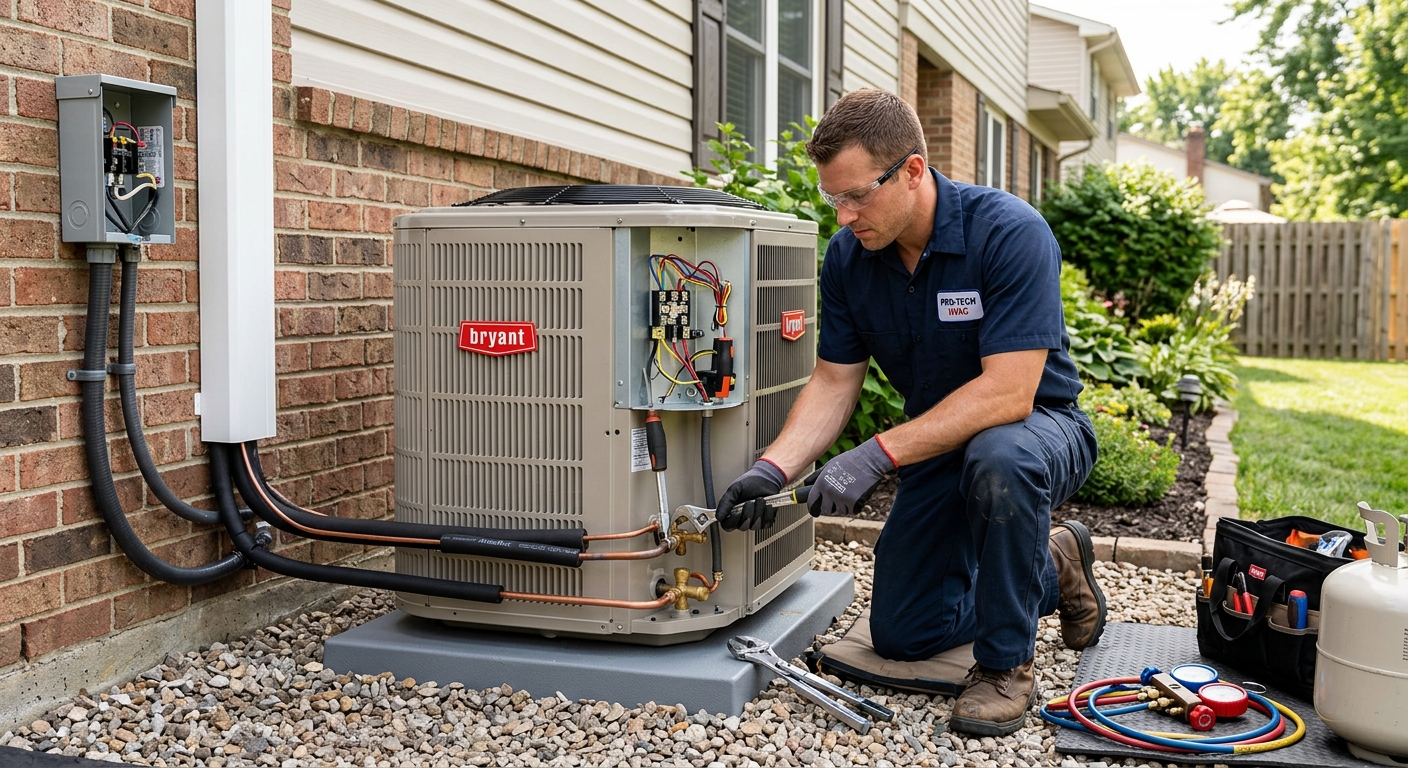
West Donegal heating and cooling prices by system type — 2026
West Donegal, with a homeownership rate of 67.8% and 34.3% of homes built before 1980 (U.S. Census Bureau, ACS 2024), is mostly a replacement market. Many residents are upgrading or replacing aging systems rather than installing for the first time. In the older parts of Lancaster County, and especially in Lancaster city’s historic rowhomes from 1880–1930, conventional ductwork is rare, so ductless mini-splits or high-velocity systems are the norm for retrofit jobs. In contrast, homes built after 1980 tend to have ductwork suited to central air and heat, making traditional replacements simpler and often less costly.
Regionally, this is a heating-dominated climate: we average 5,200 heating degree days and just 1,250 cooling degree days per year. This means that your heating system’s performance, not just cooling, drives both comfort and energy bills. Gas is common in the bigger towns, but rural areas lean on propane and oil. Electrical upgrades sometimes come into play, especially for all-electric heat pump installs. Below are installed price ranges for the most common systems in West Donegal.
| System |
Best for |
Efficiency |
Price range (installed) |
| Central AC replacement (existing ducts) |
homes with sound ductwork |
16–20 SEER2 |
$5,300–$12,500 |
| Air source heat pump (ducted) |
year-round heating and cooling |
8–10 HSPF2 |
$8,400–$18,000 |
| Cold-climate heat pump (ducted) |
heat pump as primary heat |
9–11 HSPF2 |
$13,500–$18,000 |
| Ductless mini-split (single zone) |
additions, rooms without ducts |
20–30 SEER2 |
$3,400–$7,400 |
| Full duct system installation |
homes with no existing ducts |
— |
$9,500–$19,000 |
Installed estimates for a typical West Donegal home. Equipment tonnage, duct condition and electrical capacity move these more than brand.
What construction era means for your system
In West Donegal, 34.3% of homes predate 1980, which often means skimpier insulation, single-pane windows, and questionable ductwork if it’s there at all. Many homes from this era were built when air conditioning wasn’t standard, so ducts—if present—were sized just for heating. These older systems might not support today’s high-output AC or heat pumps without replacement or modification. Electrical panels in pre-1980 homes sometimes lack the spare capacity for all-electric heat pump systems, which can raise cost and complexity.
If your home is post-1980—especially if it’s in one of the newer West Donegal subdivisions—you’re likely looking at original equipment or second replacements. Most subdivisions from the late 1990s came with builder-grade systems that are now at or past their service life. The “original” units were often generously sized, sometimes more for sales comfort than efficiency, so you’ll want a proper load calculation before just replicating the last setup.
Homes built after 1980 usually have better insulation, sealed windows, and more robust ductwork sized for both heating and cooling. Chimneys or flues in gas homes still need checking for corrosion or code issues before replacing furnaces. Bottom line: your home’s age affects everything from permit headaches to how much you can actually save by upgrading.
Maintenance that actually extends system life
Not every “tune-up” pitched by contractors is worth your money. For West Donegal homeowners, the essentials are much simpler: change your air filter on schedule (look for the right MERV number—usually 8 or 11 for typical equipment—too high and you’ll strangle airflow). Most homes are running when winter is at its peak or during the humid July afternoons, so schedule filter changes just before these seasons hit hard.
Coil cleaning (both indoor and out) helps maintain efficiency, and keeping the condensate line clear prevents backups and water damage. Refrigerant is a closed system—if your system is low, it has a leak. Topping up is not maintenance; it’s ignoring a problem. Annual “service plans” can be worthwhile if they cover genuine preventive work, spell out parts/labor costs, and let you cancel any time. Be wary if “inspection” and “priority service” cost more than a couple of regular visits per year.
Schedule routine checks in early spring or fall, before the rush of emergency repair calls hits. That way, you’re more likely to get a thorough job instead of a rushed once-over. What keeps your system alive? Regular attention to airflow, cleanliness, and any leaks—skip the fluff.
Reading the yellow label
Every new system comes with a yellow Energy Guide label showing efficiency ratings. For air conditioners and heat pumps, look for SEER2 (Seasonal Energy Efficiency Ratio 2) for cooling and HSPF2 (Heating Seasonal Performance Factor 2) for heating. These replaced the old SEER and HSPF standards, so older numbers aren’t a straight comparison.
In Lancaster County’s climate, where we log 5,200 heating degree days and only 1,250 cooling degree days, heating matters a lot more for your annual bills. That means a premium HSPF2 or cold-climate heat pump makes more sense than pushing for the absolute top SEER2. Most West Donegal homes won’t see payback from the highest SEER2 units—usually, the cost premium outpaces local energy savings above 18 SEER2.
For heating, spending for an HSPF2 in the 9–11 range can actually pay off, since you’ll run the system for months each year. For cooling, 16–18 SEER2 is usually the sweet spot—anything higher rarely justifies the extra up-front expense here. Don’t get upsold on “maximum” efficiency if your real-world bills won’t budge.
What a Pennsylvania HVAC contractor must hold
Pennsylvania does not issue a statewide HVAC contractor’s license for residential work. Instead, contractors need a Home Improvement Contractor (HIC) registration number from the Office of Attorney General for jobs over $500. You can verify a contractor’s HIC at hic.attorneygeneral.gov. For commercial HVAC, requirements can be different, but most West Donegal projects are residential and subject to these local rules.
Municipalities in Lancaster County—including Lancaster city and surrounding townships—generally require a mechanical permit and inspection for installing or replacing central HVAC systems. Local code enforcement oversees inspections, not a state board. Anyone handling refrigerants (like when installing or servicing air conditioners and heat pumps) must hold EPA Section 608 certification—this is federal law and applies across Pennsylvania, regardless of local rules.
Insurance is vital: all employers are required to carry workers’ compensation, and you can check Pennsylvania coverage status via WCAIS (wcais.pa.gov). Always ask for proof of liability and workers’ comp before work begins. Don’t be swayed by claims of certifications or licenses not listed above—they don’t change what’s legally required here.
The decision point on an aging system
Not every failing HVAC system in West Donegal needs immediate replacement. The decision often comes down to age, repair cost, and what’s actually broken. For systems under 10 years old, replacing a single component (like a capacitor or contactor) for a few hundred dollars is almost always the right call. When a unit hits 10–15 years, especially if repairs creep past a third of the cost to replace, it’s time to consider a new system—particularly after a string of repairs or a refrigerant leak involving phased-out blends.
Once a system’s over 15 years, the odds of a major failure (compressor or heat exchanger) go up quickly. In those situations, replacement is usually cheaper long-term, especially with older, less efficient equipment and rising repair costs. There are two cases where replacement is non-negotiable: a cracked heat exchanger, which is a carbon monoxide risk, and a compressor failure in an out-of-warranty system.
Think payback, too—if your bills are high but the system runs, test ducts and insulation before jumping to replacement. Efficiency gains can help, but in a heating-driven market like this, duct leaks and envelope losses often cost more than the system itself.
| Situation |
Recommendation |
Typical cost |
Reasoning |
| Under 10 years, single component failure |
Repair |
$300–$1,200 |
Planned service life not reached; fixes are affordable. |
| 10–15 years, repair over a third of replacement |
Consider replacing |
$5,300–$12,500 |
Big repairs add up, and reliability is dropping. |
| 15+ years, any major failure |
Replace |
$5,300–$12,500 |
Beyond expected life; continued repairs not cost-effective. |
| Cracked heat exchanger, any age |
Replace immediately |
$5,300–$12,500 |
Carbon monoxide hazard—no safe repair. |
| Compressor failure past warranty |
Replace |
$8,400–$18,000 |
Repair costs approach or exceed new system cost. |
| Working system, high bills |
Test ducts and envelope first |
$300–$800 |
Air leaks often waste more energy than equipment inefficiency. |
Ductwork: the part nobody quotes properly
Ductwork is the most overlooked part of home comfort in older homes around West Donegal. Many homeowners focus only on the equipment, but the truth is, duct leaks and undersized returns can cost you more in wasted energy than a slightly less efficient furnace or heat pump. In pre-1980 homes and Lancaster city’s 1880–1930 rowhouses, ducts may be absent completely, or installed only for heat—never sized for high-output cooling. Many of these homes now rely on ductless mini-splits or high-velocity systems because full-size duct runs just don’t fit.
A duct blaster test is the gold standard for measuring leakage: it pressurizes the ducts and quantifies how much air escapes into walls, attics, or crawlspaces instead of going where you need it. Sealing existing ducts with mastic or proper tape (never “duct tape” from the hardware rack) is almost always worth it unless the ducts themselves are corroded, disconnected, or run through uninsulated spaces. If the returns are choked down—a common issue in older homes—your new system can’t breathe and will wear out sooner.
Before you replace any equipment in West Donegal, have the ducts tested for leaks and checked for proper sizing. Duct problems are much cheaper to fix before the new system is installed than after. Skip this step and you could throw good money after bad with high bills and uneven temps.
Frequently asked questions — HVAC installation in West Donegal
Why are my West Donegal energy bills high with a new system?
Even with a new system, energy bills in West Donegal can stay high if your home has significant air leaks, unsealed ductwork, or low insulation. Most older homes around here weren't built with energy efficiency as a priority, and more than a third predate 1980. If your ductwork leaks—very common in both older and some suburban homes—you can lose enough heated or cooled air for bills to spike. A typical West Donegal duct blaster test and sealing runs $300–$800, but often pays for itself in the first season. Also, check your thermostat settings and the system’s blower speed; sometimes the problem is just a setup issue rather than the equipment.
How is a tax credit different from a rebate?
In Pennsylvania and West Donegal, a tax credit means you'll reduce your tax bill directly when you file your return—it doesn’t come off the purchase price up front. A rebate, on the other hand, usually comes from your utility or manufacturer and pays you after installation, either as a check or a bill credit. If the system you buy is eligible, you’ll see the rebate more quickly, while a credit arrives after tax season. For example, if you install a ductless mini-split in West Donegal for $3,400–$7,400, you may qualify for both types of offers if you file the right paperwork, but don’t expect instant savings at the register.
Is a heat pump a good choice for West Donegal winters?
Yes—modern heat pumps are much better in cold climates than they used to be, especially when sized correctly. Our winter design temperature is 12 °F, and cold-climate heat pumps are designed to handle those lows efficiently. For homes with good insulation and sealed ductwork, a ducted air source heat pump in the $8,400–$18,000 range can provide both heating and cooling reliably. In more rural areas, you may still keep a backup furnace for the coldest nights, but most West Donegal homes can see year-round comfort and lower energy use with the right setup.
How does south-central Pennsylvania's climate affect system sizing?
Here in south-central Pennsylvania, we have roughly 5,200 heating degree days and 1,250 cooling degree days. That means heating demand is much higher than cooling, so systems here are sized primarily for winter loads. If your system is grossly oversized for summer, it may short-cycle and miss humidity control—especially crucial here with our muggy July weeks. For most West Donegal homes, a correct manual J load calculation takes our insulation, window quality, and construction era into account, making sure you aren’t paying for more system than you need. Oversizing rarely pays off in this market and can shorten equipment lifespan.
Does Pennsylvania license HVAC contractors?
Pennsylvania doesn’t have a statewide HVAC license for residential jobs, although contractors must hold a Home Improvement Contractor registration for work over $500. You can check any West Donegal contractor’s HIC status before you hire them. Local municipalities, including Lancaster city and townships, may require mechanical permits and enforce inspection for any central HVAC installation or replacement. For refrigeration work, federal law requires every installer to be EPA Section 608 certified, regardless of local or state rules. Don’t be misled by anyone touting state “licensing” for residential HVAC—it’s not the law here.
How much does a new HVAC system cost in West Donegal?
Installed prices depend on whether you’re replacing an existing system or adding one from scratch. For a straight central air conditioner replacement using existing ductwork in a typical West Donegal home, expect $5,300–$12,500. If you need ductwork installed or are switching to a fully ducted heat pump for year-round heating and cooling, you’re looking at $8,400–$18,000. Always get a detailed quote that spells out duct repairs, electrical upgrades, and permit costs—these can swing the final price by thousands.
How much does a furnace replacement cost in West Donegal?
Furnace replacement pricing in West Donegal is often bundled with central air replacement (since they share ductwork and sometimes components), but as a standalone, expect similar numbers. Most replacements in suburb and township homes with working ducts are in the $5,300–$12,500 range installed. Age, gas line accessibility, and local permitting can all nudge the price up or down. If your system is failing and the heat exchanger is cracked, you’ll be looking at the upper end—don’t put it off, as this is a major safety issue.
What is commissioning and why does it matter?
Commissioning is the process your installer follows to make sure the new HVAC system is set up and running to manufacturer specs right after installation. In West Donegal, this matters because our combination of older homes and varying ductwork can make or break system efficiency. Commissioning includes checking refrigerant charge, airflow, controls, and safety devices—not just flipping a switch and hoping for the best. A properly commissioned ductless mini-split system, for example, delivers the quoted 20–30 SEER2, while a skipped setup can leave you paying more for less comfort, even with a system that cost $3,400–$7,400.
What MERV filter rating should I use?
For most homes in West Donegal, a MERV 8 or MERV 11 filter strikes the best balance between filtering out dust, pollen, and particulates without restricting airflow to your equipment. If you have allergies or respiratory concerns, MERV 11 is a good upgrade, but check your blower specs—older or undersized blowers (common in pre-1980 West Donegal homes) may struggle with higher-resistance filters. Using a MERV 13 or higher can cause issues unless your system was designed for it. Filter prices are modest, usually $12–25, but the wrong MERV can cost you a blower motor, which in this market can mean a repair charge in the $300–$1,200 range.