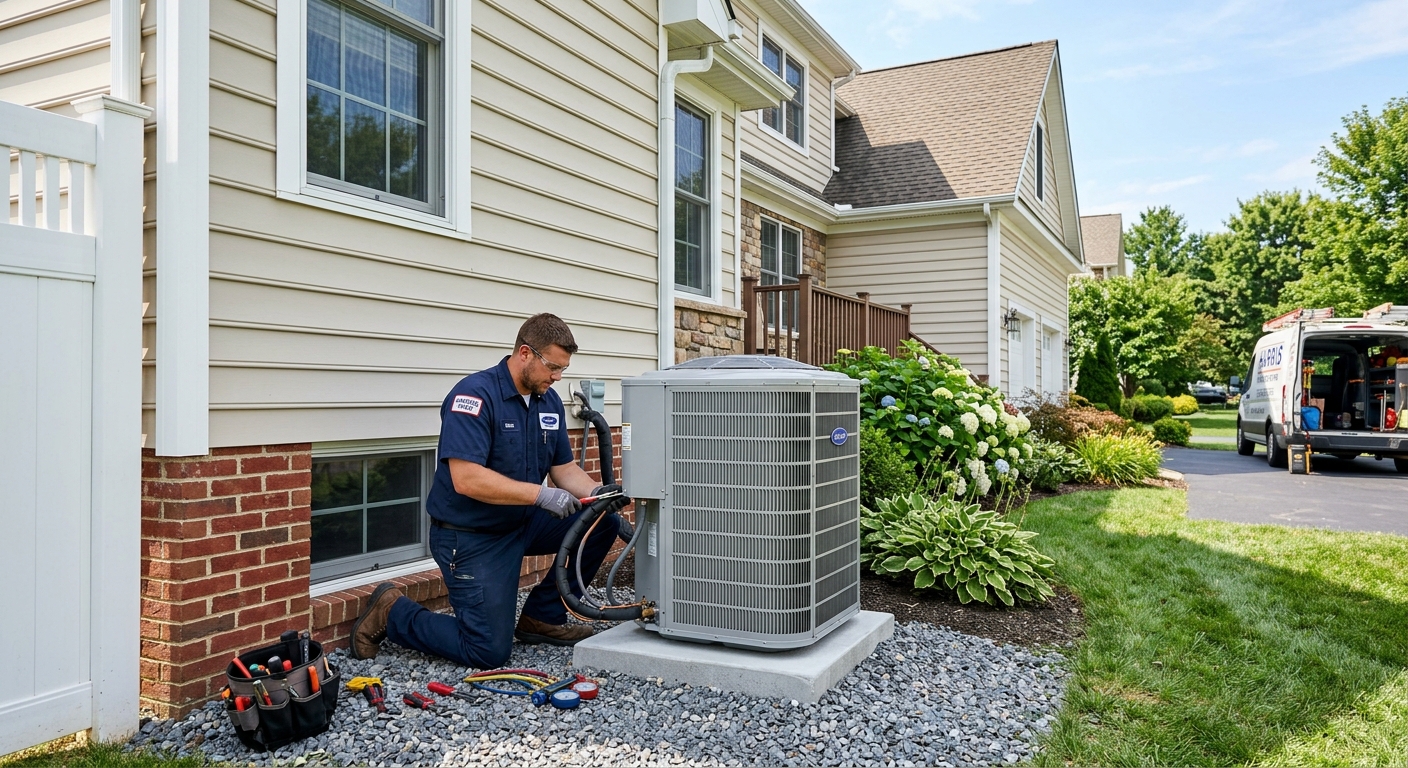
Butler heating and cooling prices by system type — 2026
Butler's homeowners benefit from one of the highest homeownership rates in Pennsylvania at 86.6%, and most properties (84.8%) are single-family homes (U.S. Census Bureau, ACS 2024). These numbers, along with 37.7% of homes built before 1980, shape Butler as a replacement-heavy market—system upgrades and ductwork retrofits are common, not just new installs. Luzerne County is known for 1900–1940 coal-era housing, and many homes are converting from legacy boilers to forced-air HVAC systems. That means you’ll often find homes where existing ductwork may need testing or repair before a new central AC or heat pump can go in, or you’ll face a full ductwork addition.
With 6,100 heating degree days and only 850 cooling degree days, Butler faces a long, cold heating season and a moderate summer. This skews decisions toward heating capacity and efficiency first—systems must reliably handle deep winter cold while handling occasional summer heat. Here’s what real-world installed costs look like:
| System |
Best for |
Efficiency |
Price range (installed) |
| Central AC replacement (existing ducts) |
homes with sound ductwork |
16–20 SEER2 |
$5,100–$12,000 |
| Air source heat pump (ducted) |
year-round heating and cooling |
8–10 HSPF2 |
$8,200–$17,500 |
| Cold-climate heat pump (ducted) |
heat pump as primary heat |
9–11 HSPF2 |
$13,500–$17,500 |
| Ductless mini-split (single zone) |
additions, rooms without ducts |
20–30 SEER2 |
$3,300–$7,100 |
| Full duct system installation |
homes with no existing ducts |
— |
$9,200–$18,500 |
Installed estimates for a typical Butler home. Equipment tonnage, duct condition and electrical capacity move these more than brand.
Reducing the net cost of a Butler installation
Three layers can help you reduce the final out-of-pocket cost for a new HVAC system in Butler: federal tax credits, utility rebates, and any state-level incentives. The main federal tool is a tax credit—this reduces what you owe at tax time next year (not your invoice today), and applies to qualified high-efficiency heat pumps, central ACs, and sometimes furnaces. The ENERGY STAR website and IRS resources will have the latest specifics.
Your electric utility, PPL Electric Utilities, and gas utility, UGI Utilities (if you have gas service), may offer rebates through their energy efficiency programs. Rebates cut your invoice amount at time of sale, putting money back in your pocket sooner than a tax credit. Program names and qualification tiers change nearly every year, so it’s best to check your utility’s current efficiency program page, not rely on an article’s sample figure. Try the ENERGY STAR rebate finder for another current reference.
The bottom line—always confirm up-to-date incentives with official sources right as you plan your project. Butler homeowners often qualify for several layers of savings, especially if you’re upgrading from an old oil or coal system, but actual rebates and eligible models shift frequently based on funding and energy policy. Good contractors will walk you through what’s available, but it pays to check for yourself.
Mechanical permits for HVAC work in Butler
Pennsylvania does not issue a statewide HVAC installer’s license. Instead, residential HVAC work is regulated by local municipalities, not by the state. For Butler, and more broadly in Luzerne County, the Pennsylvania Uniform Construction Code (UCC) applies as adopted locally. This means each town or city may handle mechanical permits and inspections differently. When you hire a contractor, they must be registered as a Home Improvement Contractor (HIC) with the Pennsylvania Office of Attorney General for jobs over $500—always check their status at hic.attorneygeneral.gov, as it’s a legal requirement for contracts of this size.
For any HVAC work involving refrigerant (like central air or heat pump installation), technicians must also have current EPA Section 608 certification, which is federally mandated. This protects you as a homeowner from unsafe refrigerant handling. To ensure the business carries workers’ compensation insurance, use the WCAIS database (wcais.pa.gov). Correct permitting and inspections help guarantee your installation meets code, protects your safety, and is required if you sell the house later. Portable plug-in space heaters are the notable exception in Wilkes-Barre, often used without a mechanical permit.
Always clarify upfront: Who will pull the permit, and who is responsible for passing inspection? A reputable contractor should never ask you to shoulder these tasks.
Refrigerant rules and your existing system
New residential HVAC systems have moved to low-global warming potential (GWP) refrigerants like R-454B and R-32, as part of an ongoing national phase-down of the older, higher-GWP refrigerant R-410A. If your current system uses R-410A, nothing in the law requires you to replace it just because of the refrigerant. It is fully legal and supportable to keep your existing R-410A system running for the foreseeable future.
The real effect hits the wallet: over time, as manufacturers shift to the new refrigerants and production of R-410A is cut back, the price for this refrigerant is likely to climb. That means if your system develops a refrigerant leak in a few years, topping it off will cost more than it used to, and major repairs on old systems become harder to justify. Still, there is no “drop dead” date on older equipment—you can service, repair, and maintain R-410A systems as long as parts and refrigerant are available.
The take-home for most Butler homeowners: keep an eye on system performance, but don’t rush to replace an otherwise reliable unit just because of a refrigerant change. When the repair costs mount—especially for a leak or compressor issue—then it’s worth weighing repair versus replacement more carefully.
The central decision for a Butler homeowner
Butler’s long, cold winters—driven by a winter design temperature of 4 °F and 6,100 heating degree days—mean your primary decision is about reliable heat more than cooling. The old advice that “heat pumps don’t work in cold climates” is now outdated, thanks to cold-climate models designed to keep running even in subzero weather. Modern cold-climate heat pumps still lose some output as the temperature drops below freezing, so in Butler, system sizing and backup strategy do matter. That’s why dual-fuel setups (a heat pump paired with a gas furnace) are also on the table for deep-cold performance.
Gas service is available in Butler proper and neighboring areas through UGI Utilities. If you live in a rural part of Luzerne County, where natural gas lines don’t reach, your other heating fuels are usually propane or oil—which cost more and are less clean than grid power. In these rural areas, a cold-climate heat pump makes a particularly attractive argument, as electric rates from PPL Utilities are often lower than delivered fuel.
A gas furnace still makes the most sense if you already have natural gas service and want maximum capacity for the rare deep freeze. But for homes going all-electric, or where reducing fuel delivery is a goal, heat pumps, with or without backup, deserve a serious look.
| Option |
Installed cost |
Operating cost here |
Best when |
Incentive eligible |
| Gas furnace + central AC |
$5,100–$12,000 |
lowest cost with existing gas service |
existing gas service, coldest zones |
furnace may qualify |
| Ducted heat pump (cold climate) |
$8,200–$17,500 |
efficient, lower in moderate winters |
good envelope, all-electric goal |
often, yes |
| Dual fuel (heat pump + gas backup) |
$13,500–$17,500 |
optimized for severe cold |
gas on site, deep cold spells |
usually yes |
| Ductless multi-zone |
$9,200–$18,500 |
flexible, by area heated/cooled |
no ductwork, zone control |
select models |
How to vet an HVAC contractor in Butler
The brand of equipment matters, but not nearly as much as the quality of the installation. In Butler—where old coal-era ductwork is common—it’s not enough to buy top-tier equipment; it must be matched, sized, and set up for your home. Always verify the contractor’s Pennsylvania Home Improvement Contractor (HIC) registration using hic.attorneygeneral.gov. For any work involving refrigerants, expect the actual installer (not just the company) to hold EPA Section 608 certification.
A good quote will specify exact equipment models and include a room-by-room load calculation–not just a “like for like” estimate. Ask whether commissioning—verifying airflow and refrigerant charge with real measurements—is standard. Every reputable installer documents this for you.
- Verify HIC registration at hic.attorneygeneral.gov
- Confirm workers’ comp via WCAIS (wcais.pa.gov)
- Ask for EPA Section 608 certification of the actual installer
- Demand a detailed, written contract per Pennsylvania law
- Require a room-by-room Manual J load calculation
- Look for full equipment model numbers on the quote
- Insist on documented commissioning and startup values
- Ask if the duct system will be tested for leaks
- Review warranty terms on parts and labor
- Check local references, especially on retrofit jobs
- Clarify who handles permits and inspection
- Get a clear project timeline and payment schedule
Red flags in the Scranton–Wilkes-Barre market? With so many contractors around, aggressive time-limited discounts and vague “all-in” estimates often signal someone relying on volume, not quality. Always walk away from anyone who dodges questions or pushes a cheap job fast over doing it right.
When an HVAC repair stops being worth it
Not every HVAC problem means you need a new system. In Butler, the expected service life of a modern furnace or AC is usually 12–20 years with proper maintenance. If a single fan or sensor fails before year 10, repair makes sense. As a system gets older, the dividing line is repair cost—if you’re facing a bill greater than a third of the cost of replacement, it’s time to compare carefully. Component failures like blower motors or valves are repairable; failures of the compressor (for AC/heat pump) or the heat exchanger (for a furnace) are major and often not worth fixing on aging equipment.
Also consider the refrigerant: with industry switching away from R-410A, topping off a leaking old system will only get pricier. Finally, in Butler’s long heating season, efficiency gains from modern systems can pay back faster than in milder climates—especially if you’re moving from oil or an old gravity furnace. But if high bills are the issue and the system runs fine, address ducts and air sealing before blaming the equipment.
| Situation |
Recommendation |
Typical cost |
Reasoning |
| Under 10 years, single component failure |
Repair |
$300–$1,200 |
Most repairs here will last, and you keep warranty coverage |
| 10–15 years, repair over a third of replacement |
Consider replacing |
$5,100–$12,000 |
Major repairs approach the price of new, where efficiency pays back |
| 15+ years, any major failure |
Replace |
$5,100–$12,000 |
Future repairs are likely, parts and refrigerant are less available |
| Cracked heat exchanger, any age |
Replace immediately |
$5,100–$12,000 |
Unsafe to operate—carbon monoxide risk |
| Compressor failure past warranty |
Replace |
$8,200–$17,500 |
Costs as much as new, efficiency gains from replacement |
| Working system, high bills |
Test ducts and envelope first |
$300–$800 |
Leaks and air sealing fix many "high bill" problems |
Frequently asked questions — HVAC installation in Butler
Is a heat pump a good choice for Butler winters?
Heat pumps absolutely can work in Butler, even in our cold winters, as long as you choose a cold-climate model and your system is sized right. The winter design temperature here is 4 °F, so older heat pumps do struggle in the deepest freezes. Modern units, though, reliably provide heat down to zero or below before needing any backup. If you have good weatherization—sealed ducts, added insulation, fewer drafts—heat pumps are an efficient fit for most Butler homes that have access to PPL Electric Utilities. You’ll pay more upfront, typically $8,200–$17,500 installed, but you can often find federal and utility incentives to lower that. For rural homes that rely on propane or oil, moving to a heat pump often lowers yearly heating costs. But if you have a very leaky old house or want maximum capacity for the rare below-zero stretch, a dual-fuel setup or keeping your gas furnace is the smarter call.
How much does a new HVAC system cost in Butler?
Butler installation costs depend on what you need and what already exists in your home. If you already have sound ductwork and just need a central AC replacement, expect to pay $5,100–$12,000 for parts and labor. Adding a ducted cold-climate heat pump can run $8,200–$17,500, with several factors playing in—system size, duct upgrades, electrical work, and the number of zones. A simple single-zone ductless mini-split for an addition or isolated room comes in lower, between $3,300–$7,100. The price goes up quickly if you need a full new duct system, which is common in Butler’s older, coal-era homes. Always ask for a detailed written quote and compare scope as much as brand.
How much does a furnace replacement cost in Butler?
For a straightforward furnace swap using your existing ductwork in Butler, expect an installed price between $5,100–$12,000. Most homes in town have natural gas from UGI Utilities, and that keeps operating costs down compared to propane or oil systems found in rural parts of Luzerne County. Your price will be at the lower end if your ducts, venting, and electrical are all up to code and the job is a 1-to-1 replacement. But plan for added expense for code-required upgrades, air sealing, or if you combine the new furnace with AC or heat pump equipment. Don’t be tempted by ultra-low bids—dealers cutting corners on sizing, installation quality, or permitting cost more in the long run.
Who inspects HVAC work in Butler?
In Butler and across Luzerne County, mechanical permits and inspections for residential HVAC are handled by your municipality, not the state. Wilkes-Barre has its own Code Enforcement Office; other towns and boroughs may use their own or sometimes defer to the Pennsylvania Department of Labor & Industry if they have opted out. Your contractor should handle the permit and inspection process, but always confirm it’s included in your contract. For any AC or heat pump work, EPA Section 608–certified technicians must handle refrigerants, regardless of local licensing. After installation, you or the contractor schedule an inspection to close out the permit and ensure everything meets the Pennsylvania Uniform Construction Code. Price-wise, typical mechanical permit fees are just a fraction of your project cost—rarely more than a few hundred dollars compared to your system cost of $5,100–$17,500.
What is the R-410A refrigerant phase-down?
The federal transition away from R-410A (“Puron”) to new lower-impact refrigerants like R-454B and R-32 is underway in all states, including Pennsylvania. If your current AC or heat pump uses R-410A, that system is still legal, still serviceable, and you can get repairs as needed. But the price of R-410A is climbing and will continue to as supply winds down. For a fixer-upper or system with a minor leak in Butler, you can repair, but if the leak is major or the unit is 15+ years old it probably makes more sense to replace—especially when you face a repair cost of $5,100–$12,000 or more. All newly installed systems this year will use the new refrigerants, so you’re protected either way.
Why are my Butler energy bills high with a new system?
If you’ve installed a new HVAC system in Butler but your electric or gas bills are still high, the culprit is often elsewhere—typically duct leaks, limited insulation, or air infiltration. Luzerne County’s homes are famous for 1900–1940 construction with patchy insulation upgrades and leaky original ductwork. Replacing the equipment only helps so much if heat is being lost through gaps or drafts. Testing and sealing your ducts and improving attic insulation can cost $300–$800 and may pay for itself in a single season if your old system was wasting conditioned air. Ask your contractor for a duct leakage test and be wary of any company that blames the equipment alone.
Do I need ENERGY STAR equipment to qualify for incentives?
Many federal and utility incentive programs in Pennsylvania, including those offered by PPL Electric Utilities and UGI Utilities, require that your new HVAC equipment meets ENERGY STAR or equivalent efficiency standards, but not all. Some state or municipal programmes have their own high-efficiency lists that go beyond, or in some cases slightly below, ENERGY STAR. If the incentives are important to you, tell your contractor up front that you want qualifying models, as not every system on the market reaches those thresholds. Most qualifying heat pumps and ACs fall in the $8,200–$17,500 installed price range, but refer to your utility’s latest guidelines before you buy. Never rely on generic claim—always verify with your contractor and the rebate source at the time you get your quote.
How does northeastern Pennsylvania’s climate affect system sizing?
Northeastern Pennsylvania’s climate—long, cold winters with occasional heat waves—means accurate system sizing is critical in Butler. Oversizing leads to wasted energy and short cycling; undersizing means you simply can’t keep up in the January deep freeze. The local winter design temp of 4 °F and 6,100 heating degree days force the contractor to size the system for the true peak load. For most single-family homes in Butler (84.8% of households), you’ll likely need higher capacity than what a generic “rule of thumb” from milder parts of the country would suggest. Proper load calculation takes insulation, duct condition, and home air leaks into account. Pay for this step—it often costs $300–$1,200 but saves years of headaches.
Do I need to be home during installation?
You’re not legally required to be present for the entire installation, but it is strongly recommended in Butler. You’ll want to be there at the start to review the work scope, answer last-minute questions, and be around for the final walkthrough and commissioning/testing, which is key for warranty and code compliance. For a full system replacement (costing $5,100–$17,500), this gives you a chance to spot issues before the job wraps. Contractors also need access to electric service, thermostat wiring, and sometimes attic or crawlspaces—these may be locked or blocked without you there. If you can’t be present, designate a trusted adult who knows your home and can answer in your absence.