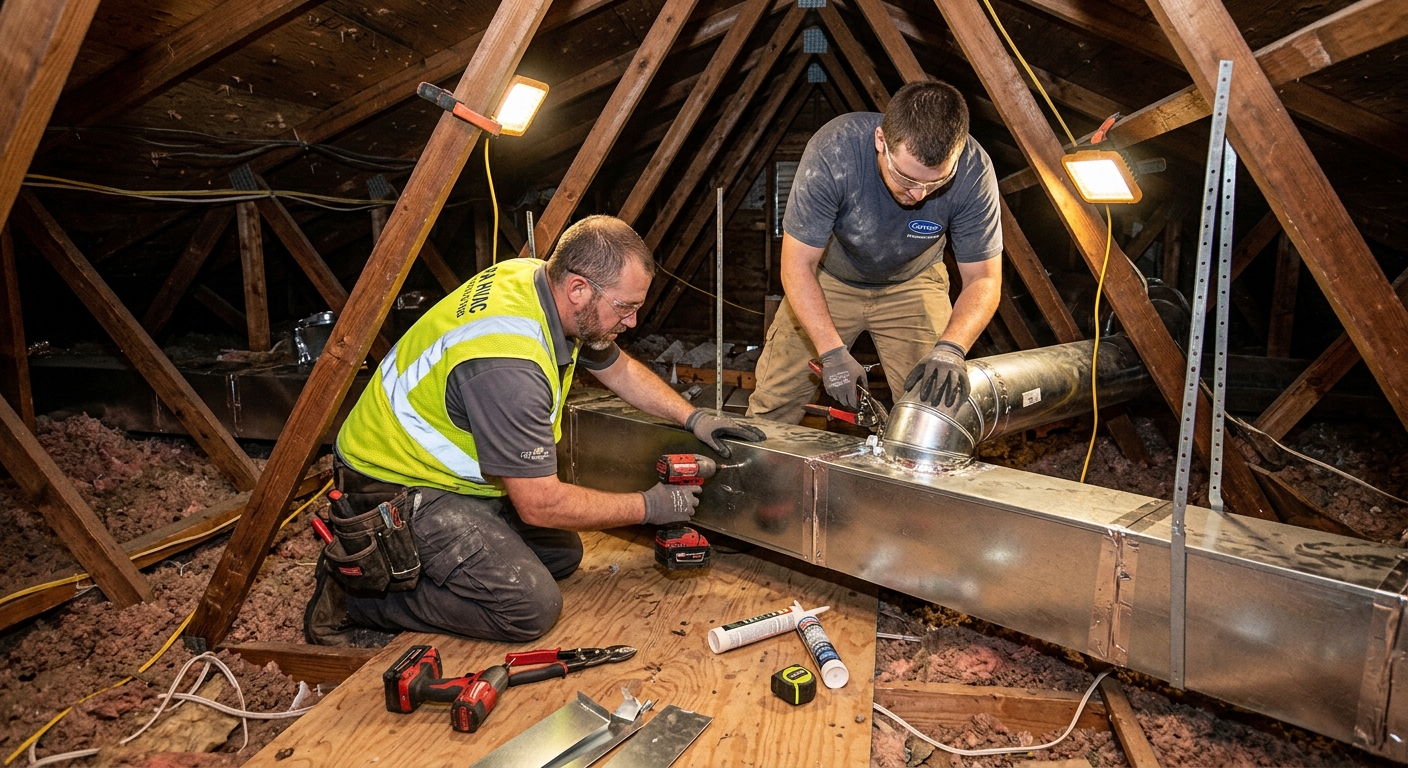
What a new HVAC system costs in Grove City
In Grove City, where 53.5% of homes are owner-occupied and an overwhelming 84.4% were built before 1980 (U.S. Census Bureau, ACS 2024), nearly every HVAC job is a replacement or retrofit, not new construction. That means your quote is shaped not just by the equipment, but by the quirks of older homes: tight basements, outdated ducts, and uncertain insulation. The towns just south—Sharon and Farrell—have massive 1900–1950 housing stock, which often means retrofitting or correcting poorly laid-out ductwork.
This part of northwestern Pennsylvania gets about 6,200 heating degree days and only 800 cooling degree days per year, making it clearly a heating-dominated climate. Winters are long, snowy, and cold (winter design temp: 5 °F). For most homeowners, sizing and selecting the central heating solution should come first—air conditioning is a comfort luxury for perhaps two hot months, while heat is non-negotiable for many more. Ductless mini-splits offer flexible solutions for specific rooms, additions, or those who'd rather avoid the cost of new ducts in older homes, which can be considerable.
Every number below is a fair install price for this area—not lowest bid, not padded either. Quote comparisons should always include a site visit and a discussion of your home’s age, duct condition, and current electrical service.
| System |
Best for |
Efficiency |
Price range (installed) |
| Central AC replacement (existing ducts) |
homes with sound ductwork |
16–20 SEER2 |
$4,600–$11,000 |
| Air source heat pump (ducted) |
year-round heating and cooling |
8–10 HSPF2 |
$7,400–$15,500 |
| Cold-climate heat pump (ducted) |
heat pump as primary heat |
9–11 HSPF2 |
$12,000–$15,500 |
| Ductless mini-split (single zone) |
additions, rooms without ducts |
20–30 SEER2 |
$3,000–$6,500 |
| Full duct system installation |
homes with no existing ducts |
— |
$8,300–$16,500 |
Installed estimates for a typical Grove City home. Equipment tonnage, duct condition and electrical capacity move these more than brand.
Comparing HVAC estimates in Grove City
Grove City homeowners should expect more from a quote than a brand and a bottom line. In older houses that dominate the market here, quality installation often matters as much as the equipment itself. Make sure your contractor details the model numbers for both the indoor and outdoor units—if they’re a mismatched pair, you won’t get the rated efficiency or warranty claims honored.
Don’t accept a proposal that sizes equipment based only on your old system’s label; insist on seeing a Manual J load calculation. For ducted systems, the quote should state if existing ducts will be reused as-is, cleaned, sealed or replaced—this alone changes comfort and cost. Ask what’s offered for the refrigerant line set, as older lines can corrode or introduce contaminants. Most Grove City homes need some electrical work—confirm if a panel upgrade is required and included.
Each estimate should specify how condensate drainage is being handled, the thermostat supplied, mechanical permit costs, and commissioning—the step where airflow and refrigerant charge are actually measured and logged on startup. Finally, verify two separate warranties: equipment (from the manufacturer) and labor (from the installer, typically 1–2 years).
| Line item |
What to look for |
Red flag if… |
| Equipment |
model numbers, indoor and outdoor matched |
brand name only |
| Sizing |
load calculation attached |
matched to the old nameplate |
| Ductwork |
condition assessed, sealing scoped |
not mentioned |
| Electrical |
circuit and panel capacity confirmed |
assumed adequate |
| Line set |
replaced or documented as reused |
silent |
| Commissioning |
measured airflow and charge, documented |
no startup report |
| Warranty |
labour years stated separately |
manufacturer only |
| Permit |
included and priced |
'not needed' |
The central decision for a Grove City homeowner
Grove City homes face a true winter. With a winter design temp of 5 °F and 6,200 heating degree days, heating isn’t just another line item—it is the deciding function of your system. In older years, most would tell you a heat pump "doesn’t cut it around here," but today’s cold-climate models maintain real output well into the teens and even single digits. That said, they do lose capacity as it gets colder, so correct sizing is critical, and some homes will need a dual-fuel setup for true sub-zero peace of mind.
If your house has access to Columbia Gas of Pennsylvania—like most in Hermitage, Sharon, and Grove City proper—a gas furnace is a strong contender for comfort and lower upfront cost. In rural Mercer townships, where gas service gets spotty, the true comparison is heat pump versus oil or propane. In those cases, running a modern cold-climate heat pump can be less expensive to operate, simpler to maintain, safer, and far more flexible for future upgrades or solar integration.
Whichever you pick, the right answer depends on your utility situation, the state of your ducts, and your long-term plans. Furnaces still make sense where gas is a given and the house leaks heat, but many households now run heat pumps as the main system, especially in moderate-sized, well-sealed homes or for those prioritizing year-round cooling.
| Option |
Installed cost |
Operating cost here |
Best when |
Incentive eligible |
| Gas furnace + central AC |
$4,600–$11,000 |
existing gas service, coldest zones |
older homes, drafty or with gas on site |
sometimes (utility programs) |
| Ducted heat pump (cold climate) |
$7,400–$15,500 |
good envelope, all-electric goal |
moderate insulation, rural properties |
often (federal and utility) |
| Dual fuel (heat pump + gas backup) |
$12,000–$15,500 |
gas on site, deep cold spells |
want efficient cooling and guaranteed winter heat |
yes (most programs) |
| Ductless multi-zone |
$8,300–$16,500 |
no ductwork, zone control |
older homes, additions, room-by-room needs |
yes (utility and some federal) |
What a Pennsylvania HVAC contractor must hold
Pennsylvania does not issue a state HVAC license for residential work. Contractors who install central air or heat in Grove City and Mercer County must, however, hold a valid Home Improvement Contractor (HIC) registration if signing jobs over $500; this is verified through the Pennsylvania Office of Attorney General. Mechanical permits for new or replacement equipment are enforced by local municipalities—Hermitage, for example, has its own inspection department, and each township controls its own approvals. No state jurisdiction covers residential HVAC licensing here; it’s local or nothing.
Anyone handling refrigerant (which is every central AC and most heat pump jobs) must personally hold EPA Section 608 certification, which is a federal requirement and not optional. Insurance is non-negotiable: all employers must carry workers’ compensation, and you can check their coverage status using the WCAIS site. Pennsylvania’s Home Improvement Consumer Protection Act requires a written contract for jobs over $500, grants you a 3-day right to cancel, and prohibits any waiving of your insurance deductible.
For homes built before 1978, any work affecting paint surfaces (like duct or equipment install) must comply with the federal EPA Lead RRP Rule—also checkable by homeowners online.
SEER2, HSPF2 and AFUE decoded
SEER2 measures seasonal cooling efficiency—higher means lower electric bills during AC season. HSPF2 is for heat pumps and stands for seasonal heating efficiency; it tells you how many BTUs of heat come out per kilowatt-hour in real-world cold. AFUE, used for furnaces, tells you what percent of the fuel becomes usable indoor heat. These numbers let you compare apples to apples, but the right level to buy depends entirely on climate.
In Mercer County, with 6,200 heating degree days and just 800 cooling degree days, heating costs will always dwarf cooling costs. Here, you’ll get real payback from a higher HSPF2 rating on a heat pump or higher AFUE on a gas furnace, but less from chasing the highest SEER2 for AC. A SEER2 rating over 18 is hard to recover in savings; spend extra only if you want near-silent operation, not payback. For heat pumps, moving from HSPF2 8 to 10 makes sense if you run it as your main heat—above that, numbers may get better but rarely pay for themselves in this market. Older articles often use SEER and HSPF, but new federal ratings (SEER2, HSPF2) use tougher test procedures, so don’t compare them directly.
What size system does a Grove City home need?
Oversizing a furnace or AC is a hidden and expensive defect: it causes short cycling, uneven heating and cooling, and higher operating costs while wearing out the equipment faster. In a place like Grove City—where the winter design temperature is 5 °F and homes often leak more than new ones—getting the size right is not a luxury, it is basic good practice.
Your contractor should run a Manual J load calculation, which incorporates the size and layout of your home, insulation levels, window type, infiltration, and even where your house sits in relation to prevailing winds. Never accept "rules of thumb" like tonnage per square foot; those ignore unique features of your home and the sheer variation in the region’s aged housing stock. Even homes on the same block can have dramatically different needs.
The only sizing question you should ask: “Did you run a load calculation, and can I see it?” If a quote simply matches your old unit’s size, it copies past mistakes forward, increasing the risk of high bills and poor comfort. The Manual J calculates how many BTUs per hour your home loses at the lowest expected temperature—here, that means 5 °F—and sets the equipment size so it’s just large enough to keep up at the deepest cold.
What each system actually costs to run in Grove City
The cost to heat or cool your home in Grove City is governed by three things: your system’s efficiency rating (AFUE, SEER2, HSPF2), the local climate (6,200 heating degree days, 800 cooling degree days, winter temps down to 5 °F), and your energy rates. Electric power here comes from FirstEnergy’s Penn Power, and while actual rates fluctuate, your bill lists your per-kWh cost—this is the number you’ll use for calculations.
To find annual operating costs, start with degree days to estimate how much heating or cooling your home needs. Say your house needs 45 million BTUs of heat per year. Divide that by your system’s efficiency: a gas furnace at 95% AFUE uses 47,400,000 BTUs of gas (45 million ÷ 0.95). For an electric heat pump at 9.5 HSPF2, convert HSPF2 to BTUs per kWh, then multiply by your run hours. Multiply fuel used by your local gas or electric rate—the numbers are right on your bill.
Remember, nothing throws these calculations off like leaky or dirty ducts—tight, well-sealed ducts can cut annual costs by 15–30%, easily outpacing the premium for an ultra-high-efficiency system. Utility rates change, and no two homes lose heat alike, so use your own energy bills for the most accurate comparisons. If you’re using propane or oil, the math tilts even harder toward high-efficiency heat pumps in outlying Mercer County townships.
Frequently asked questions — HVAC installation in Grove City
Is a heat pump a good choice for Grove City winters?
Heat pumps are a legitimate primary heat for most Grove City homes today, thanks to cold-climate models that maintain real output well below freezing. The local winter design temperature is 5 °F, which is exactly what top cold-climate heat pumps are tested against. In many Mercer County homes with decent insulation, a ducted heat pump can cover 80–90% of annual heating hours; for the occasional deep freeze, dual-fuel setups (gas backup) deliver full reliability. Expect installed cost around $7,400–$15,500 for most standard homes. Heat pumps are a strong fit in rural areas burning propane or oil, and increasingly common in town for those prioritizing future proofing or adding AC.
How do I verify an HVAC contractor's insurance?
In Pennsylvania, every HVAC contractor employing workers must carry workers’ compensation by law. Before letting anyone start a job in Grove City, ask for proof of their current insurance certificate—this should come direct from the insurer, not just off a truck. The state hosts the WCAIS (Workers' Compensation Automation and Integration System), where you can verify coverage status. For jobs over $500, your contract must carry the Home Improvement Contractor registration number, which is checked at hic.attorneygeneral.gov. This is especially important with larger projects such as heat pumps or full duct installs that can reach $8,300–$16,500. Don’t proceed with anyone unwilling to show documentation—valid insurance protects both parties in the event of an accident.
How long does HVAC installation take in Grove City?
In Grove City’s typical older single-family home, replacing a central air unit or furnace is a one-day job for a skilled crew, provided the ductwork and electrical are in good condition. Full duct system installations, or major upgrades in homes built before 1980 (which is most of the inventory here), can run two to four days depending on access, complexity, and plaster or finished walls. Installation times can extend if you’re adding AC to a house that never had it, or swapping to a heat pump with an electrical panel upgrade. Ductless mini-splits usually go in within a day per zone. Mechanical permit inspection—required in towns like Hermitage—can add a day or two to the final sign-off. Always clarify the timetable if your schedule is tight, especially during summer or cold snaps when crews can be booked solid.
What does a heat pump cost installed in Grove City?
For a typical Grove City home with existing ductwork, expect to pay $7,400–$15,500 for a professionally installed air source heat pump. That range covers real-life installation factors: equipment size, whether you’re going “all-electric” with backup strip heat, or combining your new unit with a gas furnace as a dual-fuel system. If your house requires new or extensively repaired ductwork, total cost may reach or exceed $16,500. Ductless single-zone systems (for additions or bonus rooms) price out lower, typically $3,000–$6,500. Always demand a written contract and be wary of quotes far below the band—good labor and proper commissioning can’t be mass-produced.
What is a Manual J load calculation?
Manual J is the industry-standard engineering method for calculating exactly how much heating and cooling your Grove City home needs. Unlike rules of thumb (like “one ton per X square feet”), Manual J factors in your insulation, windows, air leakage, how much sun you get, and even the direction your house faces. The goal is to precisely size your HVAC system so it isn’t too big—causing short cycles and poor humidity control—or too small for extreme days, especially when temps drop to 5 °F here. If your contractor doesn’t run or show their Manual J results, you’re flying blind and risk inheriting the same sizing errors that made the last unit wear out early. Proper calculation helps ensure lower bills, longer equipment life, and better comfort in those challenging Mercer County winters.
How cold does it get in Grove City and does that affect heat pumps?
Winter in Grove City routinely drops to 5 °F, which is the local design temperature used for equipment sizing. Modern cold-climate heat pumps are built to deliver strong heat output even at these temps. However, as outdoor temperatures fall, any heat pump gradually loses output and may require backup—either in the form of electric strip heat or by integrating with a gas furnace as a dual-fuel system. If your home is well-insulated and air-sealed (common after energy retrofits, but rare in pre-1980 houses), a cold-climate heat pump will work throughout winter. Otherwise, a good contractor will size a system with backup for rare deep freezes, often at a total installed cost of $12,000–$15,500 for a dual-fuel system. Never accept equipment sized purely for “average” days—your system must keep up on the coldest nights.
Does my utility offer a heat pump rebate in Grove City?
As of now, some utilities serving Grove City and the Shenango Valley offer rebates for qualifying cold-climate heat pumps or ductless mini-split systems. Columbia Gas and FirstEnergy’s Penn Power both operate in Mercer County, and their rebates can reach several hundred dollars depending on what you install and its efficiency rating. Eligibility may be tied to using registered contractors and having a permit/inspection completed—requirements that most legitimate installers will meet as a matter of course. For a cold-climate heat pump install in the $12,000–$15,500 range, check for state and federal programs too, as these often layer on top. Always ask your contractor to supply program details and pre-fill any paperwork during the quoting process.
Why does my system short cycle?
In older Grove City homes, most short cycling is caused by an oversized furnace or AC—often installed using square footage rules or copied from the previous unit’s size without a real load calculation. Short cycling means the system turns on and off quickly, which wears out machinery, wastes energy, and leaves rooms unevenly heated or cooled. It’s especially common after equipment replacement in houses built before 1980, many of which have been upgraded piecemeal over decades. Other causes can include poor thermostat placement, dirty filters, or ductwork that’s too restrictive. If you just invested $4,600–$11,000 in a new system and it’s cycling rapidly, demand a Manual J load calculation review and a full system checkup—often correcting the problem requires only minor adjustments, but sometimes the only cure is the right-sized equipment from the start.
What does a ductless mini-split cost in Grove City?
For a single-zone ductless mini-split—perfect for bonus rooms, finished attics, or additions that lack ductwork—the installed cost in Grove City typically falls between $3,000–$6,500. Multi-zone setups covering several rooms or an entire floor can run $8,300–$16,500, depending on the number of indoor heads and complexity of placement. Ductless is a smart choice here when retrofitting older homes with plaster walls, or where adding ducts would practically mean reconstructing the house. Always ensure your quote details the exact model, line-set length, electrical upgrades, and an included permit when required by your municipality. Done right, ductless delivers quiet, targeted comfort with minimal disruption to the home.