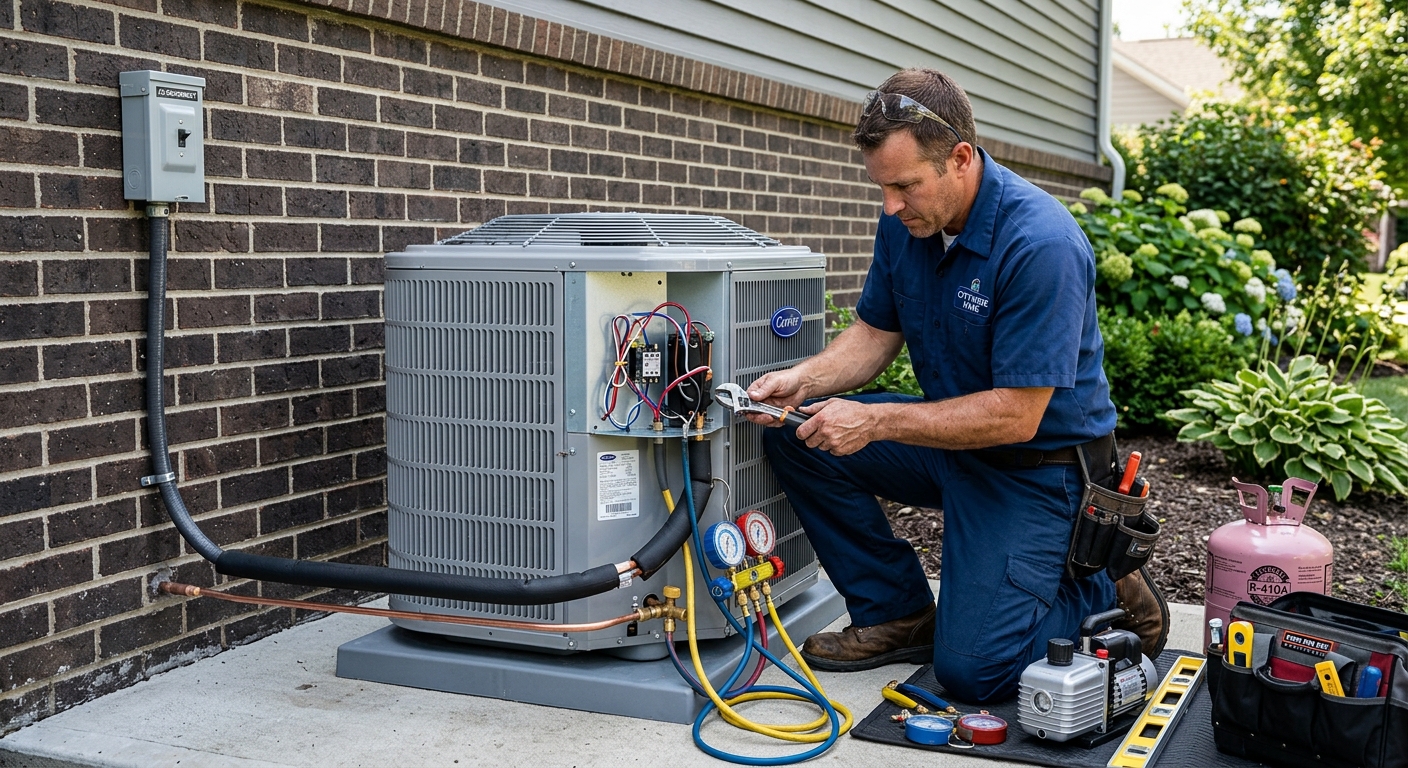
What a new HVAC system costs in Monessen
In Monessen, most homes are owner-occupied and nearly all were built before 1980 (U.S. Census Bureau, ACS 2024). The typical project here is not a first-time installation, but a replacement of an older furnace or air conditioner, or a retrofit to add ductwork or upgrade electrical service. With an aging housing stock, it's common to deal with existing ducts that may be undersized or poorly sealed, plus electrical panels that may need upgrading before installing new HVAC equipment. The majority of Monessen homes are single-family, so central systems—either gas furnace with AC or heat pump—are often the starting point, but not always the right fit.
This region sees 5,600 heating degree days and just 1,050 cooling degree days. That makes heating the main driver of comfort and energy cost, so heat pump selection and gas furnace efficiency matter much more than getting the absolute top SEER air conditioner. If you are planning a replacement, expect the biggest budget swings to come from the state of your ductwork and whether your panel can handle a heat pump's electrical load.
| System |
Best for |
Efficiency |
Price range (installed) |
| Central AC replacement (existing ducts) |
homes with sound ductwork |
16–20 SEER2 |
$4,500–$11,000 |
| Air source heat pump (ducted) |
year-round heating and cooling |
8–10 HSPF2 |
$7,200–$15,500 |
| Cold-climate heat pump (ducted) |
heat pump as primary heat |
9–11 HSPF2 |
$11,500–$15,500 |
| Ductless mini-split (single zone) |
additions, rooms without ducts |
20–30 SEER2 |
$2,900–$6,300 |
| Full duct system installation |
homes with no existing ducts |
— |
$8,100–$16,000 |
Installed estimates for a typical Monessen home. Equipment tonnage, duct condition and electrical capacity move these more than brand.
The decision point on an aging system
Not every HVAC problem in Monessen means it's time for a full replacement. Most mid-20th-century and postwar systems here will see repairs over their lifespan—especially given how many older homes have already been retrofitted once or twice. As a rule of thumb: if your system is under 10 years old and it's a single failed part, repairing almost always makes sense. Replacement starts to look smarter when the repair is over a third of what a new system would cost, or the equipment is 15 years or older. If your compressor or heat exchanger fails and you're past the manufacturer's warranty, replacement is usually unavoidable.
Consider system efficiency and refrigerant type, too. If your AC uses R-22, repairs are costly and can't be justified if the system’s at end-of-life. As for efficiency, in Monessen's climate, upgrading from, say, an 80% to a 95% AFUE furnace won't always pay back quickly unless your old unit is truly failing.
There are also “must replace” moments: a cracked heat exchanger is dangerous and immediate, and a failed compressor in an old system simply costs too much to justify fixing. But if your main complaint is high utility bills, it's worth testing your ductwork and home envelope first—fixing leaky ducts costs a lot less than a new system.
| Situation |
Recommendation |
Typical cost |
Reasoning |
| Under 10 years, single component failure |
Repair |
$300–$1,200 |
Repair is much less than replacement; newer systems are more reliable |
| 10–15 years, repair over a third of replacement |
Consider replacing |
$4,500–$11,000 |
Future repairs likely; efficiency gains may pay back |
| 15+ years, any major failure |
Replace |
$4,500–$11,000 |
System at end of design life; reliability drops fast |
| Cracked heat exchanger, any age |
Replace immediately |
$4,500–$11,000 |
CO risk, cannot legally or safely repair |
| Compressor failure past warranty |
Replace |
$7,200–$15,500 |
Compressor is most costly fix; at age, full system pays off |
| Working system, high bills |
Test ducts and envelope first |
$300–$800 |
Air leaks and duct losses common in older Monessen homes |
When ductless is the right answer
Ductless mini-split systems are an obvious fit in Monessen for several situations: additions, upstairs bedrooms, finished attic spaces, and rooms where previous heating/cooling upgrades didn't quite reach. This housing stock leans heavily on mid-century and postwar construction, much of it built before central air was the standard. That means running new ducts often means cutting into finished plaster—or trying to shoehorn ductwork into joist bays never sized for it. In those cases, a ductless system avoids major demolition and gives modern comfort with less disruption.
Single-zone mini-splits serve one room or area very efficiently, usually costing $2,900–$6,300 installed. Multi-zone systems can serve several rooms from one outdoor compressor, but the economics are not always better—each indoor head adds cost, and a single outdoor unit serving too many heads can lead to mediocre performance. If you want true independent comfort in each space, often installing two or three single-zone systems ends up faster, quieter, and sometimes even cheaper than a multi-zone.
Plan head placement for aesthetics and drainage—every wall-mount unit needs a way to handle condensate safely. You can hide linesets with trim, but you'll always see the head in the room. Still, if the alternative is tearing into finished walls or living with spaces that never heat or cool right, ductless beats retrofit ducts every time in these older homes.
What a Pennsylvania HVAC contractor must hold
Pennsylvania does not have a statewide HVAC contractor license for residential work. Instead, licensing is handled at the local level, which means municipalities in Westmoreland County oversee the mechanical permit process. When you hire for HVAC in Monessen, make sure your contractor has the Home Improvement Contractor (HIC) registration issued by the Pennsylvania Office of Attorney General—it's required for any contract over $500. You can verify a contractor’s HIC registration at hic.attorneygeneral.gov.
A contractor’s insurance and workers’ compensation must also be in order. In Pennsylvania, workers’ comp is mandatory for all employers and is issued in the private and self-insured market; you can independently verify coverage via WCAIS (wcais.pa.gov). For any system involving refrigerant—air conditioners or heat pumps—the actual installing tech must hold an EPA Section 608 certification, regardless of any local or state credentials.
Your contractor will also be pulling a mechanical permit from your local municipal office, and final inspection is required before job completion. Written contracts are required for all work over $500, and you get a 3 business-day right to cancel under the Home Improvement Consumer Protection Act.
Gas, electric or both in southwestern Pennsylvania
In Monessen and the rest of Westmoreland County, the climate is defined by 8 °F winter design temperatures and 5,600 heating degree days—a clear signal that efficient, reliable heat matters more than cooling for most homeowners. Modern “cold-climate” heat pumps have come a long way, holding strong output well below freezing, but it’s true their capacity drops as the temperature plunges. That’s why dual fuel, which pairs a heat pump with a gas furnace for backup, is popular in places with deep-winter cold snaps like ours.
Most of Westmoreland County—including Monessen—has access to natural gas. In areas where gas is not available, the alternative is outdated oil or expensive propane, so heat pumps look much more appealing. If you live in a place with reliable gas service, a gas furnace is still the lowest hassle, especially when paired with central AC. But if you’re committed to an all-electric home or in an area without affordable gas, cold-climate heat pumps make financial sense—just budget for electrical panel upgrades. Ductless makes the most sense when the house won’t take ducts at all or you want fine-grained zone control.
| Option |
Installed cost |
Operating cost here |
Best when |
Incentive eligible |
| Gas furnace + central AC |
$4,500–$11,000 |
lowest for existing gas service |
existing gas service, coldest zones |
yes, for furnace and AC |
| Ducted heat pump (cold climate) |
$7,200–$15,500 |
moderate if home envelope is good |
good envelope, all-electric goal |
yes, state and utility rebates |
| Dual fuel (heat pump + gas backup) |
$11,500–$15,500 |
low, leverages both fuels |
gas on site, deep cold spells |
yes |
| Ductless multi-zone |
$8,100–$16,000 |
variable; most efficient for zoning |
no ductwork, zone control |
yes, for heat pump portions |
Efficiency ratings and what they mean for your bill
When you see SEER2 and HSPF2 on equipment specs, here’s what matters: SEER2 tells you cooling efficiency (how much cooling output for every watt used), while HSPF2 rates heating efficiency on heat pumps (heat out for energy in). For furnaces, it’s AFUE (annual fuel utilization efficiency). In Monessen’s climate, with more than five times as many heating degree days as cooling, HSPF2 is the number that matters to your utility bill—top-tier SEER2 ratings can be nice, but the payoff isn’t as strong given our short cooling season.
Federal standards reset efficiency ratings to SEER2 and HSPF2 from the older SEER/HSPF system. If you’re reading articles or product sheets quoting the old ratings, know they aren’t apples-to-apples comparable.
In practical terms: going for very high SEER2 (say, 20+) hardly ever pays off here. Instead, invest in a mid-to-high HSPF2 (9–11) heat pump or a 95%+ AFUE furnace if you’re using gas. Spend your efficiency dollars where you see them—on the heating side in Westmoreland County homes.
Running the numbers on Monessen's climate
Here’s how you can estimate what HVAC operating costs really look like in Monessen. First, look up "heating degree days" and "cooling degree days": in Westmoreland County, that’s 5,600 and 1,050, respectively. These numbers convert our local temperatures into a measure of how much heating and cooling you need across a typical year.
Select your system’s efficiency: for central AC, it’s SEER2; for heat pumps, HSPF2; for gas furnaces, AFUE. The higher the rating, the less energy you’ll use for the same comfort. Find the system’s BTUs per hour (usually listed on the nameplate).
Multiply typical days used x average daily run time x system output = annual demand. But remember, these are estimates—envelope leaks and duct losses can easily swing the real total by 20–30%. If you have ductwork running through unconditioned spaces (like many homes in Monessen), even a super-high-efficiency unit may not deliver savings if the ducts themselves leak badly. Fixing ducts first often pays off faster than a premium-rated heat pump or AC.
Finally, check your actual electric rate from West Penn Power or your current gas/fuel rate on the latest bill. Plug in kWh (for electric systems) or therms (for gas) to see what each fuel will cost to deliver the necessary heating or cooling using your equipment’s rating. This three-step math gives you a real estimate rather than relying on sales pitches—though every unique house and year will vary.
Frequently asked questions — HVAC installation in Monessen
Does my utility offer a heat pump rebate in Monessen?
Monessen is served by West Penn Power, which has been offering heat pump rebates under their statewide energy efficiency programs. These rebates often change year to year, so the only way to know what’s available during your project is to check the utility’s website or call them directly. For a ducted heat pump, it’s common to see incentives that knock a few hundred dollars off the installed cost, which in this area runs $7,200–$15,500 depending on size and scope. Rebates are typically for ENERGY STAR–rated and cold-climate models. Some contractors in Monessen will even handle the paperwork for you, but it’s worth verifying yourself so nothing is missed. As always, rebates shouldn’t drive your project, but they can tip the math in favor of a higher-efficiency option.
Which utility serves Monessen?
For electricity, Monessen’s homes and businesses are served by West Penn Power. Natural gas comes from Peoples Natural Gas, though there are a few rural spots in Westmoreland County that still use propane or oil. If you’re replacing an HVAC system, knowing which utility serves your area will help you estimate operating costs and check for available rebates. For a new heat pump installation, your electric bill from West Penn Power will show the rates you’ll pay for heating and cooling, and that’s crucial when weighing if a system priced between $7,200–$15,500 makes sense for your budget and comfort expectations.
Why do HVAC quotes in Monessen vary so much?
There's a big price spread for HVAC installation or replacement in Monessen, with quotes for the same job ranging from $4,500–$11,000 or more. That’s partly due to the age and layout of most local homes—almost all are pre-1980, and retrofits almost always involve surprises in the ductwork or electrical panel. Quality matters: better contractors do full-load calculations, fix undersized or leaky ducts, and pull the right municipal permits. Less reputable bids may skip crucial steps to appear cheaper, risking comfort and code compliance. Equipment brand does affect price, but installation quality and the hidden work below the surface drive the real differences. That’s why detailed, apples-to-apples quotes are worth more than the absolute lowest number.
How long should an HVAC system last in Monessen?
Most HVAC systems in Monessen—whether a forced-air furnace, central AC, or heat pump—typically last 15 to 20 years if properly maintained. With nearly every home locally built before 1980 (U.S. Census Bureau, ACS 2024), it’s common to find units still running after two decades, though they're usually much less efficient than new models. Regular tune-ups, filter changes, and duct sealing can extend lifespan. If you’re nearing 15 years and facing a significant repair—say, one that’s half the cost of a new system priced at $4,500–$11,000—it’s often the smarter financial move to upgrade. Environmental exposure, electrical capacity, and past workmanship in Monessen’s vintage homes all play a role in what you get out of a system before replacement is warranted.
What does HSPF2 measure?
HSPF2 stands for Heating Seasonal Performance Factor, version 2—the latest federal standard measuring the heating efficiency of heat pumps. In plain terms, it tells you how effective a heat pump is at delivering heat over an entire season. A higher HSPF2 means more heat for every dollar spent on electricity. It replaced the old HSPF scale a few years ago, and you’ll only see HSPF2 on current equipment and rebate programs around Monessen. When shopping, look for heat pumps rated 9–11 HSPF2 for cold climates like ours. On a project costing $7,200–$15,500, the difference in bills over the life of the equipment can be substantial with the right rating.
Is it worth switching from oil or propane to a heat pump?
In Westmoreland County, switching from oil or propane to a modern heat pump can pay off if your home is well insulated and your heating loads are moderate. Propane and oil prices are volatile, and older combustion equipment tends to be less efficient. With a cold-climate heat pump, your installed cost will likely fall in the $11,500–$15,500 range (including old equipment removal and electrical work). The real payback comes from lower maintenance, a more stable electric bill with West Penn Power, and eligibility for rebates. If your current oil furnace is failing, and gas isn’t an option, it’s worth a hard look—especially if you plan to stay in the home long-term and want to avoid dealing with fuel deliveries and fluctuating prices.
Is a high-efficiency system worth the extra cost here?
High efficiency makes sense in heating-dominated climates like Monessen, where heating degree days far outweigh cooling needs. Upgrading a furnace or heat pump to a top-efficiency model often costs more upfront ($11,500–$15,500 for a premium heat pump), but the extra savings and comfort are real if your home’s envelope and ducts are in good shape. However, the highest SEER2 (cooling) ratings rarely pay back here since our cooling season is short. Spend your money where it counts—on HSPF2 ratings for heat pumps or AFUE for furnaces. If you’re being quoted a large premium for ultra-high cooling efficiency, consider the payback period carefully, and double check that your ducts aren’t leaking before spending on top-tier equipment.
What is commissioning and why does it matter?
Commissioning is the start-up process for new HVAC equipment: the installer verifies refrigerant charge, airflow, safety, equipment performance, and controls. In Monessen’s older homes—almost all built before 1980—proper commissioning is crucial because ductwork, insulation, and electrical panels often don’t match modern requirements. Skipping commissioning can leave your system short on capacity, noisy, or shortened in lifespan. For a system costing $7,200–$15,500, skipping this step can mean years of higher bills and frustration. It’s one reason why detailed local contractors may quote higher—but their systems actually deliver the comfort and savings you expect.
What is EPA Section 608 certification?
EPA Section 608 certification is a federal requirement for anyone handling refrigerants in air conditioning or heat pump systems—applying directly to every HVAC installation in Monessen and across Pennsylvania. This certification ensures that techs know how to safely recover, recycle, and dispose of refrigerants without harming the environment. Regardless of state or local licensing, Section 608 is always required for installing new systems and replacing components. Your contractor should be able to show this credential at the time of installation; if they can’t, you should choose someone else. For a project running $4,500–$11,000 or more, you want the work done by someone who meets all legal and safety requirements, including this EPA standard.