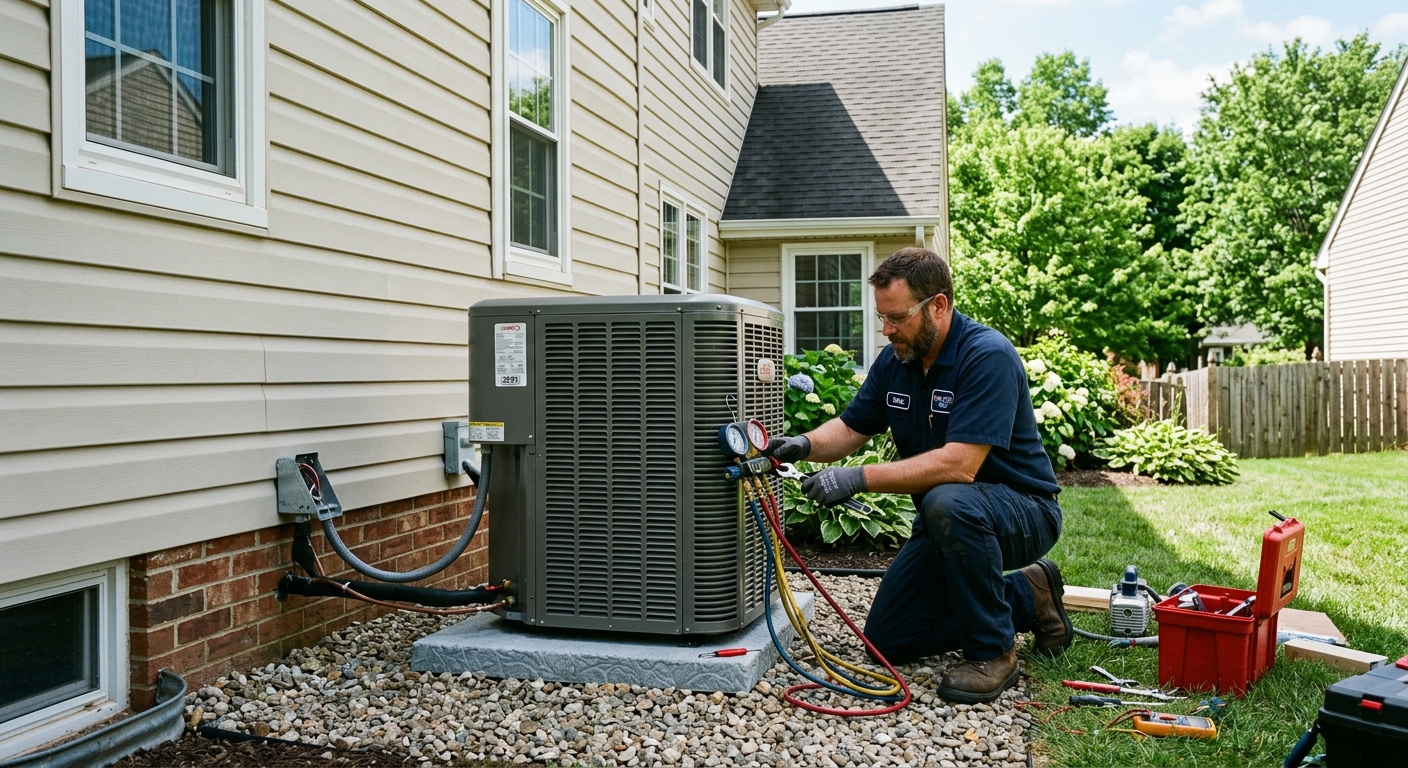
What a new HVAC system costs in North Codorus
North Codorus is a homeowner-heavy township, with 80.1% of households owner-occupied and more than half the homes built before 1980 (U.S. Census Bureau, ACS 2024). This means most HVAC work here is replacement, not new construction, and older homes may still lack central ductwork, especially if they've survived on oil, propane, or electric resistance heat. York City’s pre-1940 rowhomes and scattered older rural properties have become a proving ground for ductless mini-split and high-velocity retrofit solutions, especially for cooling where ductwork wasn’t part of the original design.
Our climate in south-central Pennsylvania sees far more “heating degree days” (5,200) than “cooling degree days” (1,250), making us a heating-dominated market. In practical terms: your heating choice and system capacity will drive sizing and cost decisions more than cooling ever does. Homeowners here weigh systems based on reliable winter performance, not just summer AC. If your ducts are in good shape, central AC and ducted heat pump costs stay manageable. If you’re adding cooling to an old house for the first time, expect ductless or full duct installation costs.
| System |
Best for |
Efficiency |
Price range (installed) |
| Central AC replacement (existing ducts) |
homes with sound ductwork |
16–20 SEER2 |
$5,000–$12,000 |
| Air source heat pump (ducted) |
year-round heating and cooling |
8–10 HSPF2 |
$8,000–$17,000 |
| Cold-climate heat pump (ducted) |
heat pump as primary heat |
9–11 HSPF2 |
$13,000–$17,000 |
| Ductless mini-split (single zone) |
additions, rooms without ducts |
20–30 SEER2 |
$3,200–$7,000 |
| Full duct system installation |
homes with no existing ducts |
— |
$9,000–$18,000 |
Installed estimates for a typical North Codorus home. Equipment tonnage, duct condition and electrical capacity move these more than brand.
Heat pump or furnace: what makes sense in North Codorus
For North Codorus homeowners, heating is the yardstick every other comfort system gets measured against. Our winter design temperature is just 12 °F, and we rack up 5,200 heating degree days a year. That’s why heating choice comes first. Twenty years ago, cold winters ruled out heat pumps. Not anymore. Modern cold-climate models reliably deliver heat at temperatures well below freezing — but as it approaches 10–15 °F, heat output does start to fall off. If your envelope is tight and you don’t need high BTUs in January’s coldest nights, a cold-climate heat pump can carry the load, especially for homeowners looking to move away from fossil fuels.
Natural gas is widely available in the denser townships of York County, but out in the rural stretches of North Codorus, you’re usually dealing with propane or oil. In these areas, switching to a heat pump — especially a cold-climate or dual-fuel model — can cut heating costs, increase safety, and reduce maintenance headaches. If you do have gas on site, a gas furnace plus central AC still makes sense for the absolute coldest rooms or draftier older homes. Dual fuel (heat pump with gas backup) splits the difference, handling 90% of the season with efficient electricity but staying reliable in a deep cold snap.
| Option |
Installed cost |
Operating cost here |
Best when |
Incentive eligible |
| Gas furnace + central AC |
$5,000–$12,000 |
lower where gas is available |
existing gas service, coldest zones |
sometimes, limited for gas |
| Ducted heat pump (cold climate) |
$8,000–$17,000 |
lower for well-insulated homes |
good envelope, all-electric goal |
yes |
| Dual fuel (heat pump + gas backup) |
$13,000–$17,000 |
efficient, combines both fuels |
gas on site, deep cold spells |
yes |
| Ductless multi-zone |
$9,000–$18,000 |
varies by insulation and zoning |
no ductwork, zone control |
yes |
Choosing an installer in York County
In York County, what separates a smooth-running HVAC system from a headache isn’t the sticker brand — it’s how carefully the installer does their job. You want proof of quality, not just promises. Pennsylvania doesn’t license HVAC contractors at the state level, but every job over $500 requires a Home Improvement Contractor (HIC) registration. Always verify at the official registry. Refrigerant work must be done by technicians with EPA Section 608 certification, and you can ask for those credentials before any work starts.
Reputable contractors provide a written quote with equipment model numbers, a proper Manual J load calculation for sizing, and details about what commissioning steps are included (verification of airflow, static pressure, charge). Insurance and workers’ compensation are also mandatory; you can verify coverage through the state’s workers’ comp portal. In the York–Hanover area, there are dozens of HVAC outfits, from city-based teams to smaller township companies. High market density means quality varies, and it’s worth a thorough screening.
- Check HIC registration at hic.attorneygeneral.gov
- Require EPA Section 608 certification for refrigerant work
- Insist on a Manual J load calculation, not just “rule of thumb” sizing
- Written estimate should show exact equipment models, not “3-ton AC”
- Proof of current liability insurance
- Verify workers' compensation via WCAIS (wcais.pa.gov)
- Ask how airflow and refrigerant charge are tested/verified
- References for recent installations — ideally in a nearby township
- Clarity on permitting and inspection included in price
- No waiving of insurance deductibles on repairs (not legal in PA)
- Lead renovator certification for pre-1978 homes (where required)
- All contracts over $500 are in writing (PA law)
Red flag: In a saturated contractor market like York County’s, steer clear of bids made off a phone call or without inspecting your current setup. Fast, vague, or “lowest price by hundreds” offers almost always cut corners on sizing, code compliance or commissioning — and those are things you’ll pay for twice.
The comfort problem that isn't temperature
In south-central Pennsylvania, winter isn’t just cold — it’s dry. And come summer, humidity spikes fast when we finally get warm weather. That’s why in North Codorus, true comfort means more than temperature control. During the heating season, forced air systems often drop indoor humidity below comfortable levels; a low-end single-stage system will dry you out faster, while higher-efficiency or variable speed units can mitigate some of that drop. Whole-house humidifiers solve the dryness but need regular cleaning and anti-scale attention — poorly maintained humidifiers do more harm than good, spreading mineral dust and even mold.
In summer, an oversized AC cools the house quickly but barely runs long enough to actually remove moisture. That leaves you with a cold, clammy home. Proper AC sizing and a correctly set blower speed are much more important for dehumidification than expensive “air quality” add-ons. Upgrading to a filter beyond MERV 11 can stress many older blowers, hurting performance instead of improving it. As homes in North Codorus become tighter and more energy efficient, mechanical ventilation becomes necessary for air quality, but air purifiers and UV lights are often pitched with claims that stretch reality. In most homes, you’ll get more from a right-sized, well-tuned system and a basic humidifier than from the high-dollar gadgets.
Permits, licensing and inspections in North Codorus
Pennsylvania does not license HVAC contractors at the state level for residential work, and there’s no state board overseeing every installer. Instead, residential HVAC jobs — including air conditioning, heat pumps, and ductwork — are regulated locally, with each York County township or municipality administering its own code office and permit process. The legal requirement for any project over $500 is registration as a Home Improvement Contractor (HIC), checked through the Attorney General’s registry, and every contract over that amount must be in writing under the Home Improvement Consumer Protection Act (HICPA).
There is a single credential that's federally required: EPA Section 608 certification for anyone who handles refrigerant. So whether your job is in North Codorus or downtown York, make sure your technician is certified under this rule. Most HVAC system installations or major replacements — anything involving ductwork, major component swaps, or new equipment — require a mechanical permit in the City of York and usually in the surrounding townships, though replacing a thermostat or plugging in a portable window AC rarely does. Proof of insurance and current workers’ compensation coverage is mandatory for employers; check coverage using Pennsylvania’s WCAIS database (wcais.pa.gov). Always ask your contractor for proof up front.
SEER2, HSPF2 and AFUE decoded
Three ratings matter for HVAC in York County: SEER2 (seasonal cooling efficiency for ACs and heat pumps), HSPF2 (seasonal heating efficiency for heat pumps), and AFUE (annual fuel efficiency for furnaces). SEER2 is the newer test — more realistic than the old SEER standard, and usually a couple points lower for the same machine — so don’t compare old numbers to new. HSPF2 is the heating side’s equivalent, with newer heat pumps showing 8–11 HSPF2 for standard and cold-climate models. AFUE, used for gas and oil furnaces, tells you what percent of your purchased fuel’s energy reaches your home as heat.
With 5,200 heating degree days every year, North Codorus homes run their heating systems far more than the AC. That means HSPF2 or AFUE will save you more real dollars than chasing ultra-high SEER2 numbers unless you’re especially sensitive to high electric bills in summer. The sweet spot for SEER2 is usually around 16–18, where additional cost rarely pays back in our climate. For heat pumps, a cold-climate rating and HSPF2 of 9 or better is worth it. On a new furnace, anything above 95% AFUE is solid; above 97% you’re mostly paying for incremental gains unless you have exceptionally high winter usage. Focus your upgrade dollars where our up-and-down climate actually hits your energy bills.
When an HVAC repair stops being worth it
If your North Codorus system is running poorly, start with a real diagnosis and resist the pressure to replace unless the numbers add up. In most cases, repairing a unit that’s under 10 years old — especially when it’s a failed contactor, capacitor, or blower — is the smart financial move. Even on older systems, a repair can be justified if it’s less than a third of the replacement cost and there aren’t other issues stacking up. Service life for AC and heat pumps is 12–20 years here, depending on usage and maintenance. If the compressor fails on a 15-year-old unit, it almost always means full replacement. A cracked heat exchanger, regardless of unit age, is not safe to repair. Systems running on R-22 (phased-out refrigerant) are prime candidates for updating, since recharge costs outweigh any repair.
If your well-maintained older furnace just needs a new ignitor or control board, fix it and keep going. But in North Codorus, where heating bills run high, a new system won’t always pay for itself unless you’re jumping several efficiency levels. Test your home’s ductwork and building envelope for leaks before blaming the HVAC equipment for high bills. Upgrades elsewhere can save significant money at a fraction of a full replacement.
| Situation |
Recommendation |
Typical cost |
Reasoning |
| Under 10 years, single component failure |
Repair |
$300–$1,200 |
Almost always the best return |
| 10–15 years, repair over a third of replacement |
Consider replacing |
$5,000–$12,000 |
Costly fix may not last long enough |
| 15+ years, any major failure |
Replace |
$5,000–$12,000 |
Near end of typical service life here |
| Cracked heat exchanger, any age |
Replace immediately |
$5,000–$12,000 |
Safety hazard—repair not an option |
| Compressor failure past warranty |
Replace |
$8,000–$17,000 |
High cost, poor long-term outlook |
| Working system, high bills |
Test ducts and envelope first |
$300–$800 |
Leaky ducts or insulation often to blame |
Frequently asked questions — HVAC installation in North Codorus
Should I close vents in unused rooms?
Closing vents in unused rooms seems logical, but for most North Codorus homes, it often leads to more problems than it solves. Ductwork in these systems is designed for whole-house airflow; closing registers can increase pressure in your ducts, causing leaks or even damaging the blower. In a house built before 1980, common in this township, you’re more likely to see leaky or undersized ducts, so forcing airflow changes can make cold and hot spots worse and decrease system efficiency. If you want zoned temperature control, a professional ductless mini-split in a single room or addition is a better solution and runs $3,200–$7,000 installed for a single zone. Leave the vents open for the system’s sake, and ask an HVAC pro about duct sealing or true zoning if you have chronic hot or cold rooms.
What is the R-410A refrigerant phase-down?
R-410A is the standard refrigerant for air conditioners and heat pumps installed in North Codorus today, but it is being phased down due to environmental regulations. Newer systems are shifting to lower global warming potential (GWP) refrigerants starting in the mid-2020s. For a homeowner considering a replacement, this means your new system will either use R-410A or, if you wait another few years, possibly a newer refrigerant. There’s no mandate to replace working R-410A units, and refrigerant refills will remain available for years, so immediate action isn't needed. If you’re looking at new equipment in the $5,000–$12,000 range for central AC, it will still be future-proofed for maintenance. Only factor in refrigerant type if you're planning to keep the same system for over 15 years.
What is EPA Section 608 certification?
EPA Section 608 certification is a federal requirement for any HVAC technician who handles refrigerant — including installing, servicing, or disposing of air conditioners and heat pumps in North Codorus or anywhere in Pennsylvania. This certification ensures the tech understands safe handling, recovery, and environmental regulations around refrigerants like R-410A. Every replacement or installation project in the township, regardless of permit level, must have at least one person on site with this credential. When choosing a contractor for a project in the $8,000–$17,000 range, don’t hesitate to ask for proof; a reputable local team will have it readily available.
Why do HVAC quotes in North Codorus vary so much?
HVAC quotes in North Codorus can seem all over the map — a central AC replacement might range from $5,000–$12,000 with the same tonnage and features. The main reasons are differences in duct condition, local permit requirements, electrical upgrades, and (most importantly) installation quality. Older homes or additions often need extra work for sizing or access, which drives up labor costs. In York County, the saturated contractor market means you’ll see everything from lowball pricing with cut-corners to thorough jobs that include detailed commissioning. Always look for quotes that clearly outline equipment model numbers, what’s included, and details on how they plan to verify system performance. The best price isn’t always the best value.
Is a heat pump a good choice for North Codorus winters?
Yes, a modern cold-climate heat pump can provide efficient heat well through a typical North Codorus winter, where 12 °F is the design minimum. With over 5,200 heating degree days per year, your system must be sized and specified for winter reliability. A ducted cold-climate heat pump in the $13,000–$17,000 range remains effective when temperatures drop into the teens. The key is making sure the installer does a real load calculation and selects models rated for low-ambient operation. For draftier, older homes, or if you’re in a rural area with propane or oil, a heat pump still makes sense for most of the season — but a backup source for the very coldest nights is a good idea. If you already have gas, dual fuel may be the most cost-effective choice.
Do I need to be home during installation?
For most North Codorus installations, especially replacements in occupied homes, you don’t need to be present for the entire project — but you should be there to let the team in, answer initial questions, and walk through the finished system. Reputable contractors will schedule around your availability for the critical start and finish days. Central AC replacements or heat pump installs (typical $8,000–$17,000) usually take one to two days, depending on ductwork or electrical upgrades. If you’re having ductwork installed or equipment placed in tighter attics or crawlspaces (common in homes built before 1980), a walk-through at the end ensures you know how things operate and that cleanup was handled.
Is a high-efficiency system worth the extra cost here?
In a heating-dominated climate like North Codorus, paying for efficiency makes sense up to a point. With 5,200 heating degree days, prioritizing a higher HSPF2 (for heat pumps) or AFUE (for furnaces) saves real money over typical 15-year system life. Yet going for the absolute top-tier — say, a 20 SEER2 AC or a 98% AFUE furnace — means much higher up-front costs, not matched by annual savings unless your home is especially drafty or large. For most homes, a central AC at $5,000–$12,000 with 16–18 SEER2 and a furnace at 95–97% AFUE is the payback sweet spot. Invest in sealing and proper sizing before chasing the highest efficiency badge.
How cold does it get in North Codorus and does that affect heat pumps?
Winter design temperature in North Codorus is 12 °F, so heat pumps here need to be rated for low-ambient performance. Older or cheaper heat pumps will lose efficiency and struggle to keep up as temperatures drop below the 20s, which is why specifying a cold-climate model is crucial if you want a heat pump as your main heat source. In most homes, a ducted cold-climate system in the $13,000–$17,000 range will remain effective for all but the very worst winter nights. For systems without backup, consider supplementary electric heat strips or a dual-fuel solution. Always choose your installer based on whether they consider these climate specifics in system design.
Do I need ENERGY STAR equipment to qualify for incentives?
Some incentives available to North Codorus residents — including potential utility rebates and federal tax credits — require ENERGY STAR-rated equipment or minimum efficiency thresholds, such as SEER2, HSPF2, and AFUE ratings. Not every system that’s right for your home will qualify; for example, the absolute lowest bid on a central AC ($5,000–$12,000) may fall short of those benchmarks. Ask your contractor to itemize which models are ENERGY STAR and what paperwork is needed for your rebate. It’s often worth going a step up in efficiency if the rebate covers much of the difference, but don’t buy a more complicated or expensive system than you’ll get value from in day-to-day use.