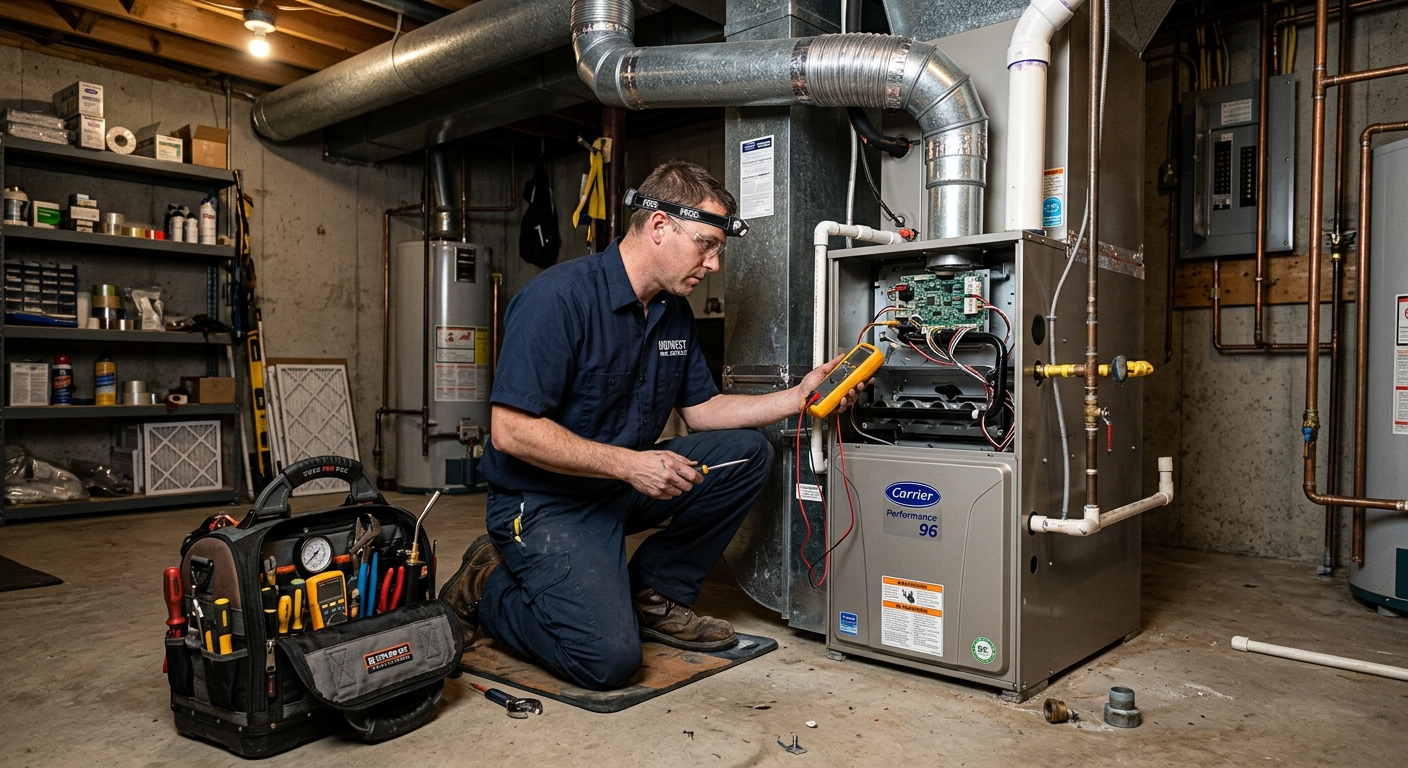
HVAC costs in Radnor — 2026
In Radnor, homeowners face a unique HVAC landscape shaped by both the area's housing stock and local climate. With a homeownership rate of 61.6% and 78% of homes built before 1980 (U.S. Census Bureau, ACS 2024), most Radnor residents are maintaining or upgrading existing central systems rather than installing new ones from scratch. In places like Upper Darby and Haverford, the dominance of older rowhouses and twins means full-sized ductwork is often missing or aging—a common situation in Radnor as well. Many homes here require creative retrofits or ductless systems to add cooling or to replace tired, inefficient equipment.
Southeastern Pennsylvania’s climate is distinctly heating-dominated, as shown by 4,800 heating degree days compared to just 1,450 cooling degree days annually. Winters are reliably cold—Radnor's winter design temperature is 14°F—while summers are sticky but short. This heavily influences which systems are most cost-effective and which upgrades make sense for long-term comfort. High-performing heat pumps are now a real option for many, but the need for reliable backup heat hasn’t gone away.
| System |
Best for |
Efficiency |
Price range (installed) |
| Central AC replacement (existing ducts) |
homes with sound ductwork |
16–20 SEER2 |
$5,600–$13,500 |
| Air source heat pump (ducted) |
year-round heating and cooling |
8–10 HSPF2 |
$9,000–$19,000 |
| Cold-climate heat pump (ducted) |
heat pump as primary heat |
9–11 HSPF2 |
$14,500–$19,000 |
| Ductless mini-split (single zone) |
additions, rooms without ducts |
20–30 SEER2 |
$3,600–$7,900 |
| Full duct system installation |
homes with no existing ducts |
— |
$10,000–$20,500 |
Installed estimates for a typical Radnor home. Equipment tonnage, duct condition and electrical capacity move these more than brand.
Humidity and air quality in Radnor homes
Radnor’s climate brings cold, dry winters and humid summers, so both dehumidification and humidification matter throughout the year. Southeastern Pennsylvania’s moderate freeze-thaw cycles and sticky summers create common comfort complaints: dry air in the heating season (nosebleeds, static, creaking floors) and clamminess during cooling. An oversized air conditioner—a frequent result of skipping proper sizing—will short-cycle and leave too much humidity in the air, compounding indoor discomfort instead of improving it.
Whole-house humidifiers can help alleviate winter dryness, but they add a real maintenance load: annual cleaning or risk of mineral buildup and mold in the system. Before spending money, weigh the maintenance commitment. When considering air filtration, MERV 11–13 filters provide a good balance for most Radnor homes, catching fine particles without choking blower airflow (which causes performance and noise complaints here more than you’d think). Going higher in MERV rating may sound good, but too-restrictive filters slow airflow and can cause system strain unless the system was designed for it.
With the tight envelope of new construction or heavy upgrades, mechanical ventilation—like an energy recovery ventilator—can be worthwhile. But for most existing Radnor homes, simple filtration upgrades and better humidity management offer more bang for the buck. Add-on air cleaners (UV, electronic) often promise more than they deliver, and are oversold in this market relative to documented health benefit. Unless medically necessary, a solid filter and a well-tuned system go further for less.
Reducing the net cost of a Radnor installation
Getting an HVAC system installed in Radnor doesn’t always mean paying full price, thanks to three main incentive layers: federal tax credits, utility company rebates, and occasional state-level programs. Tax credits, like those from the IRS for qualifying heat pumps or high-efficiency AC, reduce the income tax you owe the following year—meaning you’ll see the benefit at tax time, not on your installation invoice. Utility rebates, on the other hand, come right off your bill at installation or shortly after, giving actual cash-back in the near term.
PECO Energy Company is the main electricity and natural gas provider in Radnor, and both offer rebates through energy efficiency programs. The specifics—what qualifies and how much is on the table—change every year as program budgets and technology advance. For anyone considering a new central AC, heat pump, or mini-split, always go straight to your utility's official website for the latest information. Using national resources like the ENERGY STAR rebate finder can reveal additional or overlapping offers but should be treated as a jumping-off point, not a hard number.
Don’t plan your project budget around rebates until you check eligibility and deadlines; program amounts can change halfway through the year. And remember: not every system qualifies—brands, models, and installation standards matter. Comparing a rebate to a tax credit, ask yourself which helps your cash flow most (for many, the immediate rebate is more useful, even if smaller). For up-to-date details, check your current PECO customer portal and the ENERGY STAR rebate finder.
How to vet an HVAC contractor in Radnor
When hiring for HVAC installation or replacement in Radnor, the quality of install matters more than brand. The same model unit can work brilliantly or fail early depending entirely on the details of installation—duct sealing, charging, airflow, and commissioning. Verifying credentials isn’t a formality here; correct registration and certifications are required. Every residential contract over $500, for example, demands Home Improvement Contractor (HIC) registration from the Pennsylvania Office of Attorney General (check at hic.attorneygeneral.gov). For refrigerant circuits, federal EPA Section 608 certification is non-negotiable and applies to any tech touching your AC or heat pump’s refrigerant lines.
Insist on a written load calculation (not a rule-of-thumb guess), and make sure the proposal calls out model numbers—not just system sizes (tons or BTUs). Proper commissioning, including airflow and refrigerant charge documented at startup, should be specified in writing; it’s not universal, and you get what you measure.
- Check HIC registration at hic.attorneygeneral.gov
- Request evidence of current workers' compensation coverage (verify via WCAIS: wcais.pa.gov)
- Ask for EPA Section 608 certification for anyone handling refrigerant
- Confirm a Manual J load calculation is included
- Look for written model numbers on proposals, not just size
- Insist on a commissioning report (airflow, temperature, charge data)
- Ask about equipment warranties—actual documents, not promises
- Require a written contract per the Home Improvement Consumer Protection Act
- Make sure three-day right to cancel is spelled out
- Confirm permit requirements with your municipality (they do vary here)
- Check references from recent jobs in Delaware County
- Call your township’s code office for prior complaint history
Given the dense contractor presence in Delaware County, high-pressure sales tactics and refusal to provide documentation are major red flags. In this market, you do not have to settle for less.
The central decision for a Radnor homeowner
In Radnor, the core heating choice is shaped by southeastern Pennsylvania’s climate. With winter design temps of 14 °F and 4,800 heating degree days annually, reliable, efficient heating trumps all; summers are humid but relatively short-lived. For a long time, “heat pumps don’t work here” was fair enough—older models lost too much capacity as temperatures dropped. That’s changed. Modern cold-climate air source heat pumps deliver useful heat far below freezing, although output does still decline as it gets colder, so sizing (and a backup/auxiliary plan) matter more than ever.
PECO Energy Company provides both natural gas and electricity throughout Radnor and Delaware County’s inner-ring townships. Most homes have ready access to gas, but if you’re one of the few in the outer townships still on oil or propane, your “furnace versus heat pump” decision pivots—heat pumps look better when gas isn’t available or is expensive to add.
For most homes with ductwork—and especially if your envelope is above average—a cold climate heat pump now competes with a furnace on operating cost and comfort. Still, combustion furnaces may be the better fit in certain cases: large homes with leaky ductwork, elderly residents prioritizing high supply temperature, or anyone prone to deep cold spells who already has gas installed. Where your house sits, how tight your envelope is, and the fuel at the curb all influence the right answer. Dual-fuel systems are gaining ground—using a heat pump with a gas furnace as auxiliary offers both efficiency and cold-weather reliability.
| Option |
Installed cost |
Operating cost here |
Best when |
Incentive eligible |
| Gas furnace + central AC |
$5,600–$13,500 |
Lower with existing gas, modest in coldest zones |
Gas on site, deep freezes, lower upfront cost |
Partial (AC only for most rebates) |
| Ducted heat pump (cold climate) |
$9,000–$19,000 |
Low for tight homes, can rise in sub-14°F cold |
All-electric goal, modern insulation, average winters |
Yes |
| Dual fuel (heat pump + gas backup) |
$14,500–$19,000 |
Optimized for lowest operating cost year-round |
Existing gas, want efficiency and cold backup |
Yes |
| Ductless multi-zone |
$10,000–$20,500 |
Good for targeted zones, less for whole-home heat |
No/poor ducts, want room-by-room control |
Yes (if high efficiency) |
What a Pennsylvania HVAC contractor must hold
Pennsylvania does not issue a state HVAC license for residential work. Instead, all residential installations and replacements are regulated at the municipal level. This means the credentials and permit requirements can shift from one township to the next—even within Delaware County. Every residential job over $500 requires the contractor to be registered with a Home Improvement Contractor (HIC) number from the Pennsylvania Office of Attorney General. You can independently verify registration at hic.attorneygeneral.gov; don’t take a business card alone as proof.
Mechanical permits are required by some townships for central HVAC work (for example, in Upper Darby Township), while others differ on the threshold. Always check with your municipal code office or ask your contractor to clarify. For HVAC replacement or installation where refrigerants are handled (almost any AC, heat pump, or mini-split), technicians must hold federal EPA Section 608 certification. This is a nationwide requirement, not state-specific, and is what separates a trained technician from an unqualified installer in the eyes of code enforcement.
Insurance is another must. Pennsylvania requires all employers to carry workers’ compensation insurance. The WCAIS system (wcais.pa.gov) allows you to check up on this. Consumer protection laws demand a written contract for every home improvement over $500, with a three business-day right to cancel. Reputable contractors in Radnor expect these requirements and provide documentation up front.
The refrigerant change and what it means for repairs
There’s been a significant shift in refrigerants for new HVAC equipment: the industry is moving from R-410A to lower global warming potential (GWP) options like R-454B and R-32. This is part of a national HFC phasedown plan, but for a Radnor homeowner with an existing R-410A air conditioner or heat pump, you’re not forced into replacing anything that still works well.
R-410A will remain legal to use for servicing your current system, and there’s no cutoff for continuing repairs. However, as fewer manufacturers produce R-410A—and as distribution shifts to prioritize the new refrigerants—the price of R-410A is expected to rise. This only matters if you have a refrigerant leak or major repair; a properly sealed and tuned system can run for years unaffected.
The repair-versus-replace equation shifts especially on older systems if they develop a leak that is expensive to locate or fix, since the cost of the refrigerant itself will make up a bigger share of any bill going forward. If your Radnor home’s system is still performing reliably and leak-free, there’s no penalty for holding onto it. The change really applies to new purchases and to the long-term economics of repair versus replacement—never to legality or safety.
Frequently asked questions — HVAC installation in Radnor
Is a high-efficiency system worth the extra cost here?
In a place like Radnor, where heating dominates the annual energy bill and humid summers still demand decent cooling, a high-efficiency system can be worth the investment—but not in every situation. Most Radnor homes are older (78% built before 1980), so upgrading the envelope—insulation and air sealing—often yields bigger returns than going straight for the most efficient furnace or heat pump. If you stick to heating and cooling costs alone, cold-climate heat pumps and 16–20 SEER2 central AC units can trim your PECO bills, especially in all-electric homes. But the price jump from standard to high-efficiency can be significant: a cold-climate ducted heat pump can run $14,500–$19,000 installed. For many, a solid mid-efficiency unit, well sized and installed, is the best value—unless generous incentives are available or you know your envelope is top tier. In Radnor, a realistic payback often takes 8–10 years or longer without major efficiency improvements elsewhere in the house.
Do I need to be home during installation?
In Radnor, you or a trusted adult should plan to be home at the start and finish of an HVAC installation day—even if you step out for part of it. Contractors often need access to all areas served, especially attics and basements, and will want to walk you through system operation when finished. For a full central AC replacement (typical cost $5,600–$13,500), plan on the team arriving first thing, sometimes needing to double-check electrical panels or communicate about unexpected conditions in an old home (not uncommon in Radnor’s pre-1980 housing). If you’re comfortable with the contractor’s crew being in and out, you can arrange check-ins. But for any system involving refrigerant—heat pumps or mini-splits—it makes sense to be there to verify correct operation and commissioning before you sign off at job completion.
Do I need ENERGY STAR equipment to qualify for incentives?
Usually, yes—most rebates and federal tax credits require the HVAC equipment to meet ENERGY STAR or equivalent efficiency criteria, which are set each year. In Radnor, where PECO Energy runs utility rebates, eligibility is tied directly to achieving certain SEER2 or HSPF2 ratings for ACs and heat pumps. For example, a ductless mini-split must often reach or exceed ENERGY STAR minimums for you to get rebate dollars (installation cost $3,600–$7,900). However, program rules change often and sometimes specific model numbers listed on the rebate site are required. Some incentives focus strictly on ENERGY STAR, while others allow high-efficiency equipment not branded with the sticker—so always check the latest utility and federal documentation before purchasing, and get it in writing from your contractor that your chosen system qualifies.
Why do HVAC quotes in Radnor vary so much?
Quote variation in Radnor is all about labor, site conditions, and scope—not just brands. Older homes here often have unique installation needs, from tight attics to obsolete duct runs that need correction. Two quotes for “the same” system, such as a central AC replacement ($5,600–$13,500), can differ by thousands simply because one includes new duct sealing or electrical panel upgrades and the other does not. Delaware County’s dense contractor market also drives variation—some low quotes cut corners on system sizing, permit costs, or even the commissioning process. Before jumping on the lowest price, ask for detailed, line-by-line proposals and check that all necessary work (including local Radnor code requirements and permitting) is included. Remember, in this market, you don’t need to settle for half a job.
How does southeastern Pennsylvania's climate affect system sizing?
Sizing your HVAC system for Radnor is different from sizing for a purely cooling or heating climate. Here, with a winter design temperature of 14 °F and 4,800 heating degree days, heating demands are substantial and must be sized accordingly. Cooling loads are moderate—sufficient, but not dominant. Oversized systems, especially AC, are a chronic source of trouble: short cycling, poor dehumidification, and wasted energy. That’s why a Manual J load calculation based on Radnor’s climate data matters. For ducted heat pumps (costing $9,000–$19,000 installed), right-sizing ensures comfort in both seasons and avoids expensive operating costs. A well-sized system provides stable comfort year-round, while avoiding the headaches of an over-or-underpowered unit.
Should I close vents in unused rooms?
In Radnor’s older homes, it might seem logical to close vents to save on heating or cooling, but it’s almost always counterproductive. Modern HVAC systems—especially those connected to ducts in 1920–1980-era homes—depend on balanced airflow to function efficiently. Closing vents in unused rooms ramps up pressure in the ductwork and can cause leaks, reduce comfort elsewhere, or even trip safety switches on modern furnaces and heat pumps. If you’re considering a ductless mini-split (installation range $3,600–$7,900 per zone), zoning can be done correctly and efficiently. For forced-air systems, leave all supply registers at least partially open. If parts of your Radnor home are consistently unused, ask for a zoning or retrofit consultation rather than DIY vent closures.
Does Pennsylvania license HVAC contractors?
Pennsylvania does not have a statewide HVAC license for residential work; regulation is local. In Radnor and across Delaware County, contractors must register as Home Improvement Contractors (HIC) for jobs over $500, which you can confirm at hic.attorneygeneral.gov. Mechanical permit requirements come down to your specific township. For example, Upper Darby Township usually demands a mechanical permit for HVAC installs or replacements. Regardless of permitting, anyone handling refrigerants—installing a central AC (cost $5,600–$13,500) or a heat pump—must hold EPA Section 608 certification. Always check current documentation and don’t rely on website claims alone. The right paperwork is required not just by law, but for your protection if there’s ever a problem.
Should I repair or replace my HVAC system in Radnor?
The repair-versus-replace decision hinges on age, efficiency, and refrigerant cost—especially as R-410A (the refrigerant in many systems) creeps up in price. If your Radnor home’s system is over 12–15 years old and facing a major repair, particularly due to a refrigerant leak, it may be smarter to put that money toward a new system—especially with replacement costs starting at $5,600–$13,500 for central AC. If your system is younger and the fix is inexpensive, keep it running. For older systems, also consider the cost of operating an outdated unit versus the monthly savings a new, high-efficiency model would provide, especially during southeast Pennsylvania’s long heating season. Every house is different, but a practical rule: if the repair is more than a third the cost of replacement and your unit is more than 10–12 years old, replacement is probably the best long-term bet in Radnor.
What is a Manual J load calculation?
A Manual J load calculation is a thorough, room-by-room evaluation of your Radnor home’s actual heating and cooling needs, based on square footage, insulation, window types, and even local climate data (like the winter design temperature of 14 °F). Too many installers skip this step, instead guessing based on square footage or “what’s already there.” This often leads to oversized equipment, especially when replacing a central AC or heat pump ($9,000–$19,000). The Manual J process helps ensure your new system matches your home, eliminating short cycling, poor humidity control, or cold/hot spots. In southeastern Pennsylvania, where older homes have a mix of additions, sunrooms, or odd-shaped rooms, proper load calculation is especially vital to comfort and keeping both your up-front and long-term costs in check.